
A brand doesn’t stand out because it says more. It stands out because customers can quickly understand why it matters. If your website, ads, and social channels describe your business differently, even a strong product can feel interchangeable. A clear brand messaging strategy connects the value your business offers with what customers need to hear.
For SMEs and startups, consistency matters as you compete locally and expand through ecommerce into overseas markets. But consistency doesn’t mean repeating the same line everywhere. Your message needs a dependable foundation, with room to speak to different customer segments and fit each channel.
This guide shows you how to define a distinctive message grounded in your real value, give your team practical direction, and apply that message across your Shopify store, marketing campaigns, and customer communications. You’ll learn how brand messaging can work as part of a wider growth system, helping your business earn trust and create a clearer path to sustainable expansion.
Key Takeaways
- A brand messaging strategy is a practical system for deciding what your business communicates, to whom, and why, not simply a tagline or campaign line.
- Build your message around a specific audience need, a credible brand promise, meaningful differentiation, and proof customers can trust.
- Keep the strategic message consistent while adapting its wording and format to each channel, customer segment, and market.
- Use a simple framework to move from business goals and customer insight to message testing and clear team guidance.
- Connect your messaging to brand identity, Shopify content, advertising, SEO and GEO, and email automation so every touchpoint supports growth.
What Is a Brand Messaging Strategy, and Why Does It Matter for Growth?
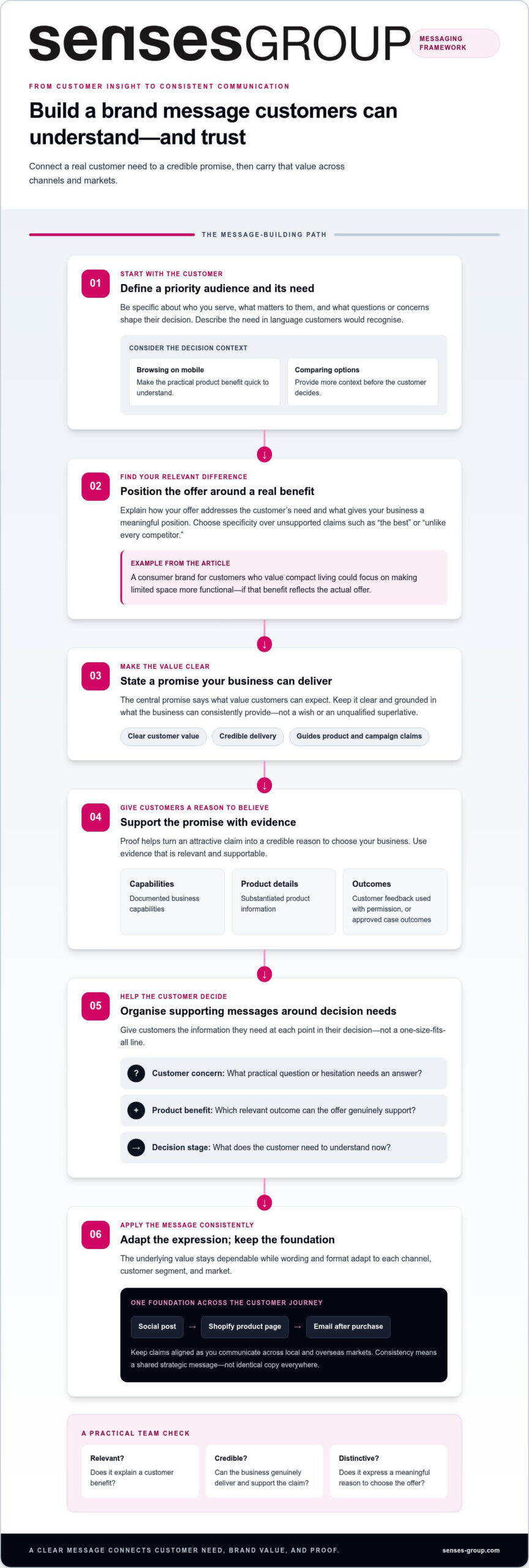
A brand messaging strategy is the system that guides what a business communicates, to whom, and why. It connects customer needs with the value the business can credibly offer, then shapes how that value is expressed across the customer journey. For an ecommerce business, that journey might begin with a social post, continue on a Shopify product page, and lead to an email after purchase.
The strategy provides the underlying direction. It isn’t a tagline, campaign line, visual identity, or collection of day-to-day copy. Those are different expressions and tools. A campaign line may focus attention on one offer for a limited period; the strategy helps ensure that the campaign still reflects the brand’s lasting position. The broader principles of Marketing Communications likewise emphasise delivering clear messages to target audiences through different channels.
Brand messaging strategy versus a tagline or brand voice
A tagline is one concise expression of a brand’s thinking, not the thinking itself. A business may change campaign lines or write different headlines for different products while remaining anchored to the same core message. Brand voice governs how the brand sounds, whether direct, warm, or highly technical. Messaging defines what it needs to communicate: the customer need it addresses, its promise, and the reasons to believe that promise.
Visual identity supports recognition through elements such as colour, typography, and design. It can make a storefront feel coherent, but appearance alone can’t explain why a customer should choose the business. The message gives those visual cues meaning.
Why growing SMEs need a clear message
As an SME grows, communication often spreads across a Shopify storefront, social content, paid advertising, and email. If each channel makes different claims or describes the offer in a different way, customers have to work harder to understand what the business stands for. That confusion can become more pronounced when the business adapts its communication for overseas audiences.
A shared messaging foundation gives a small team a practical reference point. Before publishing a product description or campaign, staff can ask: Does this explain a relevant customer benefit? Does it reflect what the business can genuinely deliver? Does it distinguish the offer in a meaningful way? These questions don’t require identical copy across every channel. They help the team adapt the expression while preserving the underlying message.
Clarity helps customers assess the offer, understand its relevance, and recognise its difference. Repeated, credible communication can also support trust: the storefront sets an expectation, the advertising reinforces it, and follow-up emails remain consistent with the experience. That alignment doesn’t guarantee a sale. It does create a stronger foundation for customers to make an informed choice and for the business to grow without losing its identity.
The Core Elements of a Brand Messaging Strategy
A message becomes distinctive when it connects a real customer need to a clear, credible reason to choose your business. A brand messaging strategy gives that connection structure, so your team can communicate the same value across different products, channels, and markets without relying on generic claims.
A brand messaging strategy is a framework that connects a priority audience and its needs to a credible brand promise, a distinct position, and proof that supports the promise.
Audience, need, and positioning
Start with a defined customer group, not “everyone who might buy.” Consider what matters to that group, what prompts a purchase, and what questions or concerns shape the decision. A customer browsing on a mobile phone may need to understand a product’s practical benefit quickly; someone comparing options may want more context before deciding.
Describe the need in language customers would recognise. Then explain how your offer addresses it and what gives your business a relevant position. Avoid unsupported claims about being the best or unlike every competitor. Specificity is stronger: a consumer brand serving customers who value compact living, for example, could focus on how its products help make limited space more functional, if that benefit reflects the actual offer.
Your brand story adds context to this position. It explains why the business exists, what informed its approach, and how that history connects to the customer’s need. The story should clarify the promise, not distract from it.
Promise, proof, and supporting messages
The central promise states the value customers can expect. Keep it clear and within what the business can consistently deliver. A promise is not a wish or an unqualified superlative; it should guide decisions about product descriptions, campaign claims, and customer communications.
Support it with evidence. Depending on the business, that might include documented capabilities, substantiated product details, customer feedback used with permission, or approved case outcomes. Proof helps turn an attractive claim into a credible reason to believe.
Then organise supporting messages around what customers need to understand at each point in their decision. For a consumer product business, that could mean:
- Customer concern: What practical question or hesitation needs an answer?
- Product benefit: Which relevant outcome can the offer genuinely support?
- Decision stage: Does the customer need an introduction, detail for comparison, or reassurance before purchase?
This structure also helps when adapting communication for overseas audiences. The wording or examples may change to suit a market, but the underlying promise and proof should remain coherent. If you’re shaping that foundation, brand strategy and messaging support can help connect customer insight with practical communication direction.
How to Assess Whether Your Brand Messaging Is Distinctive and Consistent
Consistency doesn’t mean publishing identical wording on every channel. It means customers encounter the same central brand idea, expressed in a way that fits the format, audience, and moment. A consistent brand keeps its core idea stable while adapting the words, detail, and emphasis to each channel.
Use this comparison to separate what should stay fixed from what can change:
Strategic consistency: The audience, core promise, key difference, and supporting proof remain aligned.
Channel-specific execution: A product page explains features and benefits; a social post may introduce one benefit quickly; an email can provide more context or answer a customer concern.
Review your brand messaging strategy against five tests: Is it clear enough to understand quickly? Is it distinctive rather than interchangeable with other businesses? Is it credible and supported by what the business can deliver? Is it relevant to a real customer need? Can the team use it to make communication decisions without repeatedly guessing?
A practical message audit for your brand
Gather your homepage, product pages, social profiles, advertisements, and customer emails. For each touchpoint, record the intended audience, main promise, proof offered, and tone. Then compare what you find with the message you want the brand to communicate.
- Flag contradictions: Does one channel emphasise convenience while another makes a different benefit central?
- Replace vague claims: Words such as “quality” or “great service” need specific, supportable meaning.
- Note unanswered questions: Record what a customer may still need to know to understand or assess the offer.
Look for patterns, not isolated wording differences. A social caption and a product description should sound appropriate to their formats, but both should support the same brand promise. A shared audit also gives a small team a common basis for revising copy.
Consistency across local and overseas ecommerce audiences
Keep the central promise stable as you expand, but adapt examples and emphasis to the context of each audience. Language choices, familiar references, product priorities, and buying concerns can vary between markets. Direct translation may preserve individual words while losing the intended meaning, relevance, or persuasive force.
Review local and overseas storefront content with the same questions: Does the message make sense to this audience? Does it answer the concerns that matter at this point in the purchase? Does the evidence support the claim? Adapt the expression, not the truth of the promise. That discipline helps your brand remain recognisable while communicating with greater relevance across markets.
How to Build a Brand Messaging Strategy: A Step-by-Step Framework
A strong brand messaging strategy starts with a business decision, not a clever headline. Use this sequence to turn customer insight into a message your team can apply, test, and maintain as the business grows.
- Set the business objective. Define what the communication needs to support, such as helping customers understand a new offer, strengthening a product page, or introducing the brand to a new market. Be specific about the customer decision you want to make easier.
- Gather customer insight. Review customer interviews, support questions, product reviews, and feedback from sales conversations. Note recurring concerns and the words customers use to describe their needs. Campaign data can help reveal which messages attract attention or prompt engagement, but interpret it alongside customer context.
- Draft the message foundation. Write a core promise, then identify the evidence that supports it. Add supporting messages that answer distinct customer questions. Keep claims within what the business can consistently substantiate.
- Apply and test it. Adapt the foundation for storefront headlines, product descriptions, ads, and email flows. Gather customer feedback and review relevant channel performance data. If wording is unclear or fails to address a real concern, refine the expression without abandoning the underlying position.
- Assign ownership. Record the approved promise, proof, tone, and channel guidance in a shared document. Name who maintains it and revisit it when the offer, audience, or market changes.
Turn insight into a usable message
Use this simple worksheet to make the strategy actionable. Start with one priority audience and one customer need, then complete the remaining fields before drafting channel copy.
Audience: Who is this message for, and what decision are they making?
Need: What question, concern, or goal matters to them?
Promise: What relevant value can the business credibly offer?
Proof: What documented capability, feedback, or approved outcome supports the promise?
Channel: Where will the message appear, and what does the customer need to understand there?
For example, a product page may need to explain a practical benefit and provide supporting details, while an email may address a question customers commonly raise after browsing. The message should fit the moment, but each execution should draw from the same foundation.
Verbal and visual systems should reinforce one another: design establishes recognition, while the words clarify the offer and its relevance. A considered retail brand identity design guide can help connect those choices across ecommerce touchpoints.
Put the framework into practice across your brand foundations and customer communications. Develop a clearer brand messaging system to align strategy with ecommerce execution.
Turn Brand Messaging Strategy into a Connected Ecommerce Growth System
A brand messaging strategy creates commercial value when it guides what customers see and hear across the entire ecommerce journey. Treat it as an operating foundation, not a document that sits apart from execution. When brand strategy informs identity, store content, advertising, search, and retention, each channel can reinforce the same credible promise.
Connect strategy to storefront, marketing, and retention
On a Shopify store, the promise can shape page hierarchy: what the homepage explains first, how product pages organise benefits and supporting details, and which calls to action help customers take the next step. Brand identity carries that message visually, making the experience recognisable while the copy explains the offer.
Paid media should translate the same customer insight into relevant creative. Meta and Google advertisements can emphasise different benefits for different audiences, while remaining consistent with the store’s claims. This gives campaigns a strategic direction without promising a particular performance outcome.
SEO and GEO content should also reflect the brand’s expertise and point of view. Clear, useful pages help customers understand the business, its offer, and the questions it can answer. Klaviyo email automation can continue that conversation through relevant messages at different customer stages, rather than sending disconnected promotions that weaken the brand promise.
Build a coherent system with a strategic partner
These elements work best when they are planned together. Brand strategy defines the position; brand identity makes it recognisable; Shopify content expresses it at the point of decision; and advertising, search, and email extend it across discovery and retention. For SMEs expanding into overseas ecommerce, this connected approach provides a stable foundation while allowing execution to adapt to audience context.
Senses Group documents an ecommerce rebuild for Monchhichi Jewelry Atelier, after which the client’s revenue doubled shortly after the ecommerce system launch. This is a specific reported case outcome, not a guarantee that the same result will follow for another business. It illustrates how commerce implementation can form part of a wider growth system.
Explore integrated digital marketing solutions to see how connected execution can support growth across channels. To align your own brand foundations with ecommerce and marketing, build a connected brand and growth system.
Make Your Message the Foundation for Growth
A clear brand messaging strategy gives your business more than polished wording. It defines the value you stand for, provides your team with a consistent foundation, and helps connect that promise to the customer experience across your store, marketing, and email.
Start with a specific audience and need. Ground your promise in credible proof, then adapt its expression to each channel and market without changing what your brand stands for. Finally, treat messaging as an ongoing part of your ecommerce system, not a document to write once and set aside.
Senses Group, founded in 2008, brings brand strategy and ecommerce implementation together. In a documented case, Monchhichi Jewelry Atelier’s revenue doubled shortly after its ecommerce system launch. That result reflects a specific project and isn’t a promise of the same outcome for every business.
If your website, ads, and customer communications need a stronger shared foundation, build a clearer brand and a connected growth system with Senses Group. With a message rooted in your real value, your business can move into its next stage with greater clarity and confidence.
Frequently Asked Questions
What is a brand messaging strategy?
A brand messaging strategy is a framework that guides what your business communicates, to whom, and why. It connects a priority audience and its needs with your brand promise, distinctive position, and supporting proof. Rather than prescribing identical copy for every channel, it gives your team a consistent foundation for writing website content, advertising, and customer emails that fit their purpose.
How do you create a brand messaging strategy?
Start by defining a business objective and the customer decision your communication needs to support. Gather insight from customer conversations, support questions, reviews, and campaign data. Use what you learn to identify an audience need, write a credible promise, and select proof that supports it. Then adapt the message for your storefront, advertising, and email, gather feedback, refine the wording, and document guidance for your team.
Why is brand messaging important for an ecommerce business?
Brand messaging helps ecommerce customers understand what you offer, why it’s relevant, and what distinguishes your business. A clear connection between advertising, Shopify content, and follow-up emails makes the shopping journey easier to understand. It also helps a small team make consistent communication decisions as the business grows. Messaging can support trust and customer understanding, but it can’t guarantee a particular sales or conversion result.
What is the difference between brand messaging and brand voice?
Brand messaging defines the key ideas your business needs to communicate, including its promise, audience relevance, and supporting proof. Brand voice defines how those ideas sound, such as warm, direct, or formal. A product page and an email may use different wording and formats while expressing the same message in a consistent voice. In short, messaging is what you communicate; voice is how you communicate it.
How can a small business make its brand messaging more distinctive?
Make your message more distinctive by grounding it in a specific customer need and a credible strength of your business. Replace broad claims such as “great quality” with a concrete, supportable explanation of the value customers receive. Use customer language to understand their concerns, then choose proof that makes your promise believable. A clear position built on real value is more useful than unsupported claims of being the best.
Should a brand change its messaging for overseas markets?
Adapt how you express your message for overseas audiences, but keep the central brand promise and position consistent. Language, examples, customer expectations, and buying concerns may differ between markets, so direct translation alone may not communicate the intended meaning. Review localised store content and campaigns for clarity and relevance, and ensure that any claims remain accurate and supported. Adapt the expression, not the substance of the promise.