
What if your brand, online store and marketing worked towards the same goal? For many small and medium-sized businesses, the problem isn’t a lack of activity. It’s that brand identity, ecommerce and customer acquisition are handled separately, leaving customers with an inconsistent experience and teams unsure what to prioritise. An integrated branding agency can connect these disciplines, but only when they work from a shared commercial strategy.
If you’re weighing one connected partner against several specialist providers, the right choice depends on your growth stage, internal capabilities and plans. More providers don’t automatically mean better results. Clear priorities and a consistent customer journey matter more.
This article explains how to assess an agency model and build a practical system that carries your brand from strategy into ecommerce and measurable growth. You’ll see how brand strategy and identity can shape a coherent Shopify experience, while SEO, paid advertising and Klaviyo email automation support distinct stages of the customer journey. The aim is to help you identify what your business needs first, reduce fragmented priorities and establish a stronger foundation for sustainable growth.
Key Takeaways
- Assess whether an integrated branding agency can connect your business priorities across brand strategy, ecommerce and growth, rather than simply offering more services.
- Map the customer journey from discovery to repeat purchase to identify where brand identity, Shopify, SEO, advertising and email automation can work together.
- Compare an integrated partner with specialist providers by looking at strategic ownership, execution depth, handoffs, measurement and scope flexibility.
- Start with your most pressing business constraint, then prioritise and scope the work instead of investing in every channel at once.
- Explore how Senses Group’s connected approach and documented experience may fit your growth plans.
Why an Integrated Branding Agency Matters When Your Business Is Ready to Scale
A business can invest in a polished identity, a Shopify store and paid marketing, yet still leave customers with a disjointed impression. If separate providers work from different priorities, the brand promise may shift between an advertisement, a product page and a post-purchase email. That inconsistency can make the customer journey harder to follow and the business harder to manage as it grows.
An integrated branding agency connects brand strategy, customer experience and growth activity around shared commercial priorities. It is a coordinated way of working, not a bundle of services to buy all at once. The principle is closely related to Integrated Marketing Communications, which focuses on coordinating communication across channels so the brand presents a consistent message. For an ecommerce business, that coordination should also shape how the store supports the business goal.
What does an integrated branding agency actually do?
It links positioning, brand story, visual identity and guidelines to what the business needs to achieve. Those foundations help determine what the website should communicate, how its structure guides customers, and whether content and other touchpoints make the same promise. For example, a brand preparing to reach new customer groups needs a clear, adaptable story that can speak to those audiences without losing its essential character.
This is broader than a one-off logo or design handover. Strategic coordination means keeping the foundations relevant as the business develops, so decisions about identity, Shopify, SEO, advertising or Klaviyo email automation support a connected customer experience. It doesn’t mean every channel is necessary. It means each chosen activity has a defined role.
When does an SME or startup need an integrated partner?
Look for operational signs, not a particular company size. Messaging may vary between the website and campaigns; channels may attract attention without guiding people towards purchase; or no one may own the handoffs between brand decisions, ecommerce and marketing. These gaps become more consequential when a business is preparing to scale online, because unclear foundations can be repeated across new customer touchpoints.
An integrated partner can help clarify those connections and priorities. But integration isn’t automatically the right model. If the need is narrow and well defined, such as a specific identity deliverable, a focused specialist may be the more suitable choice. Choose based on the business constraint: where coordination is the problem, assess integrated support; where one discrete capability is missing, consider specialist depth.
How an Integrated Branding Agency Connects Identity, Ecommerce and Growth
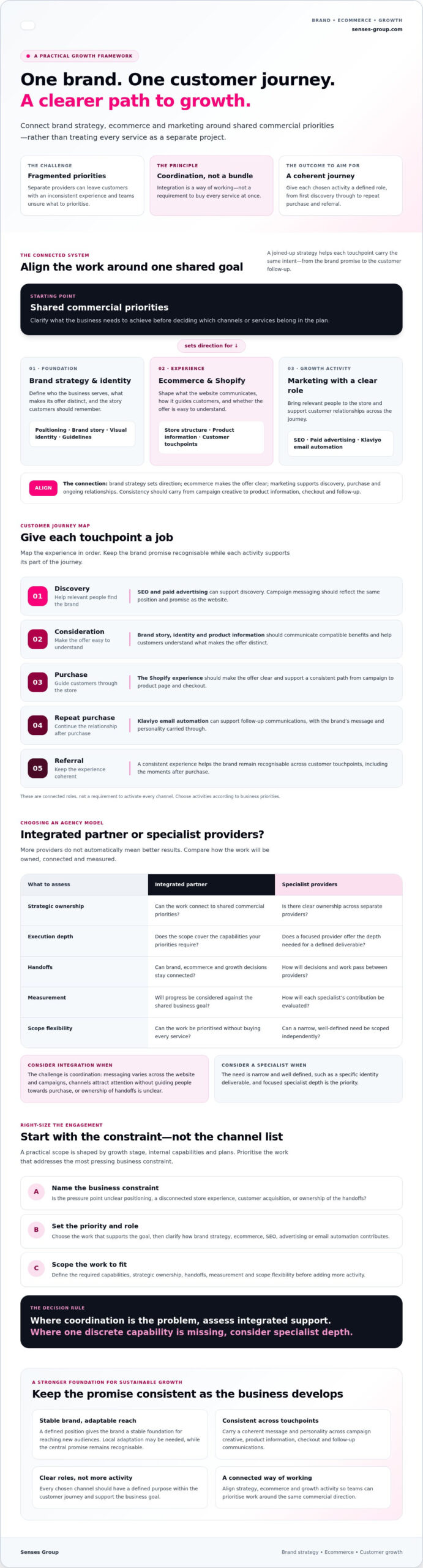
Growth works best when each customer touchpoint carries the same strategic intent. An integrated branding agency connects the path from first discovery to purchase, repeat purchase and referral, then gives each activity a clear role. Brand strategy sets the direction; ecommerce makes the offer easy to understand and act on; marketing brings relevant people to the store and supports relationships after a purchase.
This is more than visual consistency. As What is Integrated Branding explains, integration helps create a consistent brand message and personality across marketing efforts. For an ecommerce business, that consistency should carry from campaign creative to product information, checkout and follow-up communications.
From brand strategy and identity to a clear market position
Start with the fundamentals: who the business serves, what makes its offer distinct, and what story customers should remember. Those decisions shape identity design, including the visual system and guidelines that help teams apply the brand consistently across the website, advertising and email. For example, if a brand’s positioning centres on thoughtful, everyday usefulness, its product pages and campaign messages should communicate that benefit in compatible language and imagery.
A defined position also gives the brand a stable foundation for reaching new audiences. Local adaptation may be needed, but the central promise should remain recognisable.
From Shopify experience to acquisition and retention
On Shopify, store structure, navigation, product content and checkout shape how visitors move from interest to purchase. Conversion rate optimisation (CRO) is the ongoing work of identifying friction in that path and improving the experience. Platform decisions should support the business’s needs, not follow a default checklist. For additional platform-selection guidance, see 2026 Strategic Shopify Guide for Hong Kong SMEs.
Growth channels then support different stages of the journey. SEO and GEO help people discover relevant content through search and AI-driven discovery. Meta and Google advertising can direct targeted audiences to suitable pages. Klaviyo email automation can support post-purchase communication and encourage repeat engagement. None is automatically essential for every business. Select channels according to the audience, objectives and current bottleneck. Integrated Digital Marketing: Scaling Guide for 2026 offers further channel-level guidance.
To assess whether these pieces connect, trace one real customer journey: what message attracts the visitor, whether the landing page fulfils that promise, what might prevent checkout, and how the brand follows up afterwards. That review can reveal where creative, store experience and campaign messaging need closer alignment. If you’re considering a connected approach, explore Senses Group’s branding and ecommerce capabilities.
How to Compare an Integrated Branding Agency With Specialist Providers
A broad service list doesn’t prove that an agency’s disciplines work together. An integrated branding agency may offer strategic continuity, but integration doesn’t automatically mean stronger execution in every discipline. The decision is whether its expertise matches your needs and whether the working model makes ownership, handoffs and results clear.
Integration is demonstrated by shared goals and connected execution, not by the number of services under one roof. Use this comparison to focus your discussions on how work gets done:
| Factor | Integrated agency | Separate specialists |
|---|---|---|
| Strategic ownership | One partner may connect brand, store and marketing priorities. | Your team may need to define the shared direction and keep providers aligned. |
| Specialist depth | Check the experience and named roles behind each discipline. | You can select a specialist for a precise capability or complex requirement. |
| Handoffs | Ask how strategy moves into design, implementation and ongoing activity. | Agree who supplies briefs, assets, decisions and approvals between providers. |
| Measurement | Confirm how work is evaluated against common business priorities. | Set shared definitions and reporting expectations across provider teams. |
| Scope flexibility | Check whether the initial engagement can focus on the current bottleneck. | Commission only the specialist work required, while managing coordination. |
What should you ask before appointing an agency?
Ask how audience research and positioning influence creative, website and campaign decisions. Request a clear account of who owns cross-channel priorities, approvals, reporting and ongoing optimisation. If you’re comparing examples, ask what the original business challenge was, what work was included and what factors shaped the reported outcome. A case study is useful context, not a forecast for your business.
How can you assess fit, depth and accountability?
Ask who will lead the work and who will execute each discipline. A credible proposal should make the relationship between roles, deliverables and decisions understandable. Compare that scope with your actual priorities, such as clarifying brand positioning, improving a Shopify experience or connecting acquisition with customer follow-up. Don’t choose on service count alone.
Separate evidence from expectation. Documented results describe a specific case and its context; forecasts describe a possible future, while guarantees should be scrutinised rather than treated as proof. If you appoint separate providers, name an internal owner to maintain the brief, resolve competing recommendations and ensure the customer experience remains coherent. If you plan to reach new audiences, also consider how the brand’s core promise will remain clear across the channels and markets you choose to serve.
How to Scope an Integrated Branding Agency Engagement Without Overbuying
A useful engagement starts with the business constraint, not an agency’s full service menu. An integrated branding agency should help you identify what is holding growth back, define the work that addresses it, and set a clear point to review progress. That may mean strengthening brand foundations before a launch, or improving the path from a Shopify product page to purchase before expanding acquisition activity.
Use this sequence to build a focused scope:
- Clarify the constraint. Name the growth objective and the obstacle that currently limits it.
- Baseline the journey. Review how customers discover the brand, assess the offer, purchase and engage afterwards.
- Prioritise dependencies. Decide what must be in place first and what can wait until the business is ready.
- Scope the work. Agree on deliverables, owners, timing and review points for the priority problem.
- Review and adjust. Compare progress with the baseline, then decide whether to continue, refine or expand the scope.
If the business is preparing to reach new audiences, include that goal in the brief. Consider what needs to remain consistent in the brand promise and what may need to adapt. Avoid assuming that expansion requires every channel or deliverable at once.
How should you prepare a useful agency brief?
Give prospective partners the context needed to recommend a proportionate plan. State your growth objective, target customers, current offer and most important constraint. Gather relevant brand assets, store analytics, campaign information and customer feedback. Also identify internal decision-makers, dependencies and capabilities already available in-house. These details help prevent duplicate work and make ownership clearer from the outset.
If identity is the main gap, Mastering Retail Brand Identity: 2026 Digital Guide is a relevant next read for more focused guidance. The brief should make clear whether identity work is the whole need or one foundation for a wider ecommerce challenge.
How can you phase priorities and measure progress?
Separate foundational work from later execution. If positioning or identity is unclear, align those foundations before commissioning campaigns that depend on them. If the brand is established but the store journey is a barrier, scope the ecommerce work first and determine which marketing activity should follow.
Before work begins, agree on deliverables, owners, review points and measures tied to the objective. Establish a baseline rather than importing generic benchmarks. For example, if the priority is improving the purchase journey, decide which existing store measures will help assess whether the work is moving in the intended direction.
To define a focused scope for your current growth constraint, discuss a tailored branding and ecommerce engagement.
What to Expect From Senses Group as Your Integrated Branding Agency
Senses Group connects brand foundations with ecommerce and marketing through tailored solutions, rather than assuming every business needs the same package. Founded in 2008, the agency works across brand strategy and identity, Shopify development, SEO and AI Engine Optimisation, Meta and Google advertising, and Klaviyo email automation. The right starting point depends on your current constraint, growth goals and internal capabilities.
One example is Monchhichi Jewelry Atelier, for which Senses Group reports that revenue doubled shortly after an ecommerce system launch. That result belongs to a specific project and context. It isn’t a forecast or guarantee of what another business will achieve; outcomes depend on factors including the starting point, offer, audience and execution.
Which capabilities can support a connected growth system?
Different capabilities can address different parts of the customer journey. Brand strategy and identity establish the positioning and visual foundations. Shopify development can translate those foundations into a coherent online store, while SEO and AI Engine Optimisation support discovery. Meta and Google advertising can help bring audiences to relevant pages, and Klaviyo automation can support communication after a customer takes action.
Social channels may also play a role in how customers encounter and recognise a brand, but channel selection should follow the business objective, not a fixed checklist. An integrated branding agency should be able to explain why each proposed activity belongs in the scope, what it depends on and how it relates to the customer experience. If the immediate issue is unclear positioning, adding acquisition activity may not address the root problem. If the brand is clear but the store journey is difficult to use, ecommerce work may be the more relevant first phase.
What should a first conversation establish?
Bring a clear account of your current brand, ecommerce experience and growth challenge. Explain which customers you want to reach, what growth goals you’re considering, and what resources your team can contribute. Existing store data, campaign information and customer feedback can help ground the discussion in evidence rather than assumptions.
The conversation should help define the constraint, identify what information is still needed and agree on a sensible first phase. You don’t need to arrive with every answer. You do need a clear view of what the business is trying to achieve and where progress feels blocked.
Discuss your growth priorities with Senses Group and identify a practical starting point for connecting your brand, ecommerce experience and marketing activity.
Build a More Connected Foundation for Growth
As your business grows, brand, ecommerce and marketing need to support the same commercial priorities. The right integrated branding agency won’t simply recommend every available service. It will help you identify the constraint, align the customer journey and phase the work around what your business is ready to do, whether you’re strengthening your position or preparing to reach new customers.
Senses Group, founded in 2008, connects brand strategy and identity with Shopify development, search, advertising and email automation. The agency reports that Monchhichi Jewelry Atelier doubled revenue shortly after its ecommerce system launch. That is a specific case result, not a guarantee or forecast for other businesses. Your priorities, starting point and execution all matter.
The next step is a focused conversation about your goals, current customer experience and the obstacle you need to address first. Discuss your growth priorities with Senses Group and explore a practical first phase. With clear priorities and connected execution, you can build a stronger foundation for sustainable growth.
Frequently Asked Questions
What does an integrated branding agency do?
An integrated branding agency connects brand strategy and identity with ecommerce and marketing activity so they work towards shared business objectives. That can include shaping positioning and visual guidelines, building a Shopify store, supporting discovery through SEO, and using advertising or Klaviyo email automation where they fit. The agency should explain how each recommended capability serves the customer journey. Integration doesn’t mean every business needs every service.
Is an integrated branding agency better than hiring separate specialists?
Not automatically. An integrated partner can simplify coordination across strategy, creative and implementation, while separate specialists may bring deeper expertise in a narrowly defined discipline. The right model depends on your needs and your capacity to manage providers. With separate specialists, assign an internal owner to align briefs, approvals, priorities and reporting. Compare the proposed roles, handoffs and accountability, not just the number of services offered.
How do I choose an integrated branding agency for an SME?
Choose an integrated branding agency that can connect its recommendations to your SME’s growth priorities. Explain your main constraint, target customers and plans for ecommerce or market expansion, then ask how those factors shape the proposed scope. Review relevant examples, clarify each project’s context, and identify who leads strategy and who executes each discipline. Before appointing a partner, agree on deliverables, decision-making, reporting and how progress will be assessed.
Can an integrated branding agency help a business expand into overseas markets?
Yes, it can help prepare the brand and ecommerce journey for audiences beyond the current market. This may involve reviewing whether the brand position is clear, whether the Shopify experience supports the intended customer journey, and which SEO, advertising or email activities suit the expansion plan. Discuss target markets, customer research, available resources and the adaptations required. An agency can support marketing and brand planning, but expansion outcomes depend on the business and market context.
What services should an integrated branding agency provide for ecommerce?
For ecommerce, relevant capabilities may include brand strategy and identity, an Ecommerce Shopify Store, SEO and AI Engine Optimisation, Meta and Google Advertising, and Klaviyo Email Automation. The right scope depends on the bottleneck. A business with unclear positioning may need brand foundations first; one with a defined brand but a difficult purchase journey may prioritise its store experience. Ask the agency to explain the purpose and expected role of every proposed service.
How much does an integrated branding agency cost?
There’s no single fee that applies to every engagement. The scope may differ depending on whether you need brand strategy, identity, Shopify development, marketing activity or a phased combination, as well as the work’s complexity and duration. Ask for a written proposal that specifies deliverables, responsibilities, assumptions, exclusions and payment terms. Compare proposals by scope and accountability, not headline price alone.
How can I measure the results of an integrated branding engagement?
Start with a baseline and choose measures tied to the business objective. For brand discovery, review relevant search or campaign indicators; for ecommerce, assess agreed store journey and conversion measures; for retention, monitor appropriate customer and email engagement signals. Define reporting sources, ownership and review points before work begins. Avoid relying on generic benchmarks or attributing every change to one activity. Results should be interpreted in context, not treated as guaranteed outcomes.