
A polished Shopify store can still leave customers unsure what to buy or give your business little room to grow. Shopify store development should solve more than a design brief. When the scope is unclear, agency proposals are difficult to compare, and visual refinement alone cannot fix a disconnected customer journey or retention strategy.
Your store needs to express your brand clearly, help customers move from discovery to purchase, and connect with the marketing systems that bring them back. If you plan to reach customers in different markets, the experience should also reflect their needs and the questions your business must address as it expands.
This guide will help you plan the decisions behind a useful Shopify build, define its scope, and assess agency proposals on strategic and commercial value, not appearance alone. You’ll explore how brand, user experience, conversion, Klaviyo email automation, SEO and GEO, and paid marketing can work together as a growth system. The aim is to build a store that supports customer retention and sustainable expansion beyond launch.
Key Takeaways
- Set a commercial objective before discussing design so your store’s scope reflects what the business needs to achieve.
- Use product information, navigation, and page structure to make customer decisions easier, not just to create a polished storefront.
- Compare development approaches by what they include, from brand alignment and content to integrations, testing, and launch support.
- Prepare a clear Shopify store development brief with customer priorities, current pain points, marketing systems, and expansion plans.
- Connect the store with email automation, SEO and GEO, and paid media to create a foundation for ongoing learning and growth.
Shopify Store Development Starts With a Commercial Goal
A store is a customer journey, not simply a visual website. Its structure should help the right customer understand what you offer, evaluate the options, and take the next step with confidence. Shopify store development covers the planning, design, build, and preparation of an ecommerce storefront for business use. Each decision should serve the customer journey and the business priorities behind it.
That distinction changes the brief. Before comparing designs or agency proposals, clarify your business model, target customers, product range, and growth ambitions. These decisions influence what customers need to know, how they’ll find products, and what the store must support at launch. For a foundational overview of the platform, see Shopify.
A well-defined brief also gives you a fair basis for assessing scope and agency fit. It makes success criteria explicit, helping you separate launch essentials from optional enhancements and compare proposals based on what they will actually deliver.
What should a Shopify development project achieve?
Start with the primary purchase journey. Identify how customers are likely to discover your offer, what they need to understand about a product, and which decisions could make them hesitate. A considered product range, for example, may call for clear comparisons and detailed product information. A broader catalogue may need intuitive categories, filters, and navigation to help shoppers narrow their options.
Set practical objectives for usability, conversion, brand consistency, and future marketing. Then separate launch essentials from improvements that can follow once customer behaviour provides evidence. A focused launch might prioritise a clear product journey and consistent brand presentation. Later work can refine content or marketing based on what customers actually need. This keeps the scope purposeful without treating launch as the end of development.
When does a business need Shopify store development?
A new ecommerce launch needs a storefront designed around the business from the outset. An established business may need development when its current store is difficult to use, no longer reflects its brand, or makes the customer journey unclear. Expansion can also expose gaps: an experience that works for an existing audience may not answer the questions of new customers.
Look for practical signals. Customers may struggle to find or understand products, key pages may communicate different brand messages, or planned marketing may have no coherent destination. A store refresh should address the cause, not just replace the visual layer. The goal is to align the business proposition, customer needs, and commercial priorities.
Shopify development is a connected commercial build that aligns brand, customer journey, and business priorities, not just theme setup. Use that principle to decide what must be ready at launch, what can be tested later, and how you’ll judge whether the project is fit for growth.
What Shopify Store Development Should Include From Strategy to Launch
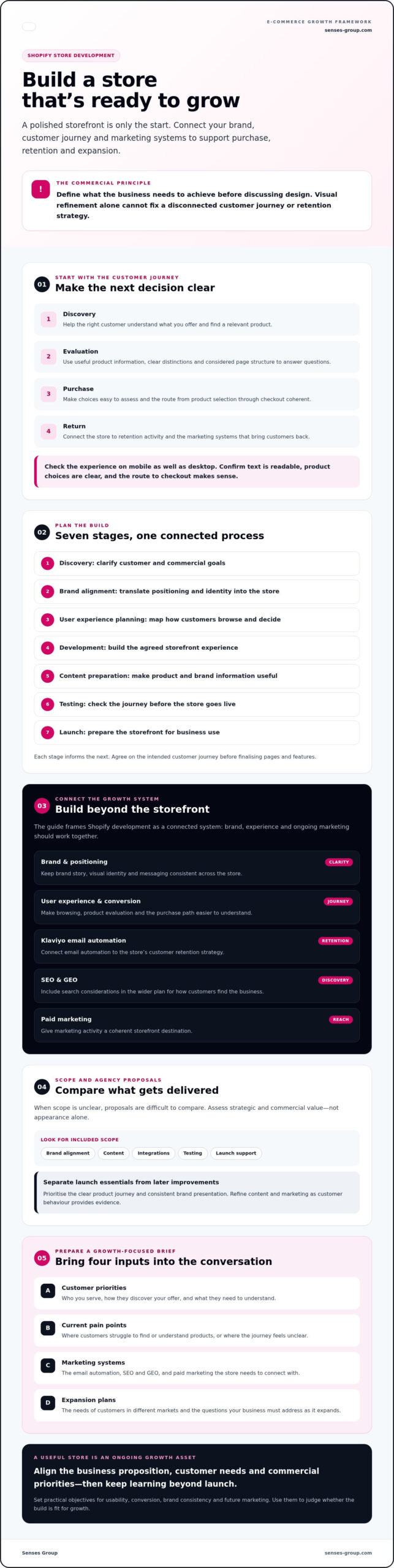
A strong store build follows a clear sequence: discovery, brand alignment, user experience planning, development, content preparation, testing, and launch. Each stage informs the next. Begin with customer and commercial goals, then turn them into a storefront that’s clear to use, credible to buy from, and ready to support marketing.
That strategic foundation matters when a business plans to serve customers across different markets. An E-Commerce Strategy connects platform decisions with marketing and business priorities. For Shopify store development, agree on the intended customer journey before finalising pages and features.
How do strategy and brand shape a Shopify storefront?
Translate your positioning, brand story, visual identity, and guidelines into decisions customers can recognise throughout the store. Navigation should reflect how people browse your range. Page layouts should give important information the right prominence. Product pages should explain relevant benefits, distinctions, and purchase details so shoppers can make an informed choice without searching for answers.
For a deeper perspective on how brand identity guides digital retail, see Mastering Retail Brand Identity: 2026 Digital Guide. The principle is practical: consistency isn’t decoration. It helps customers understand who the business is and what makes its offer relevant.
Test the journey on mobile as well as on a desktop preview. Check that text is readable, product choices are easy to assess, calls to action are clear, and the route from product selection through checkout feels coherent. A visible button cannot compensate for unclear information or a confusing next step.
Which marketing systems should be considered during development?
Plan marketing connections while defining the store structure. If you intend to use Klaviyo email automation, decide where customer sign-ups fit naturally and how the email journey should relate to browsing and purchasing. For SEO and GEO, plan descriptive content, page structure, site speed, and internal links as part of the build rather than treating them as later add-ons.
Marketing integration belongs in the build plan, because the store must give campaigns a clear destination and customers a consistent journey.
Before launch, test key pages and customer paths, including on mobile. After launch, review available performance signals against the objectives set during discovery. Use what you learn to prioritise improvements. A store provides a foundation for iteration, not a guarantee of results. Businesses shaping that foundation can explore Shopify ecommerce and brand expertise as one point of reference.
How to Compare Shopify Development Approaches and Agencies
The right approach depends on your store’s complexity, internal resources, and growth plans. A theme-led setup can suit a business with straightforward needs. A tailored project may better address a distinctive customer journey. An integrated agency engagement can connect the store with brand and marketing priorities. None is automatically best. Compare what each proposal includes, assumes, and leaves to your team.
| Approach | Questions to ask | May suit a business that |
|---|---|---|
| Theme-led setup | What configuration, content, testing, and launch tasks are included? Which decisions and updates are our responsibility? | Has a clear brand and store structure, relatively straightforward requirements, and the capacity to manage parts of the setup internally. |
| Tailored development project | Which customer or operational needs require tailoring? How are those needs reflected in scope, testing, and handover? | Needs a more distinctive user experience or store structure than a standard setup can provide. |
| Integrated agency engagement | How do brand, user experience, content, integrations, and marketing planning connect? Who owns each deliverable? | Wants the store considered alongside brand strategy and ongoing marketing priorities, including growth across different markets. |
Use the comparison to identify meaningful differences, not simply to rank proposals by design quality. Check that each one explains deliverables, assumptions, responsibilities, testing, launch support, and what happens after launch. A proposal should also clarify who supplies product information, who approves content, and who makes final launch decisions.
What questions should you ask a Shopify development agency?
Ask how discovery turns your business objectives into site structure and customer journeys. Then clarify ownership: who prepares content and product information, coordinates approvals, tests the store, and signs off on launch? Finally, ask how the build will accommodate future marketing, measurement, and iterative improvements. The answers reveal whether the agency has considered the commercial system or only the visible storefront.
How can you assess strategic fit beyond design quality?
Look for a clear rationale connecting brand choices to customer needs and commercial goals. Review relevant ecommerce work and ask what the agency actually delivered, rather than judging the finished visuals alone. For additional planning context, consult the 2026 Strategic Shopify Guide for Hong Kong SMEs. A strong partner should explain how its proposed scope fits your resources and ambitions without presenting one development model as a universal solution.
For Shopify store development, compare like with like. Map each proposal against the same requirements, note exclusions, and identify unresolved decisions before committing. Clear scope gives your team a stronger basis for choosing an approach that can serve current needs and adapt as the business learns and grows.
How to Prepare a Shopify Development Brief for Growth
A useful brief turns business ambitions into decisions an agency can scope and your team can evaluate. For Shopify store development, clarity at the start helps prevent competing assumptions about what the store must do, what’s needed for launch, and how the build should support future growth.
What information belongs in a Shopify project brief?
Gather the essentials before requesting proposals. This sequence can help:
- 1. Clarify objectives. State what the business needs the store to achieve, such as launching ecommerce, improving an existing customer journey, or preparing for expansion.
- 2. Describe customers and desired actions. Identify your priority audiences, what they need to understand before buying, and the actions you want them to take.
- 3. Map your product range. Summarise categories, product distinctions, and the information customers commonly need to compare or choose.
- 4. Assemble brand assets. Share your positioning, visual identity, brand guidelines, and existing content that should shape the storefront.
- 5. Document systems and friction points. List current digital and marketing tools, known customer questions, and issues such as confusing navigation or hard-to-find product information.
- 6. Explain growth priorities. Describe your intended expansion in broad terms, including which audiences or markets matter next, without assuming operational or regulatory requirements.
Include existing performance insights where available, along with product content, customer questions, and examples of pages or journeys that work well or create friction. This gives the agency evidence and context, not just a list of design preferences.
How should you define launch priorities and success measures?
Separate what must be in place for launch from what can be improved after the business has learned from customers. Essential requirements might include accurate product information, clear navigation, consistent brand presentation, and a tested route through the intended purchase journey. Later opportunities could include refining content, improving marketing journeys, or testing changes based on observed behaviour.
Choose measures that reflect the project’s objectives, then agree on what each measure means with the people responsible for reviewing it. If the goal is to make product discovery clearer, for example, define what evidence would show that customers can find and understand relevant products. Keep launch readiness distinct from longer-term conversion, retention, and acquisition goals. A launch checklist confirms the store is prepared; it doesn’t guarantee commercial results.
A well-prepared brief makes scope easier to discuss and agency proposals easier to compare. If you’re shaping requirements for a new build or rebuild, discuss your Shopify store development needs with a team working across ecommerce, brand, and marketing.
Build Shopify Store Development Into a Connected Growth System
A Shopify store is a foundation for growth, not a guaranteed revenue engine. Its value depends on how well the brand, customer experience, and marketing work together before and after launch. Brand strategy clarifies what the business stands for. Shopify UX turns that positioning into a shopping journey. Email automation supports ongoing customer communication, while SEO, GEO, and paid media help connect discovery with the store experience.
Consistency matters whenever a business wants to reach new customers. An ad or search result sets an expectation. The store should continue the same story, make the offer easy to understand, and guide customers towards a relevant action. After launch, customer and campaign insights can inform what to refine next.
Why connect Shopify development with ongoing marketing?
Marketing systems work best when they’re considered alongside the customer journey. Klaviyo flows, for example, can be planned around how customers interact with the store, supporting relevant communication without assuming a particular performance outcome. Senses Group lists Klaviyo email automation among its capabilities. For a closer look at one use case, explore Mastering the Klaviyo Abandoned Cart Strategy for Global Ecommerce.
SEO and GEO, content, and paid media also benefit from clear store structure. A well-defined destination helps campaigns and discovery channels lead into an experience that reflects the brand and answers customer needs. Shopify store development should connect launch with a considered plan for measurement and ongoing improvement.
What to expect from a strategic development partner
A strategic partner should connect brand decisions with the practical work of building and improving the ecommerce experience. Senses Group’s capabilities include brand strategy, brand identity design, Shopify development, UX and CRO, SEO and GEO, Klaviyo email automation, and Meta and Google advertising. The aim is a joined-up system, not a collection of disconnected activities.
Senses Group was founded in 2008 and reports more than 18 years of expertise as of 2026. A complete ecommerce rebuild for Monchhichi Jewelry Atelier was followed by doubled revenue shortly after launch. That is a specific case outcome, not a promise or forecast for another business. Results depend on each brand, its customers, and its wider commercial context.
Build your next stage on a clear strategy, a considered store experience, and marketing systems that can evolve with the business. Build your Shopify growth engine with Senses Group.
Build a Store That’s Ready for What Comes Next
Effective Shopify store development starts with a commercial goal, then connects brand, customer experience, and marketing around a clear journey. Define what the store must achieve, set a deliberate scope, and choose a partner based on strategic fit and the work required, not design alone. After launch, use customer and marketing insights to guide improvements rather than expecting the storefront to guarantee growth.
Senses Group, founded in 2008, reports more than 18 years of expertise as of 2026 and has managed more than $4 million in advertising spend. A complete ecommerce rebuild for Monchhichi Jewelry Atelier was followed by doubled revenue shortly after launch. That is a specific case outcome, not a forecast or promise for other businesses.
If you’re preparing to launch, rebuild, or expand your ecommerce business, build your Shopify growth engine with Senses Group. Start with a clear brief and a connected plan, then create a foundation your business can continue to learn and grow from.
Frequently Asked Questions
What is Shopify store development?
Shopify store development is the process of planning and building an ecommerce storefront around a business, its products, and its customers. The scope can include strategy, brand application, user experience, content structure, development, testing, and launch preparation. It goes beyond choosing a theme: the store should guide customers through a clear journey and provide a foundation for future marketing. Specific deliverables depend on your business goals and project requirements.
How long does Shopify store development take?
The timeline depends on the agreed scope, decision-making process, content readiness, design requirements, and integrations. A straightforward setup and a tailored ecommerce build may involve different stages and dependencies. Ask an agency to map its proposed phases, approval points, responsibilities, and factors that could affect progress. A generic timeline before requirements are assessed may not reflect your project, so use the proposal to understand what needs to happen and when.
How much does Shopify store development cost?
There’s no single reliable cost for every project because scope, design, content, integrations, and required work vary. Compare proposals by deliverables and assumptions, not headline price alone. Ask what’s included, what your team must supply or approve, and what post-launch support covers. A relevant estimate should follow a clear understanding of your requirements. If two proposals differ, check whether they include the same work before comparing their figures.
Do I need a Shopify developer or a Shopify agency?
Choose the partner whose capabilities match the work. A developer may suit a clearly defined technical task, while an agency can be a fit when brand, user experience, development, and marketing need to align. Neither label guarantees the right expertise. Review the proposed deliverables, who owns each responsibility, and the partner’s relevant ecommerce work. For a complex build or expansion plan, confirm that the required strategic and technical capabilities are covered.
Can a Shopify store support overseas expansion?
A Shopify store can form part of an overseas expansion plan, but the storefront alone doesn’t resolve every market requirement. Start by assessing target customers, brand communication, product content, customer journeys, and marketing needs for each intended market. Confirm relevant platform capabilities and market-specific operational or legal requirements through appropriate sources rather than assuming they’re included in development. A clear brief helps align the store experience with your wider expansion plans.
What should be included in a Shopify development brief?
A useful brief explains your business model, target customers, product range, brand positioning, current pain points, and desired outcomes. Include required content, existing digital and marketing tools, launch priorities, and intended expansion goals. Gather product information, brand guidelines, common customer questions, and relevant performance insights if available. Separate launch essentials from later improvements. This gives potential partners the context to propose a considered scope and makes competing Shopify store development proposals easier to assess.