
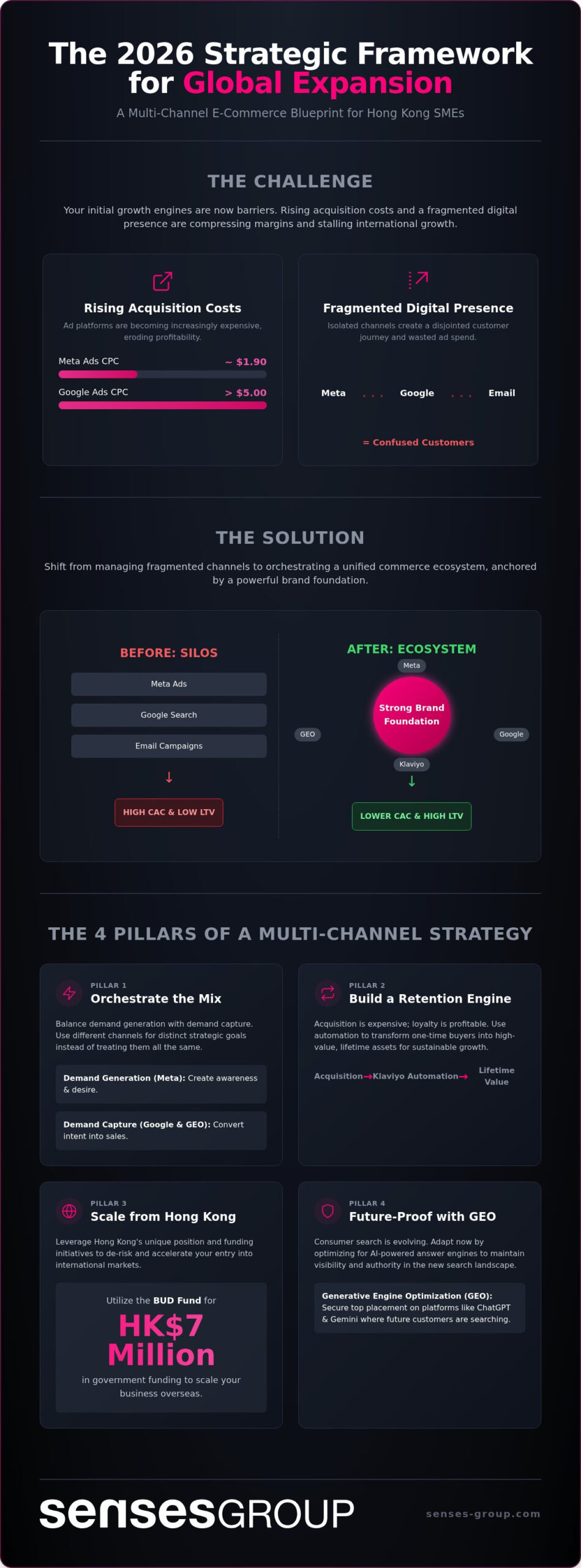
What if the advertising platforms that fueled your initial growth are now the primary barrier to your global expansion? For many Hong Kong SMEs, the transition from local success to international leadership is stalled by rising acquisition costs and a fragmented digital presence. You’ve likely seen your margins compressed by Meta CPCs hovering around $1.90 and Google Ads climbing above $5.00. Executing a sophisticated multi-channel marketing strategy for Shopify is no longer just an option for growth; it’s the foundational requirement for survival in a competitive global market.
A true multi-channel approach is not about being everywhere at once, but about creating a unified ecosystem where every touchpoint reinforces the next. This article provides the 2026 strategic framework to transform your ecommerce operations into a high-performance growth engine. We’ll examine how to secure up to HK$7 million through the BUD Fund, implement Generative Engine Optimization for AI search, and deploy Klaviyo automation to turn one-time buyers into lifetime assets. You’ll learn to move beyond traditional models and build a brand that commands authority on the world stage.
Key Takeaways
- Shift from fragmented channel management to a unified commerce ecosystem where a strong brand foundation acts as the primary driver for lowering customer acquisition costs.
- Master a sophisticated multi-channel marketing strategy for Shopify that balances demand generation on Meta with demand capture through Google and emerging AI-driven search engines.
- Implement a retention-focused backend using Klaviyo automation to ensure that your global acquisition efforts result in sustainable profit and long-term brand loyalty.
- Utilize Shopify Markets and local Hong Kong funding initiatives like the BUD Fund to systematically scale your business from a traditional local model into an international powerhouse.
- Future-proof your digital presence by adopting Generative Engine Optimization (GEO) to maintain visibility as consumer search behavior shifts toward AI-powered platforms like ChatGPT and Gemini.
Defining Multi-Channel Marketing for Shopify in 2026
The traditional approach to digital sales has reached its expiration date. In 2026, executing a successful multi-channel marketing strategy for Shopify requires a shift from fragmented visibility to systemic integration. Most businesses treat their marketing like a collection of isolated silos, managing Meta ads, Google search, and email as independent projects. This creates a disjointed experience that confuses the consumer and inflates your costs. Instead, we must view the architecture of Defining Multi-Channel Marketing as a singular, coordinated sales funnel that moves a prospect through a logical progression of trust and value.
A multi-channel strategy is a coordinated sales funnel designed to guide a prospect through a sequence of psychological states rather than a disconnected list of social media platforms. In the current landscape, presence is passive; dominance is structural. Simply having an account on every platform does nothing for your bottom line if those channels don’t talk to each other. A “brand-first” approach is the only way to prevent this fragmentation. By anchoring your efforts in a core identity, you ensure that whether a customer finds you on a search engine or a social feed, the message remains consistent, authoritative, and persuasive.
The Shift from Multi-Channel to Omni-Channel
Modern consumers don’t follow a straight line from discovery to purchase. They might see a Meta ad during their commute, research the brand on Google AI Overviews at lunch, and finally convert through a Klaviyo email on their desktop. This non-linear journey requires a unified commerce ecosystem where data flows seamlessly between Shopify and third-party marketing tools. By utilizing a “Marketing Map,” you can visualize the total sales funnel. This allows you to identify exactly where prospects are dropping off and which channels are driving the highest lifetime value rather than just the lowest initial click.
Why Hong Kong SMEs Must Diversify
For Hong Kong SMEs, diversification is a matter of commercial survival. The local market is geographically limited and intensely competitive; relying solely on one platform leaves your business vulnerable to sudden algorithm shifts or rising ad costs. Digital transformation is not just about moving online, but about leveraging Hong Kong as a strategic gateway for international market entry. A robust multi-channel marketing strategy for Shopify allows you to capture demand in overseas markets while maintaining a stable foundation at home. It reduces the risk of over-dependence on a single advertising platform and builds a more resilient, scalable business model that can withstand global market fluctuations.
The Brand Foundation: The Anchor of Multi-Channel Success
Many Hong Kong SMEs mistake branding for an aesthetic exercise. They view a logo as a finished product rather than the beginning of a commercial system. In reality, your brand is the anchor that prevents your multi-channel marketing strategy for Shopify from drifting into high-cost obscurity. Without a clear identity, every new channel you add becomes a new source of friction. With one, every platform acts as a force multiplier for your message. This structural clarity begins with deep Market Research and Competitive Analysis to identify where your competitors are weak and where your unique value is strongest.
The “Sales Atom” concept serves as the core of this framework. It represents the fundamental identity of your business that remains unchanged whether it appears in a 15-second Meta reel or a detailed Google search result. When this core is well-defined, it lowers customer acquisition costs by reducing the cognitive load on the consumer. They recognize you instantly. They trust you faster. Investing in a premium brand identity for retailers isn’t about vanity; it’s about creating a visual shorthand for quality that justifies a higher price point in the global market. Refining your Brand Strategy is the first step toward this systemic transformation.
Developing a Commercial Visual Identity
Visual consistency is the silent driver of conversion. Your brand guidelines must be rigid enough to ensure recognition across Meta, Google, and Email, yet flexible enough to accommodate different platform requirements. This involves more than just color palettes; it requires a visual language that resonates with international consumers who may not share your local cultural references. By integrating AI visual production, you can maintain this consistency while generating the high volume of creative assets needed for modern ad platforms, ensuring your brand remains fresh without losing its foundational essence.
Messaging That Travels: Local Roots, Global Appeal
Scaling from Hong Kong to the world requires a brand story that translates across borders. Your Unique Value Proposition (UVP) must be standardized for multi-platform use while remaining adaptable to local nuances. Strategic brand development is the non-negotiable prerequisite for any paid media spend. It ensures that when you capture attention on a global scale, you have a compelling, unified narrative ready to convert that attention into a transaction. If the messaging is fragmented, the growth engine will stall.
Orchestrating the Mix: Meta, Google, and GEO
Success in 2026 isn’t found in a single channel. It’s found in the friction-less transition between them. Most merchants fail because they treat Meta and Google as competing interests rather than synergistic partners. A robust multi-channel marketing strategy for Shopify demands a balance between demand generation and demand capture. When these channels work in isolation, you pay twice for the same customer. When you deploy integrated digital marketing solutions, you create a compounding growth effect where every dollar spent on awareness feeds the efficiency of your conversion campaigns.
Meta and Google: The Performance Powerhouse
Meta and Google remain the performance powerhouse of any scaling framework. We use Meta ads management for ecommerce to disrupt the user’s scroll and build top-of-funnel awareness for Hong Kong brands. This isn’t about immediate sales; it’s about planting the seed of desire. We then use a Google ads strategy for brands to harvest that desire when the user actively searches for a solution. Data-driven allocation is the key. If your search volume drops, you shift budget back to social. If your CPCs on Meta spike, you lean into high-intent searchers. It’s a dynamic equilibrium.
The New Frontier: Generative Engine Optimisation (GEO)
AI search engines like ChatGPT, Gemini, and Deepseek are fundamentally changing brand discovery. You can’t rely on keyword stuffing anymore. You need Generative Engine Optimisation (GEO). GEO complements traditional SEO for Shopify stores by ensuring your brand isn’t just found on a results page, but cited as the definitive answer by an AI agent. This requires a topical map system that establishes your brand as a primary authority in your niche. Your metadata must now be LLM-optimised, providing the structured data these models need to categorize and recommend your products. This is the 2026 requirement for any brand that intends to remain visible as traditional search evolves.
Retention Architecture: Leveraging Klaviyo for Lifecycle Value
Acquisition is a vanity metric if retention is absent. Many Hong Kong brands burn through capital on Meta and Google without a system to capture and cultivate that traffic, leading to a cycle of diminishing returns. A sophisticated multi-channel marketing strategy for Shopify is fundamentally incomplete without a retention-focused backend. Klaviyo serves as the central nervous system of this ecosystem, synchronizing data from every marketing touchpoint to create a singular, actionable view of the consumer. It is not merely a tool for sending newsletters, but a systemic architecture designed to maximize the commercial value of every acquired lead.
By deploying precision-engineered post-purchase sequences and behavioral cross-sells, strategic email automation can triple average order value by ensuring the second and third transactions occur with zero additional advertising expenditure. This shift from transactional to relational marketing is what separates a struggling SME from a global ecommerce leader. When your data is integrated, your marketing becomes predictive rather than reactive. You stop guessing what your customers want and start automating the solutions they need. To build this foundation, you must implement Klaviyo Email Automation as a core component of your growth engine.
Essential Klaviyo Flows for Shopify
Profitability is built on the strength of your automated flows. The Welcome Series should not be a simple greeting; it is a strategic brand immersion that establishes authority and trust within the first 48 hours of discovery. Beyond this, behavior-based triggers such as abandoned cart and browse abandonment sequences act as automated profit recovery systems, capturing high-intent users who would otherwise be lost to the noise of the digital market. Your monthly promotion strategies must then complement your active paid ad campaigns, ensuring a consistent message across the entire sales funnel.
SMS and ManyChat: Real-Time Engagement
Real-time engagement is the final piece of the retention puzzle. Integrating SMS marketing allows for high-urgency notifications that cut through the clutter of a crowded inbox, boasting open rates that far exceed traditional channels. Simultaneously, using ManyChat for automated social media lead generation creates a seamless transition from a casual Instagram interaction to a high-value email list signup. This multi-layered approach ensures that your brand remains top-of-mind, regardless of where the customer chooses to engage. It turns social engagement into a structured path toward conversion and long-term loyalty.
Scaling From Hong Kong: The Global Market Entry Strategy
Hong Kong businesses are uniquely positioned at the intersection of East and West, yet many remain tethered to traditional models that artificially limit their commercial reach. True scaling is not about adding more physical locations within a local district; it’s about shifting to a robust global ecommerce presence that treats the world as a singular marketplace. This transition requires a multi-channel marketing strategy for Shopify that is designed for cross-border complexity from day one. By leveraging Shopify Markets, we remove the technical friction of international selling, allowing you to manage localized currencies, languages, and domains through one centralized dashboard. It’s about building a system that scales without a proportional increase in operational headache.
A sustainable growth engine is not built on luck, but on a performance-based architecture. Beyond paid ads, we implement affiliate marketing models that allow you to scale reach through third-party advocates who are rewarded only upon a successful transaction. This ensures that your expansion efforts are always tied to actual revenue rather than speculative awareness. The final step in this transformation is moving from a collection of marketing tactics to a long-term, scalable growth engine. This engine operates as a unified system, ensuring that your brand identity remains dominant regardless of the geographic market you enter. A well-structured ecommerce social media advertising strategy is essential to ensuring your social channels contribute meaningfully to this global growth architecture.
Overcoming International Growth Hurdles
Entering a foreign market is a psychological challenge as much as a technical one. You must adapt your brand identity to meet the specific sensibilities of foreign consumers without diluting the core essence that made you successful in Hong Kong. This involves meeting rigorous technical SEO and GEO requirements to ensure your brand is the cited authority in international search results. Managing global ad accounts requires a disciplined, data-driven ROI focus. It’s not enough to spend capital; you must spend it where the data proves a path to sustainable profit. If your brand doesn’t resonate culturally, your technical performance will inevitably suffer.
The Senses Group Approach to Transformation
At Senses Group, we don’t just provide services; we act as a strategic partner in your digital transformation. Our 18 years of expertise have taught us that success is found in the deeper mechanics of business systems rather than superficial creativity. We’ve managed over $4 million in ad spend and have a proven track record of scaling brands from zero to multimillion-dollar successes. In one snapshot of our work, we doubled a client’s revenue by replacing fragmented marketing silos with an integrated ecommerce system that prioritized lifetime value. We understand the unique challenges Hong Kong SMEs face when trying to break into global markets. If you’re ready to stop managing platforms and start leading a global brand, Let’s Build Your Growth Engine.
Building Your Global Ecommerce Legacy
Scaling a business from Hong Kong to the global stage requires more than just high-intent traffic; it demands a unified commerce ecosystem. We’ve explored how a definitive brand foundation acts as the anchor for your entire multi-channel marketing strategy for Shopify, ensuring that Meta, Google, and emerging AI search engines work in synergy rather than silos. By prioritizing retention through automated lifecycle marketing, you transform one-time purchasers into enduring commercial assets that drive sustainable profit.
The path to international leadership is complex, but you don’t have to navigate it alone. Senses Group brings 18+ years of strategic branding expertise and a track record of managing over $4 million in ad spend to your growth engine. We’ve proven our ability to scale multimillion-dollar brands from zero, and we’re ready to apply those same systemic principles to your business. Partner with Senses Group to build your high-converting growth engine and secure your place in the future of global commerce. Your transformation starts with a single strategic decision.
Frequently Asked Questions
What is a multi-channel marketing strategy for Shopify?
A multi-channel marketing strategy for Shopify is a systemic framework where your brand engages prospects across several digital platforms while maintaining Shopify as the central commerce hub. It moves beyond simple cross-posting to create a coordinated sales funnel that guides users from discovery to conversion. This architecture ensures that your brand message remains consistent and persuasive whether a customer interacts with you on Meta, Google, or through direct email automation.
How does multi-channel marketing differ from omni-channel?
Multi-channel marketing focuses on being present on various platforms to reach a wider audience. Omni-channel takes this further by ensuring these platforms are fully synchronized, providing a seamless customer experience where data flows freely between touchpoints. For a Hong Kong SME, the transition to omni-channel means that a customer’s interaction on a Meta ad directly informs the personalized content they receive in a Klaviyo email, creating a unified, non-linear journey toward purchase.
Why should Hong Kong SMEs focus on more than one marketing channel?
Relying on a single platform creates a dangerous point of failure for your growth engine. Hong Kong SMEs must diversify to mitigate the risks of algorithm shifts and rising acquisition costs on saturated channels. By implementing a multi-channel marketing strategy for Shopify, you build a resilient business model that captures demand from international markets. This diversification allows you to scale beyond local geographic constraints and achieve long-term commercial stability and growth.
What is the most effective marketing channel for Shopify in 2026?
No single channel operates as a silver bullet in 2026. The most effective approach is the integration of demand generation via Meta with demand capture through Google and AI search. However, the true driver of profit is the retention backend. Without Klaviyo email automation to maximize lifecycle value, even the most successful acquisition campaigns will eventually fail to maintain positive margins. Effectiveness is found in the system, not the individual platform.
How does AI and GEO impact my Shopify marketing strategy?
AI is fundamentally disrupting traditional search behavior through Generative Engine Optimization (GEO). Instead of simply ranking for keywords, your Shopify store must now be optimized to be cited as the definitive answer by AI agents like ChatGPT and Gemini. This requires a topical map system and LLM-optimized metadata. Incorporating GEO into your digital framework ensures your brand remains visible as consumers shift away from traditional search results toward AI-driven recommendations.
Can I manage a multi-channel strategy without a large marketing team?
You don’t need a massive internal department to execute a sophisticated strategy; you need robust automation and strategic systems. Tools like Klaviyo for email and ManyChat for social interactions handle the repetitive tasks of lead nurturing and retention. By partnering with a seasoned agency, you leverage 18 years of expertise and proven systems to manage complex ad accounts and AI-driven content, allowing you to focus on high-level commercial growth.
How much should I spend on a multi-channel marketing budget?
Budget allocation typically ranges from 7% to 35% of revenue based on your current growth phase. Stores with under $1 million in annual revenue often allocate 25-35% to advertising to gain traction. The key is not the total amount spent, but the data-driven allocation between channels. You should prioritize spend where the ROI is highest, using performance-based models to ensure your expansion remains profitable and sustainable for the long term.
How do I ensure brand consistency across all my sales channels?
Consistency is maintained through a rigorous brand identity system known as the “Sales Atom.” This core identity acts as a commercial visual shorthand that remains unchanged regardless of the platform. By establishing clear brand guidelines for typography, color, and messaging, you ensure that your authority is recognized instantly across Meta, Google, and your Shopify store. This alignment reduces consumer friction and builds the trust necessary for high-velocity global expansion and market dominance.