
More segments don’t automatically make email more relevant. In Klaviyo, a list is a defined collection of profiles, while a segment is a rule-based audience that can update as customer data changes. A strong Klaviyo segmentation strategy uses this distinction to target people based on what they buy, when they buy, and how they engage.
For Hong Kong ecommerce businesses, the challenge is making customer data useful as the business grows locally and reaches overseas markets. Broad targeting can overlook repeat-purchase patterns, while overly narrow groups can make campaigns harder to manage. This article explains how lists and segments differ, then shows how purchase history, engagement, timing, and browsing signals can shape more relevant email targeting. You’ll see how to think about replenishment windows, customer recency, likely next orders, and product interest, so each audience has a clear reason to receive a particular message.
Key Takeaways
- Use lists for organized profile groups and rule-based segments for audiences that change as customer behaviour changes.
- Shape replenishment messages around customers’ actual purchase cadence rather than sending the same reminder to everyone.
- Separate active, cooling, and repeat customers by engagement and purchase recency to make campaign relevance clearer.
- Use predicted next-order timing to reach customers when a repeat purchase is more likely to be on their mind.
- Combine product-viewing signals with purchase history to tailor follow-up messages to expressed interest.
1. List vs Segment in Klaviyo: What’s the Fundamental Difference?
A list is a managed group of profiles, often organized around a purpose such as newsletter sign-ups. A segment is an audience defined by rules based on profile data or events. That distinction shapes campaign relevance: a list provides a stable organizational structure, while segment membership can change as customer behaviour changes.
For example, a Hong Kong retailer might maintain a newsletter list, then create a segment of subscribers who clicked a product campaign but haven’t purchased. The list answers who is organized together; the segment answers who currently meets specific targeting conditions. Klaviyo’s example of a highly engaged audience includes customers who opened and clicked an email in the last 30 days.
Which customer data and events can Klaviyo use for segmentation? Conditions can draw on profile details, such as location or stated preferences, and events such as purchases, email engagement, and product views. If connected systems pass relevant data into Klaviyo, review activity can also support conditional messaging.
Klaviyo segments update automatically as profiles start or stop meeting their rules. These are dynamic audiences, not fixed snapshots: a customer can enter after clicking a campaign and leave after making a purchase.
Location and preference rules make targeting more specific. A Hong Kong store could combine a Kowloon location condition with an interest in skincare; use AND when both conditions must apply. Use OR when either of two interests, such as skincare or makeup, qualifies the profile. Clear logic prevents a message intended for one audience from reaching a broader group.
Location data should support useful distinctions, not assumptions about a person. A district or shipping region may help tailor store updates, while a language preference can guide the message language. Klaviyo custom segments cannot use hyper-specific geolocation data, so precise proximity targeting is not a sound basis for a segment. Choose location conditions that match the data actually collected.
Review-based messages also depend on clear event logic. For example, if a connected review platform records a submitted review, a follow-up campaign could acknowledge that action; a separate condition can identify customers who have not reviewed. Build email audiences around permission-based sign-ups, and exclude profiles that have unsubscribed from email campaigns. This keeps list growth and targeting aligned with customer choices.
List hygiene supports reliable analytics. Remove invalid or unwanted profiles from active sending groups, and review segment rules when products, markets, or sign-up journeys change. Open data can be unreliable, particularly because of Apple Mail Privacy Protection, so use clicks and purchase events alongside opens to define engagement. A sound Klaviyo segmentation strategy prioritizes meaningful actions over a single signal.
2. Purchase-history and replenishment emails
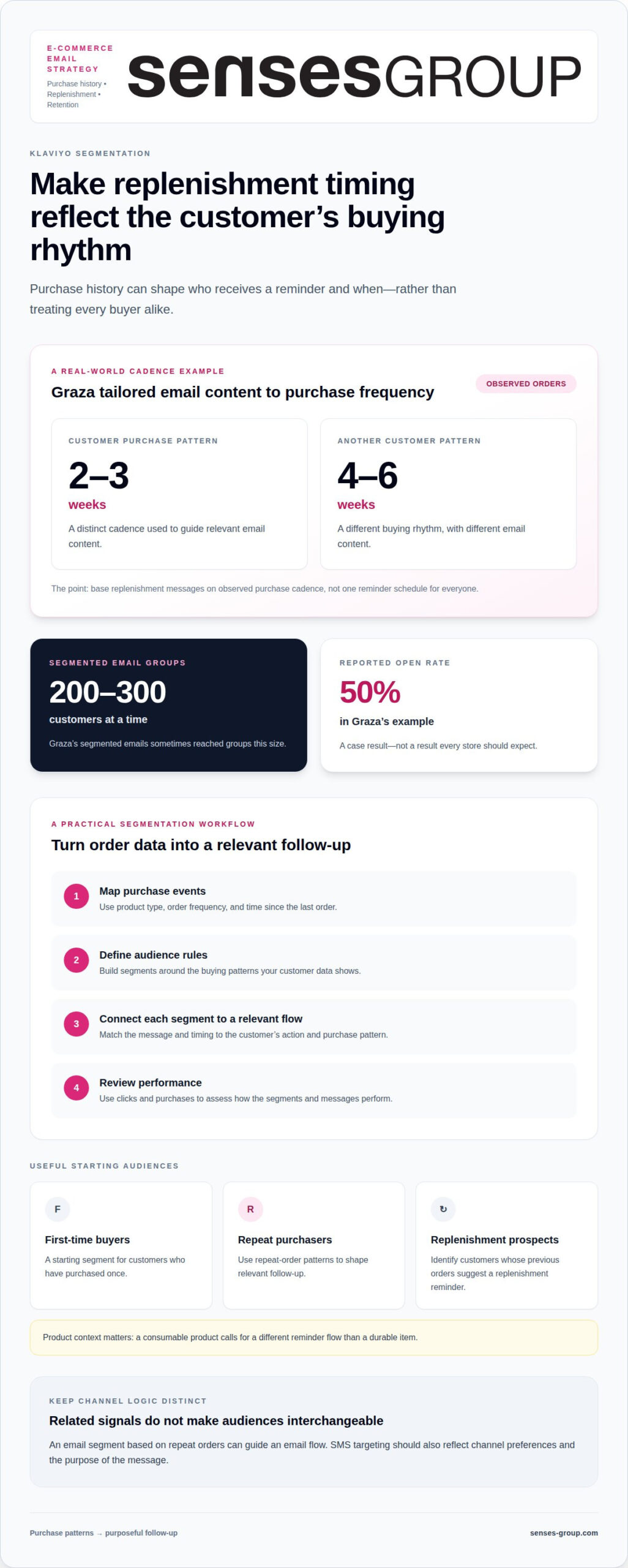
Purchase history gives replenishment campaigns a practical starting point: the customer’s own buying rhythm. Graza sent different email content to customers purchasing every 2-3 weeks and customers purchasing every 4-6 weeks. Rather than treating every buyer alike, that approach ties each message to a pattern in actual orders.
To build effective customer segments in Klaviyo, map purchase events to product type, order frequency, and time since the last order. Then define audience rules, connect each segment to a relevant email flow, and review performance using clicks and purchases.
What are the best Klaviyo segments for ecommerce and email marketing? Useful starting points include first-time buyers, repeat purchasers, and customers whose previous orders suggest replenishment. The right choice depends on the products and purchase patterns: a consumable product calls for a different reminder flow than a durable item.
Graza’s example also shows why groups don’t need to be enormous to support tailored sending. Its segmented emails sometimes reached groups of 200-300 customers at a time, and its granular segmentation achieved a 50% open rate. Those figures illustrate the case, not a result every store should expect; the useful lesson is to align content with observed buying cadence.
For a Hong Kong ecommerce store, segmenting by purchase history can make campaigns more purposeful across local and overseas audiences. A customer who repeatedly buys one product may need a replenishment reminder, while someone who purchased once may respond better to complementary product guidance. Segmentation helps acquisition and retention work together, rather than sending the same promotion to every profile.
Email and SMS can use related customer signals, but their audiences should be planned by channel. For example, an email segment based on repeat orders can inform the timing of an email flow, while SMS targeting should reflect the customer’s channel preferences and the message’s purpose. Separate channel rules help prevent treating an email audience as automatically suitable for SMS.
Integrate segments with flows by matching each trigger to a clear customer action. A completed order can start a post-purchase sequence; order frequency can shape replenishment timing; a new purchase can prevent an outdated reminder from sending. Flow and segment logic should work together, so customers receive a relevant next message instead of overlapping campaign content.
As your catalogue and customer base grow, this structure helps keep acquisition, repeat purchasing, and retention connected. A well-integrated ecommerce and email journey links store activity to purposeful follow-up, while purchase patterns guide the message and timing.
3. Engagement tiers and purchase recency
Engagement and purchase recency answer different questions: does a subscriber respond, and when did they last buy? Klaviyo engagement tiers can separate customers who purchased within the last 4 months from nearly lapsed customers who purchased 4-13 months ago. That distinction helps shape promotion intensity: a recent buyer may need useful product information, while a cooling customer may need a relevant reason to return.
Set engagement windows to match campaign purpose, then compare them rather than treating one window as universally correct. Common setups use 30-day, 60-day, or 90-day click and open windows; a 180-day click window can define a wider audience. Huda Beauty sends regular campaigns to subscribers engaged within the last 120 days. These examples offer starting points, not a substitute for evaluating your own customer cycle.
Purchase frequency adds another layer. A segment for customers who purchased 3 or more times can support loyalty-oriented messaging, while RFM-based targeting distinguishes a one-time purchaser from someone with 10 purchases. Ruffwear reported a 49% increase in click-rate using RFM segmentation. The practical lesson is to align the promotion with customer value and recency, rather than sending every profile the same offer.
Engagement tiers can also guide deliverability decisions. Profiles that click or purchase provide stronger evidence of interest than profiles that only appear to open messages. Klaviyo suppresses profiles after 7 consecutive soft bounces within the past 2 years, and a successful delivery breaks the streak. A professional can use engagement conditions to prioritize responsive subscribers while keeping sending audiences grounded in observable activity.
Never-engaged subscribers need different treatment from previously active customers. A profile with no recorded clicks, purchases, or other meaningful actions should not receive the same promotion as a recent buyer. A re-engagement message can test whether the person still values the brand. If there is no response, exclude that profile from regular campaigns to keep active-audience signals clearer.
Testing makes engagement tiers more useful. Compare one engagement window with another, or test a product-led message against a promotion for the same audience. Keep audience conditions consistent while changing one message element, then review clicks, purchases, and unsubscribes by segment. Open data can be unreliable, so don’t treat opens as the sole measure of interest.
For Hong Kong SMEs expanding overseas, market and product cycles can affect what “recent” engagement means. A seasonal product may call for a different window from a frequently purchased consumable. Review analytics by segment after each campaign, note which interests produce meaningful actions, and refine the timing before the next promotion. This keeps engagement tiers connected to customer behaviour rather than arbitrary labels.
4. Expected next-order date targeting
Purchase history can do more than describe past behaviour; it can inform when a customer may buy again. Klaviyo’s example expected-next-order segment targets customers predicted to order within the next 2 weeks. This gives a campaign a defined timing signal, rather than relying only on a fixed interval after every purchase.
The prediction is useful when it connects to a relevant next step. For a customer who regularly reorders a consumable, a timely reminder may be more appropriate than a broad promotion. For a Hong Kong store serving local and overseas markets, product availability and customer buying patterns can shape the message, while the predicted date guides when targeting begins.
Klaviyo predictive analytics has eligibility requirements: at least 180 days of order history, orders within the last 30 days, and at least 500 customers who have placed an order. These thresholds matter because a predicted date depends on usable purchasing history. A newer store without this depth can still build campaigns around observed order events and customer timing, without relying on predictive targeting.
Once a segment identifies customers expected to order soon, the message should reflect why they might buy again. A replenishment email could remind someone about a product they have purchased before. A related-product suggestion may suit a different purchase pattern. A discount is one possible incentive, but it should support the offer’s commercial purpose rather than become the default for every predicted customer.
Garrett Popcorn’s campaigns to customers likely to reorder soon generated 4x higher revenue per recipient than its campaigns overall. The result illustrates the potential value of timing an audience around predicted purchase intent. It does not make the same outcome automatic for every store; product type, customer history, and the message itself all influence how the segment performs.
Connect the predictive condition to the appropriate campaign or flow, then ensure new orders change the customer’s position. If a customer purchases before receiving a reminder, that order should inform whether the message remains relevant. This coordination helps prevent an outdated prompt from competing with the customer’s latest activity.
Measurement completes the process. Compare revenue per recipient, clicks, and completed orders for the expected-next-order audience against other campaign audiences. If a predicted window produces little response, review the product cycle and message relevance before changing the targeting. For businesses expanding into overseas ecommerce, separate market patterns can also reveal whether one timing approach suits every customer group.
5. Browsing-history personalization
A product view signals interest, but it doesn’t confirm purchase intent. Klaviyo’s segment example combines viewing a product with not having purchased in the previous 30 days. This pairing makes the audience more specific: the message can address a product someone considered, while the purchase condition helps exclude customers who already bought.
For example, a Hong Kong skincare store could target profiles that viewed a moisturiser but haven’t purchased it within that period. The follow-up might explain how the item fits a particular routine or highlight relevant product details. For overseas shoppers, the same browsing signal can inform a market-appropriate message, while product selection and brand positioning shape what the email says.
Browsing-based targeting works best when an event connects to a clear message. Distinguish a product view from a completed order, apply the purchase exclusion, and connect the resulting audience to suitable email content. A viewed item might prompt a product reminder; a purchase event should update the audience so the customer doesn’t receive an irrelevant prompt.
Context matters. Someone who viewed several products in a category may have broader interests than someone who viewed one particular item. The segment should reflect the intended message, not every available browsing signal. If the message concerns one product, a focused condition is more coherent than combining unrelated views into a single audience.
Browsing history can complement other channels without treating them as interchangeable. A product view may guide an email, while a purchase or stated preference informs a different communication. For example, a customer who browsed a new collection and later bought an item should receive follow-up that recognizes the purchase, rather than repeating the original browsing prompt. That continuity can support loyalty through more relevant interactions.
Review performance using actions tied to the campaign’s purpose. For a product-view email, examine clicks and subsequent purchases, then consider whether the message, audience conditions, or timing needs updating. Open data alone can be unreliable, so it shouldn’t be the only measure of response. Comparing results across browsing audiences can also show whether category-level or item-level interest better supports the message.
Keep the system disciplined as the catalogue changes. When a product is removed or a collection changes, review associated campaign content and segment conditions. This prevents outdated browsing signals from driving messages that no longer match the store. For businesses expanding from Hong Kong into other markets, consistent product information across storefronts also helps maintain a coherent customer experience.
Turn product-view events into purposeful follow-up with browsing-based email automation built around relevant products, purchase activity, and customer interests.
Senses Group: Brand Strategy
Senses Group helps businesses connect customer data with a clear brand and ecommerce strategy. Turn to the team when Klaviyo segments and flows need to support a coherent customer journey rather than operate as isolated campaigns.
Through Klaviyo Email Automation, segmentation can be structured around purchase timing, engagement, and browsing behaviour. Brand Strategy helps define the role each message should play, while Brand Identity Design keeps communications consistent with the business’s positioning. For companies building or refining their online sales foundation, an Ecommerce Shopify Store can connect the storefront experience with customer follow-up.
This integrated approach is especially useful for Hong Kong SMEs preparing to grow locally and reach overseas audiences. Contact Senses Group to discuss how your brand strategy and email automation can work together.
Make customer timing part of your growth system
A durable Klaviyo segmentation strategy is not a collection of isolated audience rules. It is a way to connect customer behaviour with the decisions behind your brand: what to communicate, when to communicate, and how each interaction supports the next stage of growth. For Hong Kong businesses reaching customers across markets, that coherence matters. The experience should feel recognisable even as products, audiences, and campaigns evolve.
The next step is to turn segmentation into a deliberate operating framework. Align customer signals with clear message priorities, then ensure the wider ecommerce experience reinforces the same positioning. When these elements work together, repeat-purchase timing becomes part of a stronger relationship, not just another campaign trigger.
Contact Senses Group to discuss your segmentation, and take the next step toward a more connected customer experience.
Frequently Asked Questions
What is Klaviyo segmentation and how does it work?
Klaviyo segmentation groups profiles according to customer information and recorded activity, then uses those audiences to guide marketing. For example, a clothing store could create an audience of customers who bought a particular product category but haven’t purchased a matching item. Segment conditions determine who qualifies, and changes in profile activity can change membership. The strategic value comes from matching each audience to a message with a clear purpose.
How does a professional segment Klaviyo audiences by engagement, purchase history, and lifecycle stage?
Map customer events to the message needed at each lifecycle stage. A new subscriber might receive introductory content, a first-time purchaser could receive product-use guidance, and a repeat customer might receive a loyalty-focused message. Engagement signals help distinguish responsive profiles from inactive ones. Segment rules should account for relevant purchases and recent activity, so someone who has already taken the desired action doesn’t continue receiving the same prompt.
How should Klaviyo segments differ from lists and tags?
Lists organize profiles around a defined collection or purpose, while segments select profiles using conditions that can reflect changing behaviour. Tags can help organize profile information for reference. For example, a retailer could use a tag to record how someone joined, then build a segment combining that tag with purchase activity. Use each structure for its intended role, rather than treating tags as a substitute for audience logic.
How does a professional use predictive analytics and RFM segmentation in Klaviyo?
A professional uses predictive analytics when the store has enough order data to support forecasts, then builds audiences around predicted customer behaviour. Klaviyo predictive analytics segmentation requires at least 180 days of order history, orders within the last 30 days, and at least 500 customers who have placed an order. RFM segmentation organizes customers by recency, frequency, and monetary value, helping tailor messaging to different purchasing patterns.
How does a professional measure and improve the performance of Klaviyo segments?
Evaluate each audience against its campaign goal, using measures such as clicks, orders, and revenue rather than relying on opens alone. For instance, assess a category-interest campaign by whether recipients click through or purchase relevant products. Testing one message change at a time makes results easier to interpret. Segment-level comparisons can then guide refinements to audience conditions, creative, or timing for future sends.
What are common Klaviyo segmentation mistakes and deliverability risks?
Common mistakes include combining unrelated behaviours, leaving past purchasers in a message audience, and treating opens as definitive engagement. Open-rate data can be unreliable, particularly because of Apple Mail Privacy Protection. Klaviyo suppresses profiles after 7 consecutive soft bounces within the past 2 years, and a successful delivery breaks the streak. Excluding unsubscribed profiles and basing targeting on meaningful activity helps keep campaigns better aligned with customer intent.