
B2B ecommerce is the online sale of products or services from one business to another, with ordering and payment workflows shaped around business accounts. Shopify B2B ecommerce solutions can support account-specific catalogs and pricing, payment terms, invoices, self-service ordering and repeat purchases. The key is to make the buying process fit how your business customers actually place and manage orders.
For Hong Kong SMEs and startups, taking wholesale sales online involves more than adding a checkout. Buyers need access to the right products and prices, clear payment processes, and an easy way to reorder. When these steps work together, your team can spend less time managing routine orders and more time growing the business.
This article explains how Shopify supports B2B payment workflows, including customer-specific terms, invoice handling and self-service account features. It also looks at how to structure pricing and repeat ordering, and what to consider when creating an ecommerce experience for local and overseas business customers.
Key Takeaways
- Tailor catalogs and pricing to business accounts so buyers see relevant products, rates and purchasing conditions.
- Use customer profiles and self-service tools to make account management and repeat ordering more straightforward.
- Map your B2B buying workflow before choosing how online orders, approvals and customer service should work together.
- Align payment terms, invoices and available payment methods with the process your business customers already use.
- Build your Shopify store around a clear brand and a scalable customer journey for Hong Kong and overseas markets.
Account-specific catalogs, pricing, and payment terms
Shopify B2B ecommerce solutions let businesses tailor the buying experience to each company account. Catalog access, negotiated prices, and payment conditions can follow the commercial relationship.
Customer-Specific Catalogs
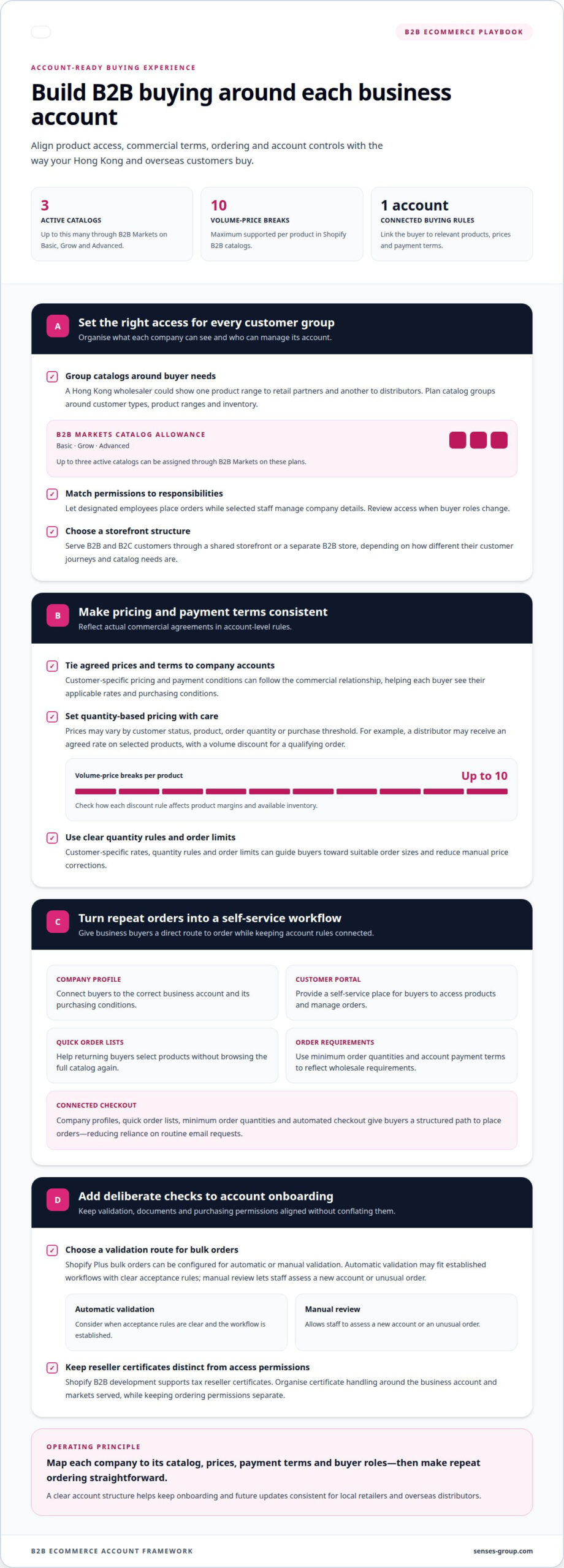
A catalog controls which products a company can browse and order. For example, a Hong Kong wholesaler could show one range to retail partners and another to distributors. Shopify Basic, Grow, and Advanced stores can assign up to three active catalogs through B2B Markets. Plan catalog groups around customer types, product ranges, and inventory, so business buyers can find relevant items without searching through an unsuitable assortment.
Company-specific pricing and payment terms can also be tied to B2B accounts. Shopify B2B ecommerce solutions are useful when customer groups need distinct product access as well as tailored purchasing conditions. Map each company to its catalog and account rules to make onboarding and future updates more consistent.
Wholesale Pricing and Discounts
Wholesale prices can vary by customer status, product, order quantity, or purchase threshold. A distributor might receive an agreed rate on selected products, while a larger qualifying order unlocks a volume discount. Shopify B2B catalogs support up to 10 volume-price breaks per product. Structure discounts around actual commercial agreements, then consider how each rule affects product margins and available inventory.
Customer-specific pricing shows each business account its agreed rates. Quantity rules and order limits can guide buyers toward suitable order sizes. Clear settings reduce manual price corrections and help sales teams apply wholesale terms consistently.
Buyer Access Controls
Company profiles connect buyers with the right account and purchasing conditions. Set permissions to match responsibilities, such as letting one employee place orders while another manages company details. Review access when roles change so account administration continues to support the customer’s buying process.
A Shopify store can serve B2B and B2C customers with experiences tailored to each profile. Businesses can use a shared storefront or a separate B2B store, depending on how different their customer journeys and catalog requirements are.
How do catalogs, company accounts, and buyer permissions work? Company profiles link business buyers to relevant catalogs, prices, and payment terms. Permissions define which actions each buyer can take within the account.
Which Shopify plans support B2B features? Basic, Grow, and Advanced support up to three active catalogs through B2B Markets. Consider this catalog limit alongside the account structure your store needs.
How do Shopify B2B pricing, licensing, and transaction fees work? Plan licensing and payment-processing charges are separate considerations. The applicable costs depend on the selected plan and payment setup.
How does Shopify B2B compare with Shopify Plus, BigCommerce, and Magento? These are different platform and plan choices. Compare their fit against your required account structure, catalog controls, payment workflows, and administration needs.
Self-service ordering and account management
A self-service account shifts routine buying from email threads into a structured platform. Shopify B2B includes company profiles, a customer portal, quick order lists, minimum order quantities, and an automated checkout. Together, these features give buyers a direct route to place orders while helping your team manage account-specific purchasing rules. For a Hong Kong wholesaler serving local retailers and overseas distributors, that can make the ordering process easier to standardise across customer groups.
Company profiles provide the foundation for business purchasing. Connect buyers to the correct account so they can access relevant products and manage orders through a self-serve portal. Quick order lists make it easier to select products without browsing the full catalog again. Minimum order quantities can reinforce wholesale requirements at checkout, while payment terms can reflect the account’s agreed arrangement.
Account permissions should match how each customer buys. A retailer, for example, may have several employees placing orders, while only selected staff manage account details. Specify who can order and who can administer the company account. When a buyer changes roles, update their access as part of the account review. Individual company profiles keep purchasing activity tied to the right business relationship instead of scattered across informal requests.
Business account validation creates a checkpoint before access or orders are accepted. Shopify Plus bulk orders can be configured for automatic or manual validation. Automatic validation may suit established workflows with clear acceptance rules; manual review gives staff a chance to assess a new account or unusual order. Base the process on the information your team uses to approve buyers, and apply it consistently.
Reseller certificates can also form part of a B2B account workflow. Shopify B2B development supports tax reseller certificates, which can be associated with business account processes. For Hong Kong businesses selling overseas, organise certificate handling around the customer account and the markets served. Keep account records and ordering permissions distinct, so a document review does not accidentally grant broader buying access.
- Onboard: Create the company profile and assign the appropriate buyers.
- Configure: Set quick order lists, minimum quantities, and payment options for that account.
- Validate: Apply automatic or manual review to new accounts or bulk orders.
- Maintain: Review account access when buyer responsibilities change.
These decisions shape the store’s operating model, not just its checkout. A carefully structured Shopify ecommerce experience can bring account access, ordering, and brand presentation into one coherent buying journey.
B2B ecommerce definition and workflows
B2B ecommerce means businesses selling products or services online to other businesses. A Hong Kong wholesaler selling stock to retailers through a tailored portal is one example. The transaction follows business-specific steps, such as account approval, negotiated purchasing conditions, order review, and fulfilment. Shopify can support one store serving both wholesale and direct customers, or a separate B2B store. The right structure depends on how different those buying journeys need to be.
Map the buying workflow before checkout. A business buyer identifies its company, accesses the appropriate product range, and builds an order. The seller then applies account rules, reviews the purchase, and moves it into fulfilment. A distributor ordering several product lines, for instance, may need a different review path from a returning retailer placing a routine order. Mapping these steps before launch clarifies what the portal should automate and where staff involvement is needed.
Automation works best when it removes repeat administration without obscuring important decisions. Shopify B2B includes company profiles, automated checkout, and self-service account tools. For larger operations, integrations can connect ecommerce with systems such as ERP, PIM, CRM, OMS, and WMS platforms. APIs are one way software systems exchange information, such as product records or order details. Plan each connection around a clear task, such as passing approved orders into an order management system.
Plan for exceptions as well as routine orders. A new account, unusual purchase, or stock discrepancy may need staff review before the order progresses. Define which events trigger a review, who handles the next action, and how the buyer receives an update. This keeps automation from treating a first-time wholesale enquiry like an established account’s routine purchase. Set a clear source for inventory information, especially if you sell across multiple channels.
What are the limitations, risks, and common costs of running B2B ecommerce on Shopify? The fit depends on required account controls, catalog structure, integrations, and approval workflows. Costs can include the selected Shopify plan, payment processing, apps, integration work, custom development, and ongoing maintenance. Complex processes may require additional configuration, while poorly aligned account data or inventory can create order errors. These operational demands matter more than simply launching a storefront.
Before launch, document the workflow from account creation through order completion. Identify which steps Shopify handles, which systems exchange data, and where a person makes a decision. Then test representative cases: a new buyer, a repeat order, and an order requiring review. This gives the business a concrete basis for refining its B2B commerce process as customer needs and sales volume grow.
B2B payment terms, invoices and payment methods
Payment design shapes how a business order moves from checkout to collection. Shopify B2B ecommerce solutions support payment terms of Net 7, 15, 30, 45, 60, and 90 days. Choose terms that match each customer agreement, then make the due date clear during purchasing. For Hong Kong businesses selling locally and overseas, consistent terms help sales and finance teams manage expectations across different accounts.
Connect the invoice process to the order record. Define when an invoice is issued, which date begins the payment period, and how the buyer settles the balance. For example, if an account has Net 30 terms, the invoice and account records should show the same due date. Clear handoffs between checkout, order administration, and accounts help staff follow up using consistent information.
Shopify Plus supports percentage-based deposits attached to payment terms. A 30% upfront deposit is one example. This can structure an order where the buyer pays an initial amount before the remaining balance is due. Make the deposit, outstanding amount, and payment timing clear before checkout, and ensure they match the commercial agreement. That clarity helps prevent confusion between the buyer’s procurement team and your finance staff.
Credit card vaulting is also supported for B2B. It stores payment details for future transactions, which can simplify repeat purchasing when the buyer and seller use that process. Available payment methods depend on the store’s payment configuration and the buyer’s market. For Hong Kong and overseas sales, consider how selected methods fit customer expectations, settlement processes, and finance integrations.
Which Shopify B2B features and payment options are relevant for businesses in Hong Kong? Shopify B2B ecommerce solutions can support account-specific payment terms, while Shopify Plus supports deposits and credit card vaulting. Businesses can align checkout with agreed terms and configured payment methods, then keep invoice details consistent with order records.
Use this sequence to refine payment operations:
- Set the terms: Match each business account with its agreed payment period.
- Align invoices: Keep order references, balances, and due dates consistent across records.
- Configure checkout: Present payment methods that suit the account’s purchasing arrangement.
- Connect records: Use integrations to align order and payment information with finance workflows.
The aim is not to offer every possible payment method, but to create a clear, manageable payment journey for each account. A considered checkout connects customer terms, invoice handling, and finance processes, giving Hong Kong businesses a stronger foundation for serving buyers across markets.
Self-service purchasing and repeat orders
Repeat purchasing should make familiar orders easier without removing useful controls. Shopify B2B supports purchase orders, bulk ordering, and self-service buying for business customers.
Purchase Orders and Estimation
A purchase order links the buyer’s internal approval process to the seller’s order record. Shopify Plus can assign a purchase order number to each transaction completed using purchase orders. For example, a retailer can enter its approved reference at checkout, helping its finance team match the purchase with internal records. An estimation process can also help buyers review proposed quantities and pricing before committing to a larger purchase.
Bulk Ordering and Discounts
Shopify Plus allows B2B customers to order up to 500 items. Bulk ordering suits wholesale buyers who already know their product requirements and need to add multiple lines efficiently. Shopify B2B development can support bulk orders and discounts, helping businesses apply purchasing incentives to defined order conditions. Set discount rules around eligible products, quantities, or customer agreements, so a larger basket supports the intended commercial outcome.
Repeat Order Purchasing
A repeat-order journey should reduce routine work while preserving account-specific terms. Quick order lists help buyers find regularly purchased products and build a new basket without repeating product discovery. For a Hong Kong retailer replenishing established stock, a clear list can shorten the route from login to checkout. Keep product details and quantities easy to review before the order is submitted.
For recurring purchases, make frequently ordered items easy to find, show relevant quantity rules, and keep the purchase order reference accessible where buyers need it. This makes each step easier to follow, whether a customer orders wholesale occasionally or replenishes stock regularly. Developers can configure the buying journey to match these requirements and the business’s approval and selling processes.
- Make repeat products accessible: Organise quick order lists around common customer needs.
- Keep order details visible: Let buyers review quantities, pricing, and purchase references before checkout.
- Apply discounts deliberately: Connect incentives to the relevant wholesale terms and order conditions.
A well-structured Shopify store can connect repeat purchasing with a consistent brand experience. Build your Shopify ecommerce store around the way your business customers order, approve, and replenish products.
In 2022, 59% of surveyed B2B buyers said they were comfortable placing orders worth more than $50,000 online. That level of comfort reinforces the value of a clear self-service path, with familiar products, transparent order details, and account-specific purchasing steps available together.
Gartner reported that 61% of B2B buyers wanted self-serve options in 2025. Give buyers room to complete routine tasks independently while keeping support available for questions or exceptions. A straightforward repeat-order flow can make replenishment easier to manage and help customers move forward with confidence.
Senses Group: Ecommerce Shopify Store
Senses Group helps Hong Kong businesses build Shopify stores around the realities of B2B buying. Its Ecommerce Shopify Store service can bring company account journeys, wholesale ordering, and repeat-purchase flows into a considered customer experience. Brand Strategy and Brand Identity Design help establish a consistent foundation across the storefront, while Klaviyo Email Automation can support relevant customer communications after purchase.
Turn to Senses Group when your store no longer reflects how business customers browse, order, and return, or when you are preparing to expand into overseas markets. The focus is a connected ecommerce experience, not a storefront in isolation. Contact Senses Group to discuss your Shopify ecommerce plans.
Shape the next stage of your B2B growth
Your next decision is not simply which feature to launch. Decide which customer relationships your digital experience should support as the business grows, and what those buyers need to understand before placing an order. For a Hong Kong SME preparing to serve new trade accounts or overseas buyers, a clear market position and a considered storefront can create a stronger foundation for expansion. Shopify B2B ecommerce solutions are most effective when the customer experience reflects the commercial direction of the business.
Senses Group combines Brand Strategy, Brand Identity Design, and an Ecommerce Shopify Store to connect business positioning with the online buying experience. This integrated work can shape a coherent presence for your next stage of growth, rather than treating the store as a standalone sales channel.
When you’re ready to develop your direction, contact Senses Group to discuss your ecommerce plans. A clear strategy gives your team a stronger basis for moving forward with purpose.
Frequently Asked Questions
What is B2B ecommerce?
B2B ecommerce is the digital buying and selling of products or services between businesses. A food supplier selling ingredients to restaurants through an online account portal is one example; a consumer ordering groceries for home delivery is B2C. Business purchasing can involve negotiated terms, multiple buyers, and internal approvals. The platform needs to support those commercial relationships, not simply display products and accept payment.
How do you build your B2B ecommerce implementation roadmap?
Start by documenting how a business customer moves from discovery to a completed order. Identify the systems, account rules, and approval points behind each step. Prioritise essential product, customer, and order data flows before adding optional features. Test the plan against practical cases, such as a new account and a repeat purchase. Assign an owner to each phase, then review the live workflow after launch.
What do B2B ecommerce trends and statistics show?
Digital ordering is now a core part of B2B commerce, but buyers still value support when decisions are complex. McKinsey’s 2026 B2B Pulse Survey found that 71% of B2B companies offer ecommerce. Gartner’s 2026 survey found that 67% of B2B buyers preferred a rep-free experience. Together, these findings point toward a blended model: enable independent purchasing for routine needs, while preserving access to knowledgeable sales support.
Which Shopify apps and integrations support B2B ERP, CRM, and inventory workflows?
Shopify integrations can connect ERP, CRM, and inventory workflows through standard apps or custom API connections. Shopify Flow, Shopify Admin API, webhooks, Zapier, and Make support different automation and data-transfer needs. The Shopify App Store contains over 16,000 apps, each reviewed through a 100-checkpoint process before publication. Choose tools based on the required data flow, then review app permissions, protect credentials, and limit staff access to necessary data.
How do Shopify B2B solutions compare with Shopify Plus, BigCommerce, and Magento?
Compare platform and plan options against your required account structure, catalog controls, payment workflows, and administration needs.