
More campaigns don’t automatically create stronger ecommerce growth; relevant follow-up does. Klaviyo is a marketing platform that helps online stores use customer and shopping activity to send targeted email campaigns and automated messages. With Klaviyo, flows can respond to actions such as browsing or placing an order, while A/B testing helps compare message variations.
For SMEs and startups, Klaviyo can bring more structure to customer communication as an online store grows or expands into new markets. But automation works only when customer data, timing and messaging fit the buying journey. A poorly planned flow can add noise instead of building loyalty.
This article explains what Klaviyo does, how ecommerce lifecycle flows and A/B testing work, and when the platform’s strengths and limitations matter. You’ll also learn what to consider when deciding whether it suits your business, so you can connect the technology to a practical growth strategy rather than expect the tool to deliver results on its own.
Key Takeaways
- Map customer journeys before building automated flows, so each message has a clear purpose and place in the buying cycle.
- Use A/B tests to compare one meaningful change at a time and apply the learning to future campaigns.
- Weigh the platform’s automation and customer-data capabilities against the setup, integration and ongoing management they require.
- Assess whether your store, customer activity and expansion plans are suited to lifecycle marketing across Hong Kong and overseas markets.
- Align your brand strategy, Shopify store and email automation so customer communications support one consistent ecommerce experience.
Ecommerce lifecycle automation and flows
Lifecycle automation connects customer actions to timely messages throughout the ecommerce journey. In Klaviyo, a flow can respond to an event, such as a first purchase, and trigger the next communication.
Email and SMS Marketing Features
Email and SMS serve different moments in a customer relationship. Email can explain a product range or provide detailed post-purchase guidance, while a concise SMS can deliver a timely update. Klaviyo lets businesses coordinate campaigns and automated messages using customer activity and profile information. Before building a sequence, decide which channel serves each purpose, what action triggers it, and how the message reflects your brand.
Klaviyo and Shopify Setup
To connect a Shopify store, create a Klaviyo account, add the Shopify integration and authorize the connection. Choose which data to sync, then confirm that customer profiles, orders and relevant store events appear correctly. Test the connection before activating a flow. For example, verify that a test order enters the right segment and triggers the intended follow-up, not an unrelated campaign.
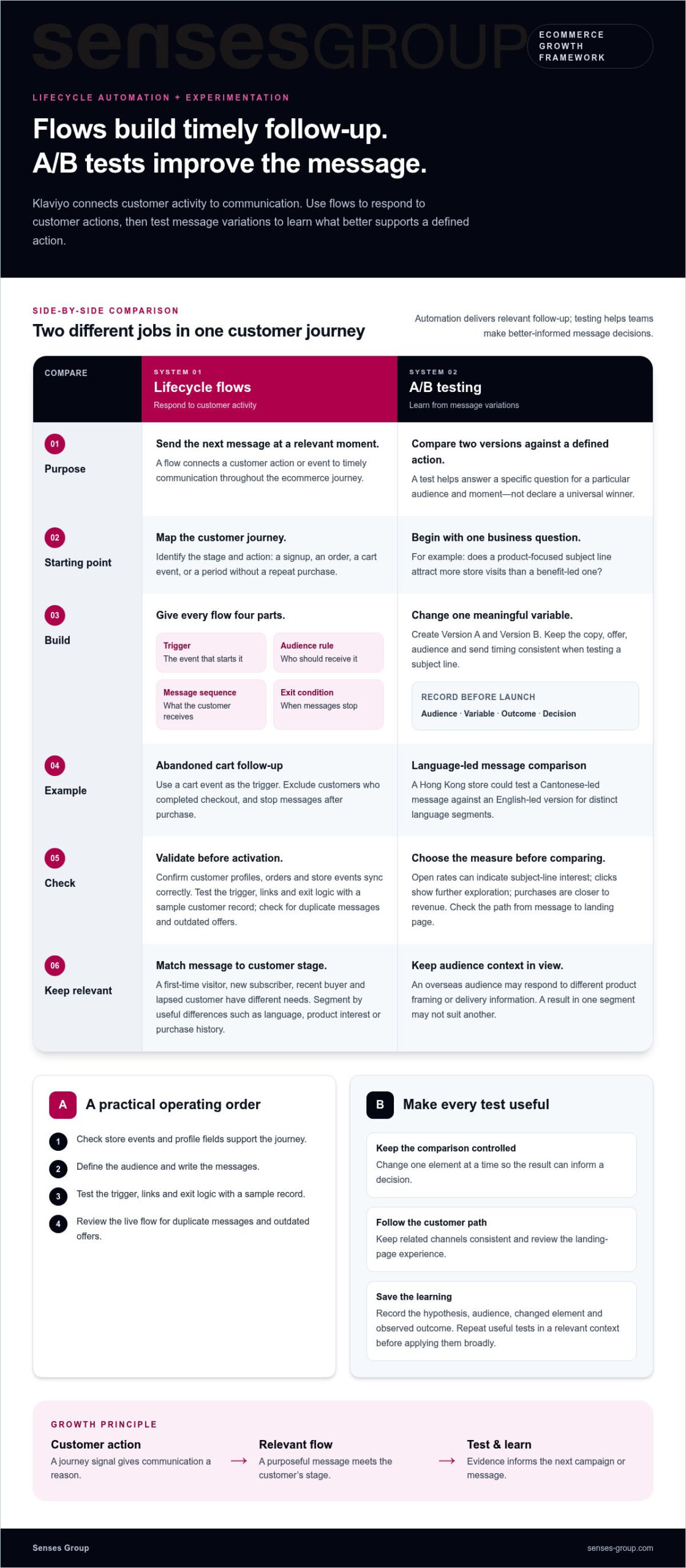
Start with the customer journey, not a catalogue of automations. A first-time visitor, new subscriber, recent buyer and lapsed customer have different needs. Map each stage and identify the action that signals a transition. A signup may begin a welcome series; an order may trigger product-care guidance; a period without a repeat purchase may prompt a re-engagement message. Klaviyo flows work best when each message reflects the customer’s stage.
A useful flow has four parts: a trigger, an audience rule, a message sequence and an exit condition. For an abandoned cart, the trigger could be a cart event. An audience rule can exclude customers who have completed checkout, while the exit condition stops messages after purchase. This structure reduces irrelevant follow-ups and keeps each communication tied to a customer action.
Build flows in a deliberate order. First, check that store events and profile fields support the journey. Next, define the audience and write the messages. Then test the trigger, links and exit logic with a sample customer record. Finally, review the live flow for duplicate messages and outdated offers. Revisit the setup when product priorities or customer journeys change.
For Hong Kong businesses selling locally and overseas, segmentation can reflect useful differences in language, product interest, or purchase history. Keep the brand voice consistent while adapting messages to customer context. Shopify’s app ecosystem has more than 8,000 apps, so integration choices should serve a defined process. Klaviyo can connect customer data and communication, but thoughtful flow design gives that connection purpose.
A/B testing
A/B testing compares two versions of a marketing message to learn which better supports a defined customer action. In Klaviyo, test a campaign or flow message, then compare a clear outcome such as clicks or completed purchases. The aim isn’t to declare a universal winner, but to make a better-informed decision for a particular audience and moment in the commerce journey.
Begin with one business question. For example, does a product-focused subject line attract more store visits than a benefit-led one? Create Version A and Version B, changing only the subject line. If the copy, offer, audience and send timing also change, the result won’t reveal which difference influenced customer behaviour. A controlled comparison gives the team a finding it can use.
Before launching, document the test in a simple experiment record:
- Audience: define the customer group, such as recent first-time buyers.
- Variable: choose one change, such as a subject line or call-to-action.
- Outcome: select a measure connected to the goal, such as clicks to a product page.
- Decision: state how the result will shape the next campaign or message.
Customer data helps make the comparison meaningful. A Hong Kong store might test a Cantonese-led message against an English-led version for distinct language segments, rather than mixing both groups. An overseas audience may respond to different product framing or delivery information. Keep the test audience and customer context in view, since an apparent winner in one segment may not suit another.
Choose the measure before comparing results. Open rates can indicate subject-line interest, while clicks show whether a message prompted further exploration. A purchase measure is closer to revenue, but a single campaign may not explain why customers bought. Check the full path from message to landing page, and don’t treat one outcome as proof of lasting performance. Repeat a useful test in a relevant context before applying it broadly.
For omnichannel marketing, coordinate email experiments with related messages on other channels. If an email promotes one product while a separate campaign presents a different offer, customers receive competing information. Keep the journey consistent and record which channel and message produced each interaction. Custom tracking or storefront events can help when standard data doesn’t capture the action you want to measure.
Testing is a learning system, not a quick design contest. Save each hypothesis, its audience, the changed element, and the observed outcome. Those notes help teams avoid repeating inconclusive experiments as campaigns evolve. A coherent brand strategy can also help ensure test variations remain recognisably consistent while exploring different messages.
Advantages and limitations
Klaviyo’s value depends on how closely its data, automation and reporting capabilities match your ecommerce operation. The depth that supports tailored marketing can also add complexity for a smaller team.
Platform Strengths and Trade-Offs
For ecommerce brands, a key strength is connecting customer activity with targeted email communication. A store can use purchase history to shape follow-up messages, while engagement data helps teams assess how customers interact with campaigns. This structure is useful when repeat purchases and relevant customer journeys matter.
That depth also requires effort. Teams need reliable data, clear audience definitions and regular reviews of campaign logic. A small shop with a short product range and occasional email updates may not need extensive segmentation. Before adopting Klaviyo, list the customer journeys you intend to manage, then compare them with your available time and technical capacity.
How does Klaviyo compare with Mailchimp and Shopify Email? Klaviyo focuses on ecommerce customer data and lifecycle marketing; Mailchimp can suit broader email marketing needs; and Shopify Email is tied to the Shopify ecosystem. Compare the tools against your store’s integrations, customer journeys, reporting needs and team workflow, rather than choosing by feature count alone.
Integration complexity can also affect the decision. A Shopify store with clean product and customer records has a stronger foundation for useful targeting than one with inconsistent data. Custom integration work can become substantial when a business needs complex connections, so define the essential customer events first. Avoid technical complexity that doesn’t support a clear marketing purpose.
Contact and Email Send Pricing
Klaviyo email pricing is based on the number of contacts and the email-send volume available in a plan. As a business grows its list or sends more campaigns, it may need a different plan. The practical cost driver isn’t just list size, but how often the business communicates with those contacts.
For planning, estimate active contacts and campaign frequency based on your store’s actual sending pattern. Include automated messages as well as scheduled campaigns, since both contribute to communication volume. Then review list quality: keeping outdated or unengaged records can increase the contact base without improving engagement. Set a regular review process before growth makes list management harder.
Compare expected plan requirements with operating needs, not just an entry-level tier. A startup sending occasional product updates has a different profile from a growing Shopify brand with regular campaigns and multiple lifecycle messages. Revisit the calculation when list growth, launch schedules or overseas activity changes. Keep budget decisions connected to email’s role in the wider commerce strategy, and assess whether Klaviyo’s capabilities suit that role.
Ideal business types and use cases
Klaviyo is often a strong fit for ecommerce businesses with repeat customer interactions and a clear reason to communicate after purchase. A skincare store, for example, may educate buyers about product routines, while a homeware shop may share care guidance and related products. The key question is whether customer activity can shape useful communication, not whether the company has a large marketing team.
Product range and purchase frequency influence the opportunity. A retailer selling consumables can build communication around replenishment, while a fashion brand may focus on new arrivals, seasonal edits and customer preferences. A business with one-off, high-consideration purchases can still use email, but its message strategy will differ from that of a store with regular repeat customers. Define the customer relationship before choosing the depth of automation.
When expanding into overseas markets, customer context matters. A campaign for local shoppers may need different language, product information or seasonal framing from one aimed at customers elsewhere. Segment by relevant customer attributes and purchasing behaviour, while keeping the core brand identity consistent. Pay attention to mobile presentation too: product imagery, readable copy and a clear next action should work on a small screen.
Integration needs help determine whether the platform fits an existing commerce stack. A Shopify store with consistent product and order data has a practical foundation for connecting marketing activity to store events. Businesses using other ecommerce systems should map the customer records and events they need before building campaigns. The goal isn’t to collect every available data point, but to make data useful for a specific customer experience.
Klaviyo may suit brands that want customer data to inform both campaigns and lifecycle communication. More than 60% of active Shopify Plus stores use Klaviyo. That adoption figure signals a strong relationship with Shopify Plus merchants, but it doesn’t determine whether the platform fits an individual business. Team capacity, data quality, and the need for tailored communication remain decisive.
A lean startup may benefit when it has a clear audience, a functioning online store and a manageable first use case. Start with one business priority, such as welcoming new subscribers or supporting customers after an order. A retailer with irregular promotions and little customer segmentation may gain less from a complex setup. Match the platform’s capabilities to how the business operates, then expand when the next use case is clear.
Use this fit check before committing resources:
- Customer journey: Identify where timely communication can improve the experience.
- Data foundation: Confirm that store records support useful segments and campaign decisions.
- Team capacity: Assign ownership for content, testing, and ongoing maintenance.
- Market plan: Map how local and overseas audiences need distinct, consistent communication.
What are Klaviyo’s key features for email and SMS marketing?
Klaviyo brings campaign messaging and customer information into one marketing environment. For an ecommerce business, its practical value lies in coordinating planned emails, automated messages and SMS around customer activity. Each channel needs a clear role: email can explain a product range, while a concise text can highlight a specific update.
Email tools support campaign creation, audience selection, and message scheduling. A Hong Kong homeware store, for example, could send a product-edit email to customers interested in kitchen items. Segmentation helps tailor that content using relevant customer or purchase information. Templates and brand assets can support consistency, but the message still needs a clear offer, useful detail, and destination page.
Automation connects messages to customer events. A welcome sequence can introduce the store after a subscription, while a post-purchase email can explain product care or suggest related items. Flow logic determines who receives each message and when. Review the entry event, audience rules and exit conditions together, so a completed purchase doesn’t leave someone receiving an irrelevant reminder.
SMS provides a more immediate format for concise communication. A retailer might use a text to highlight a launch or remind an interested customer about a promotion, while email offers fuller product context. Use the channels as a coordinated system, not duplicate versions of the same message. Check how each message appears on mobile and make sure its link leads to the intended product or collection.
- Campaigns: Plan announcements and product communication for defined audiences.
- Segmentation: Organize customers around relevant interests or purchase activity.
- Flows: Connect customer events with sequenced email or text messages.
- Testing and reporting: Compare message variations and review engagement signals.
These features depend on reliable customer records and a coherent brand system. If product names, imagery or tone shift between a campaign and the store, the customer experience feels disconnected. Set shared standards for subject lines, visual hierarchy, calls to action and mobile readability. Then use campaign results to refine the next message, rather than changing several elements without a clear learning goal.
Klaviyo introduced AI-powered features in 2023. For an SME, these can be considered alongside core needs such as audience organization, automation, and campaign measurement. Start by listing the messages your team needs to manage, then identify which tasks require a repeatable process. This keeps feature decisions connected to the operating model, not novelty.
For a connected email journey, plan your ecommerce email automation around customer needs, brand consistency, and the store experience.
Define your priorities before adopting advanced tools. Custom setup of integrations for marketing automation flows can cost well over 6-figures, so weigh that investment against your existing needs and resources.
Senses Group: Brand Strategy
Senses Group helps Hong Kong businesses connect brand direction with the ecommerce experience customers actually encounter. Its Brand Strategy clarifies positioning and messaging, while Brand Identity Design creates a consistent expression across customer touchpoints. For businesses building or refining their online store, an Ecommerce Shopify Store and Klaviyo Email Automation can bring the shopping journey and follow-up communication into a more connected system.
Turn to Senses Group when your store, brand and marketing messages feel disconnected, or when expansion into new markets calls for a clearer foundation. The next step is to discuss how these elements can work together for your business. Visit senses-group.com to contact Senses Group.
Build the next stage around a connected customer experience
Growth becomes more manageable when each customer touchpoint reflects the same commercial direction. Before expanding your use of Klaviyo, decide what your business needs to clarify next: its market position, how the brand appears, or the path from discovery to purchase. That decision gives your marketing system a stronger foundation.
For Hong Kong SMEs preparing to scale locally or overseas, the next step may involve aligning brand direction with the store experience. Senses Group offers Brand Strategy, Brand Identity Design, and Ecommerce Shopify Store development to help connect those foundations. A cohesive experience gives campaigns and customer communication a more deliberate place within the wider business.
Share the growth challenge you’re working through and discuss your ecommerce needs with Senses Group. A clear next step can turn scattered marketing activity into a more focused path forward.
Frequently Asked Questions
What is Klaviyo?
Klaviyo is a marketing platform for businesses that want to connect customer information with email and SMS communication. An online retailer can use it to organize audiences, send campaigns, and coordinate messages around customer activity. For example, a shop launching a new product can tailor an announcement to customers whose previous purchases indicate relevant interest, rather than sending identical content to every subscriber.
What is Klaviyo and does it work in Hong Kong?
Yes, Hong Kong ecommerce businesses can use Klaviyo to manage customer marketing communication. A local retailer can plan messages for customers in Hong Kong while organizing distinct campaigns for overseas audiences. The practical setup should reflect the store’s customer data, preferred languages, and market-specific content. For example, prepare separate message versions when product details or customer expectations differ between local and international shoppers.
What is Klaviyo and what does it do?
Klaviyo helps ecommerce businesses manage marketing messages using customer and store information. A business might use it to announce a seasonal collection, group customers by product interest or review which campaign links drive store visits. The platform gives marketers a structured way to plan and deliver customer communication. The business still defines the message, audience, brand voice and intended next action.
What are the common drawbacks and risks of using Klaviyo?
Common drawbacks include setup effort, ongoing campaign management and costs that can change as contact numbers and email volume grow. Poorly maintained customer records can also lead to irrelevant targeting. For example, a customer who has already bought an item could receive a message promoting the same purchase. Assign responsibility for list maintenance and campaign reviews, and keep each automated message aligned with the customer’s latest interactions.
How much does Klaviyo cost, and what is included in each plan?
Klaviyo email pricing is based on contact count and email-send volume, so costs can rise as your list or sending frequency grows.