
A polished logo can’t compensate for a brand experience that changes from your website to your ads to your customer communications. For SMEs and startups, corporate branding solutions should do more than improve appearances: they should connect what the business stands for with how customers experience it, in local and overseas markets.
If your visuals feel disconnected from your strategy, or branding, ecommerce and marketing are working in separate silos, the problem isn’t a lack of activity. It’s a lack of alignment. Standing out and expanding into overseas markets both depend on a clear position customers can recognise and trust across every touchpoint.
This article explores how to build that practical foundation. You’ll learn how brand strategy clarifies who you serve and what sets your business apart, how identity creates consistency, and how Shopify ecommerce and connected marketing can bring the brand to life. The result is a joined-up system designed to support customer confidence, ecommerce growth and market expansion, rather than a collection of disconnected campaigns.
Key Takeaways
- Set business objectives and define your audience before shaping brand expression, so positioning can guide decisions as the company grows.
- Corporate branding solutions should turn your positioning into clear, repeatable choices across customer-facing channels, not stop at a logo.
- Use a practical diagnose, define, design, apply and review process that reflects your SME’s ecommerce priorities and expansion goals.
- Align brand guidelines with your Shopify store, email automation, SEO and advertising to create a more coherent digital experience.
- Review how customers encounter your brand across markets, then refine the system where inconsistencies weaken recognition or trust.
What Corporate Branding Solutions Should Achieve for a Growing Business
For a growing company, corporate branding solutions should connect business direction with what customers actually see, hear and experience. They help define who the business serves, why it is distinct, and how that promise should appear across its website, ecommerce store, marketing and customer communications. The aim isn’t simply to look more polished. It’s to give the business a coherent foundation for making decisions and earning recognition as it grows.
Corporate branding is the system that aligns a company’s strategy, identity and customer experience so people can recognise what it stands for and encounter that promise consistently. This is broader than visual identity alone. A useful starting point is the wider concept of corporate branding, which considers how an organisation presents itself as a whole. For an SME, this distinction matters: local relevance must be clear, while the underlying brand should be adaptable enough to support overseas ecommerce and new audiences.
Clear positioning gives teams a shared reference point. It helps customers understand why a business is relevant, supports a more consistent experience, and guides practical choices, from product-page language to email campaign messages. A brand system won’t solve every growth challenge, but it can reduce confusion about what the business offers and how it should communicate that value. For example, a product page, paid ad and welcome email should explain the same core value, even if each uses a different format.
How corporate branding differs from logo and identity design
Brand strategy establishes the business’s direction: its audience, position and promise. Brand identity translates that direction into recognisable visual and verbal elements, including the logo, typography, colour and tone. Customer experience is where people encounter the brand, through a Shopify store, an advertisement, an email or a service interaction.
A logo expresses the brand; it can’t replace the positioning behind it. Brand guidelines help teams apply the identity consistently, so a campaign or new sales channel feels connected to the same business rather than improvised on its own. They should be practical enough to guide everyday decisions, such as which logo version to use, how product imagery should feel, and how the brand speaks to customers.
When a growing company should revisit its brand
Consider a review when messaging varies across channels, the business is attracting a different audience, or competitors are making it harder to explain what sets the company apart. Expansion plans are another prompt: entering overseas ecommerce markets can expose unclear positioning or an identity that doesn’t translate well to new customer contexts.
Start by diagnosing the source of the problem. If the offer, operations or customer journey needs attention, a visual refresh alone won’t fix it. The right response may be to clarify positioning, update guidelines or improve how the brand appears online. Preserve what customers already recognise while addressing what no longer supports the business.
The Core Elements of Corporate Branding Solutions That Work Together
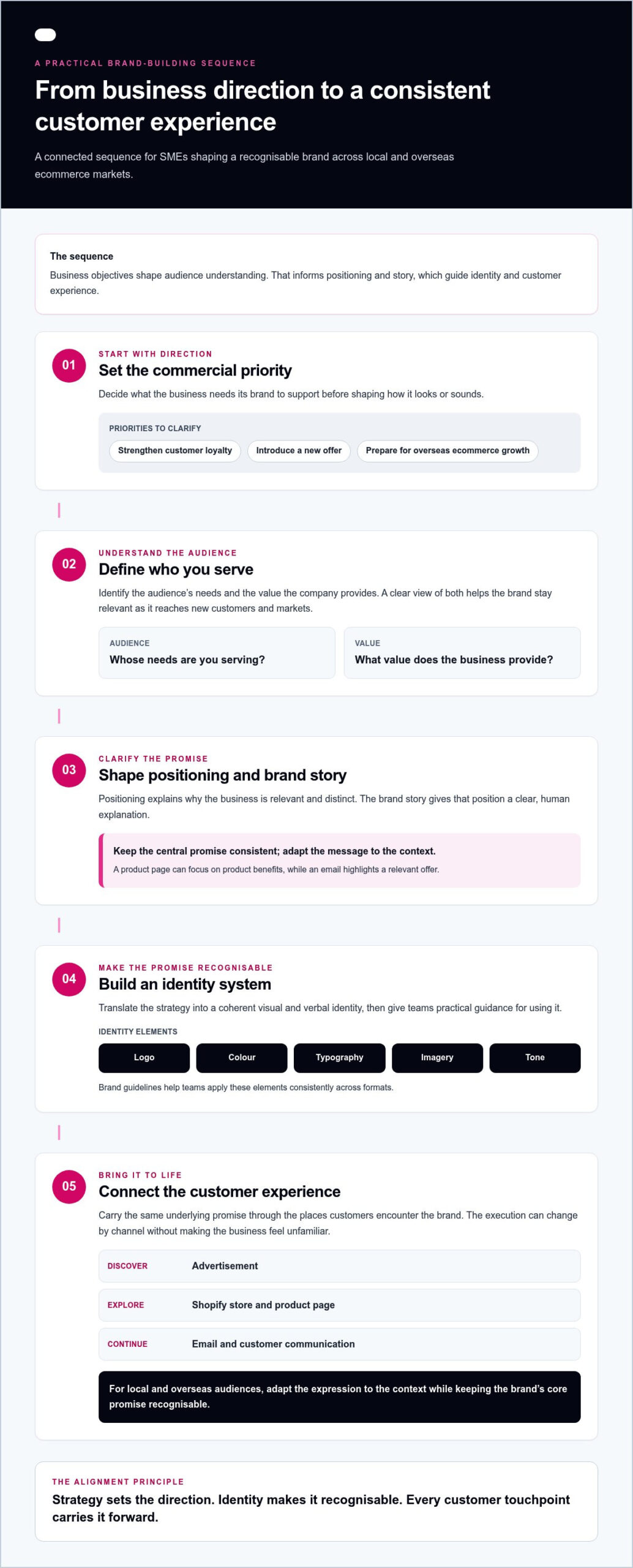
Effective corporate branding solutions follow a clear sequence: business objectives shape audience understanding, which informs positioning and story, then guides identity and customer experience. Each element has a role. When they share the same strategic foundation, a business can communicate a recognisable promise at home while adapting its expression for overseas customers.
Start with the commercial direction. Is the priority to strengthen customer loyalty, introduce a new offer, or prepare an ecommerce business for overseas growth? Then define the audience’s needs, the value the company provides, and the meaningful differences that set it apart. Harvard Business Review’s framework for the nine components of corporate identity offers a useful prompt: consider how the company’s culture, strategy and external expression fit together, rather than treating branding as a design task in isolation.
Brand strategy, story, and positioning
Strategy turns business ambition into choices about whom to serve and what value to lead with. Positioning states why the business is relevant and distinct; the brand story gives that position a clear, human explanation. Together, they help writers shape consistent messages for product pages, social campaigns and customer emails without making every channel sound identical. For example, the central promise can remain the same while a product page focuses on product benefits and an email highlights a relevant offer. Explore strategic brand development alongside channel planning to see how the foundation informs marketing decisions.
Identity systems and digital customer experiences
Once the strategy is clear, the identity system makes it visible through the logo, colour, typography, imagery and other visual assets. Brand guidelines show teams how to use those elements, as well as tone and messaging, across formats. This matters in ecommerce: a customer should be able to move from an advertisement to a Shopify product page and an email without encountering a brand that feels unfamiliar at each step. For a closer look at visual expression in retail, see retail brand identity design.
Consistency doesn’t mean copying the same execution everywhere. It means keeping the underlying promise recognisable while adapting content to the needs of each audience and channel. A shared strategy gives founders, designers and marketers a common basis for those decisions, reducing contradictory claims and disconnected creative. Businesses shaping this connected foundation can explore Senses Group’s branding and ecommerce approach to align brand direction with digital execution.
Is Corporate Branding Just a Logo? Evaluate the Commercial Value
No. A logo is a recognisable asset, but it can’t explain what a business stands for, who it serves or why a customer should choose it. Corporate branding solutions connect those strategic decisions with the identity and customer experience that bring them to life. The commercial value lies in creating a clearer, more consistent basis for communication and decision-making, not in promising a particular revenue or conversion result.
Brand identity versus an integrated branding system
Isolated design can produce attractive materials. Without positioning, though, different teams may interpret the brand differently, leaving the website, product pages and campaigns with inconsistent messages. An integrated system connects the design to the business model and customer journey.
| Area | Visual identity alone | Integrated branding system |
|---|---|---|
| Scope | Visual recognition | Strategy, identity and customer experience |
| Business inputs | Design preferences and visual references | Business objectives, audience, offer and positioning |
| Deliverables | Logo and selected visual assets | Identity, messaging direction and usage guidance |
| Application | Primarily visual placements | Website, ecommerce content and marketing touchpoints |
For example, a retailer preparing to sell overseas needs more than a logo file. Its product descriptions, store experience and campaigns should express a coherent promise while remaining relevant to each intended audience. Connected digital services, such as Shopify development, email automation and advertising, can carry that identity through the buying journey. They extend the brand; they don’t replace the strategy that guides it.
A consistent brand experience helps customers know what to expect, from the first message they see to the moment they buy.
How to assess fit, evidence, and business relevance
Assess proposed branding work against the real business context. Does it reflect the company’s offer and audience? Will it support a stated priority, such as improving ecommerce consistency or preparing for market expansion? Can the team apply the resulting guidelines across the channels it actually uses? These questions help distinguish a useful system from creative work that looks polished but has little connection to business needs.
Evidence should be relevant and carefully interpreted. A portfolio can show the type of brand and digital work completed, while a case study can explain its context and scope. Treat reported outcomes as specific to that project, not as a forecast for your business. Branding can support recognition, trust and clearer communication, but results also depend on factors such as the offer, customer demand and execution. No visual identity or strategy can guarantee revenue or conversion gains.
How to Put Corporate Branding Solutions into Practice
Make the work manageable by treating corporate branding solutions as a sequence of decisions, not a demand to replace everything at once. For an SME, the priorities might be clarifying the offer, improving the online buying journey, or preparing to reach overseas customers. A focused process helps direct limited time and resources towards the changes that support those goals.
From brand audit to a clear strategic foundation
Diagnose. Review current messaging, visual identity, website, customer journey and marketing materials. Note where customers could encounter different claims or where the brand promise becomes unclear. A simple audit can record each touchpoint, the message it communicates and any inconsistency that needs attention.
Define. Clarify the priority audience, its needs, the business’s distinctive value and the growth objective. Identify which obstacles are strategic and which are executional. If customers understand the offer but struggle to find key information on the website, for example, the issue may be site structure rather than the brand position.
Design. Once those foundations are clear, develop or refine the identity and practical guidelines. Prioritise the elements the team needs to use first, such as core messaging, visual rules and ecommerce assets. This avoids investing in new creative before the business knows what it needs to communicate.
Apply the brand across ecommerce and growth channels
Apply. Translate the brand into Shopify navigation, page content, product information and the purchase journey. Make it easy for customers to understand the offer and recognise the business from discovery through checkout. When reviewing a store, check that the main navigation reflects how customers shop, that product pages answer the questions they need to evaluate an offer, and that the visual identity is consistent from landing page to checkout. This strategic Shopify guide for SMEs offers a focused starting point for thinking about ecommerce foundations.
Carry the same strategic message into SEO and GEO content, paid advertising, social media and email automation. Consistency means the position and promise remain recognisable; it doesn’t mean every channel uses identical wording. A new overseas audience may need different explanations, language choices or emphasis. Adapt the expression to audience context while keeping the brand’s core meaning intact.
Review. Check whether customers receive a coherent experience across key touchpoints, whether the team can apply the guidelines, and whether the brand still supports current business priorities. Compare key pages, ads and emails side by side to spot inconsistent promises or visual choices. Refine based on what the business learns, rather than changing identity for its own sake. To connect brand foundations with digital execution, explore Senses Group’s growth approach.
How Senses Group Connects Corporate Branding to Digital Growth
Brand foundations create value when they shape how a business reaches and serves customers. Senses Group connects brand strategy and identity with ecommerce and marketing, helping SMEs and startups align the message customers encounter with the experience they receive. This integrated approach is particularly relevant when a business is building its online presence or preparing to reach customers overseas.
An integrated partner from brand foundations to customer acquisition
Strategy and identity inform the structure, content and experience of a Shopify store. Sales-funnel planning then helps connect that experience to the steps a customer takes, from discovering the business to considering an offer and making a purchase. Each element has a distinct role, but they work best when guided by the same brand direction.
SEO and GEO support discovery through useful, relevant content. Meta and Google advertising can put messages in front of intended audiences, while social media and Klaviyo email automation help carry those messages through ongoing customer interactions. The objective isn’t to activate every channel at once. It’s to connect the channels that fit the business’s audience, capacity and growth priorities. For more on coordinating these efforts, read the integrated digital marketing scaling guide.
Because SMEs have finite resources, the work should be shaped around the company’s stage and objectives rather than a fixed package. One business may need clearer positioning before investing in campaigns; another may have its brand foundations in place but need a more coherent ecommerce journey. Connecting the work allows priorities to be addressed in context, without treating strategy, design and marketing as separate projects.
Evidence, experience, and a sustainable growth mindset
Senses Group was founded in 2008 and states that it has more than 18 years of expertise as of 2026. Its documented clients include Sony, Barclays, Panasonic and LVMH, reflecting work with businesses across different sectors. For an SME, the relevant question is how an agency’s experience applies to its own audience, business model and next stage of growth, not whether another company’s results can be replicated.
Senses Group reports that Monchhichi Jewelry Atelier’s revenue doubled shortly after its ecommerce system launch. That is a reported outcome tied to a specific project and timeframe, not a guaranteed result or proof that one intervention alone caused the change. Sustainable growth depends on several connected factors, including the offer, customer demand and execution. A considered system gives a business stronger foundations to act on those factors.
Build your growth engine with Senses Group by connecting brand strategy, identity and digital marketing around your business priorities.
Build a Brand Foundation for Your Next Stage of Growth
Sustainable growth depends on more than a recognisable logo. Corporate branding solutions connect business strategy, identity and customer experience, giving customers a clearer sense of what your business stands for across your website, ecommerce store and marketing. For SMEs looking to grow at home or overseas, a consistent foundation can help the brand stay recognisable while its communication adapts to different audiences.
Start by clarifying your position and priorities, then apply that direction across the touchpoints customers use to discover, evaluate and buy. Review the experience regularly so your brand keeps pace with your business. These steps won’t guarantee revenue or conversion results, but they can help align the decisions that shape how your business shows up.
Senses Group was founded in 2008 and states it has more than 18 years of expertise as of 2026. Its documented client work includes Sony, Barclays, Panasonic and LVMH. For a strategic partner to connect brand foundations with digital growth, build your growth engine with Senses Group. A clearer, more coherent brand can give your next stage of growth a stronger starting point.
Frequently Asked Questions
What are corporate branding solutions?
Corporate branding solutions are a connected set of strategic and creative activities that clarify a company’s position and express it consistently. Business strategy sets direction; messaging explains the company’s value; visual identity makes it recognisable; and customer-facing applications bring the brand to life across websites, ecommerce and marketing. The scope depends on the business’s needs. It’s not simply a logo project, and it can’t guarantee a particular commercial result.
Why is corporate branding important for a small business?
Corporate branding helps a small business communicate what it offers and why it matters in a clear, recognisable way. Consistent messaging across a website, product pages and marketing can make it easier for customers to understand the business. The right approach should reflect its audience, business model and growth priorities, including ecommerce ambitions. It should build on the company’s strengths, not copy a larger competitor’s identity or scale.
Is corporate branding the same as logo design?
No. Logo design is one part of brand identity, while corporate branding also covers strategy, positioning, messaging, guidelines and customer experience. A logo alone can’t establish why the business is different or what customers should expect. For example, an identity should be applied consistently across a company website, product pages, campaigns and customer communications, so each interaction feels connected to the same brand rather than like a separate effort.
How do corporate branding solutions support ecommerce growth?
Corporate branding solutions give an ecommerce business a foundation for clear messaging, useful website structure, visual consistency and a coherent buying journey. Those principles can inform Shopify development and conversion-focused design, while SEO and GEO support discoverability. Advertising and email automation can then carry aligned messages into customer interactions. Branding helps create a connected experience, but it doesn’t guarantee sales, traffic or a particular conversion rate; those outcomes depend on multiple factors.
Can a company adapt its brand for overseas markets without losing consistency?
Yes. A company can preserve its core positioning and identity principles while adapting communication to the context of each audience. Document which elements stay consistent, such as the brand promise and visual rules, and where messaging or the customer experience may need adjustment. This gives teams room to make relevant choices without changing what the business stands for. Review each adaptation against the intended audience and business goals rather than assuming one execution fits every market.
How can a business measure the impact of corporate branding?
Choose measures that relate directly to business objectives. Brand recognition research and customer feedback can indicate whether people understand and remember the company; website engagement, lead quality and ecommerce behaviour can reveal how customers respond at different stages. Establish a baseline and review the indicators in context, since each reflects a different part of the journey. Don’t attribute revenue changes to branding alone without reliable evidence and a clearly explained measurement approach.