
What if the next stage of growth depends less on adding another marketing channel and more on connecting the ones you already have? A Shopify agency for growing brands should help align your positioning, storefront, customer acquisition and retention, so each part strengthens the next. That matters when your store is gaining traction and you’re preparing to reach overseas customers without diluting your brand.
A polished Shopify site is a starting point, not a growth system. When brand messaging, paid campaigns, search visibility and follow-up emails pull in different directions, it becomes harder to turn traffic into lasting customer relationships. The right partner looks beyond launch tasks and understands the commercial priorities, technical foundations and expansion plans behind your next move.
This guide will help you identify the strategic and technical capabilities that matter at your growth stage, assess agency fit through relevant evidence, clear scope and sound working processes, and plan a connected roadmap for Shopify, acquisition and retention. You’ll also learn what to consider when expanding into overseas markets, so your customer experience can adapt without losing the consistency that makes your brand recognisable.
Key Takeaways
- A Shopify store is a deliverable. Sustained growth depends on connecting commercial priorities with brand, customer acquisition and retention.
- Choose a Shopify agency for growing brands by assessing strategic depth, relevant Shopify experience and how its capabilities fit your expansion plans.
- Look beyond case studies and promises. Clarify the proposed scope, team responsibilities, dependencies and how progress will be reviewed.
- Before engaging an agency, document your growth challenge and the current constraints across your store, brand, marketing and operations.
- A specialist may suit a clearly bounded task, while broader growth challenges may call for an integrated partner and a coordinated roadmap.
Why a Growing Brand Needs More Than a Shopify Store
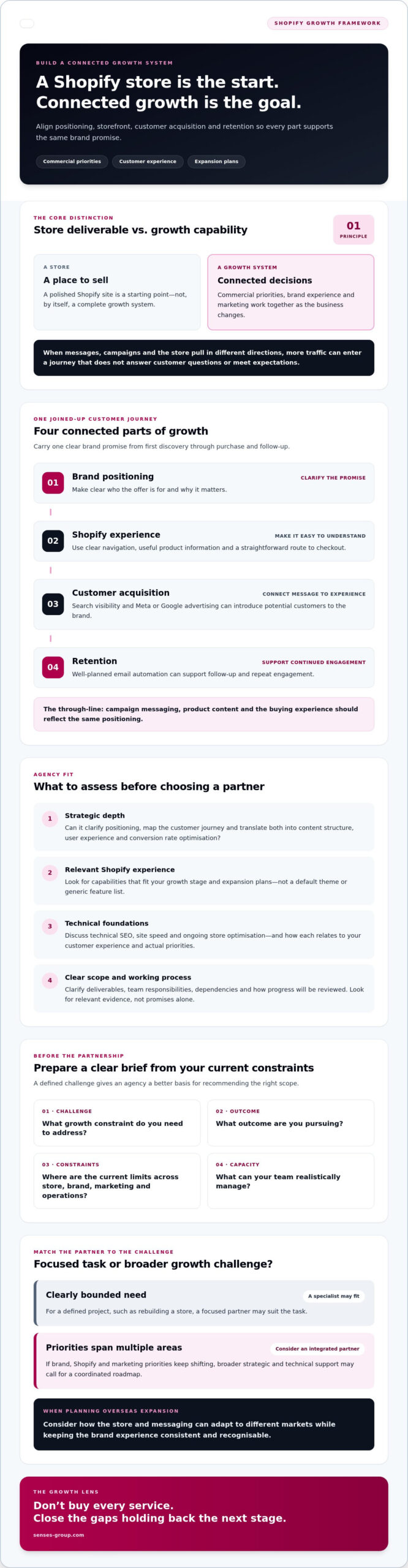
A Shopify store gives a brand a place to sell. On its own, it can’t resolve unclear positioning, inconsistent marketing or a customer journey that loses people before they buy. A Shopify growth agency should connect commercial goals with brand decisions, store experience and marketing execution, so each part supports the same direction.
That joined-up view matters because electronic commerce (e-commerce) involves more than the transaction screen. The brand promise has to carry through from an advert or search result to the product page, checkout and the experience that encourages a customer to return. If these touchpoints contradict one another, adding traffic may simply send more potential customers into a journey that doesn’t answer their questions or meet their expectations.
When does a growing brand need a Shopify agency?
Look for friction, not just an outdated design. Your current store may make it difficult to add products, serve a new market or present the brand consistently. Marketing ownership may also be fragmented, with one team shaping the message, another managing advertising and nobody responsible for connecting those efforts to the store or repeat purchasing.
A defined need, such as rebuilding a store, may call for a focused project. If priorities keep shifting across brand, Shopify and marketing, you may need continuing strategic and technical support instead. Before requesting proposals, write down the constraint you need to address, the outcome you’re pursuing and what your team can realistically manage. This gives agencies a clearer basis for recommending scope, rather than defaulting to a standard package.
What should a Shopify growth partner connect?
Start with the promise. Brand positioning clarifies who the offer is for and why it matters. That should shape campaign messaging, product descriptions, imagery and the expectations set before purchase. Shopify UX then carries that promise into the buying experience. Clear navigation, useful product information and a straightforward route to checkout help customers understand what they’re choosing and what to do next.
Acquisition and retention belong in the same customer journey. Search visibility and Meta or Google advertising can introduce the brand to potential customers, while well-planned email automation can support follow-up and repeat engagement. These efforts work best when their messages reflect the same positioning and lead to a store experience that delivers on the promise.
- Brand: Make the offer and its value clear.
- Store: Carry that clarity through product discovery and checkout.
- Marketing: Connect acquisition messages with the actual buying experience.
- Retention: Give customers a consistent reason to stay engaged.
The right scope depends on your growth stage, internal capacity and priorities, including whether you’re strengthening current sales or preparing for overseas markets. A Shopify agency for growing brands should first understand those conditions, then recommend the capabilities and sequence that fit. The goal isn’t to buy every service. It’s to close the gaps holding your next stage back.
What a Shopify Agency for Growing Brands Should Actually Deliver
A Shopify build is an output. Growth is a capability: the ability to keep aligning your commercial priorities, brand experience and marketing as the business changes. A capable partner makes that connection visible in its scope, showing what it will deliver, who is responsible and how progress will be assessed. If you’re preparing to expand overseas, this also means considering whether your store and messaging can serve different markets without losing a consistent identity.
Which strategic and Shopify capabilities matter most?
Strategy should shape the build, not sit in a separate presentation. Look for a partner that can clarify positioning, map the customer journey and translate both into content structure, user experience and conversion rate optimisation (CRO). Development should respond to your brand and business requirements rather than default to a generic theme or feature list.
Ask how the agency will approach technical SEO, site speed and ongoing store optimisation, and how those activities relate to the customer experience. A fast, well-structured store can support discovery and usability, but technical work should be prioritised against your actual constraints and goals. For example, a brand planning to enter a new market may need to assess its content and store structure before investing in more acquisition activity.
How should acquisition and retention fit the agency scope?
Acquisition channels need a shared direction. SEO and AI Engine Optimisation, paid advertising through Meta and Google, and social activity should reinforce the brand’s positioning and lead to relevant pages, not operate as disconnected workstreams. Ask what each channel is expected to contribute, how its performance will be reviewed and what happens when the evidence points to a change in approach.
Retention belongs in that same plan. Klaviyo welcome, behaviour-based and promotional flows can support different points in the customer lifecycle, provided the messages reflect what customers have seen and done. A Klaviyo abandoned cart strategy is one focused example of how follow-up can connect store behaviour with retention activity.
Translate the proposed scope into responsibilities and indicators that suit your objective. For a store rebuild, agree what the agency will implement and how your team will review the customer journey after launch. For ongoing growth work, clarify who manages each channel, how insights feed into store improvements and when priorities are revisited. The Shopify agency for growing brands you choose should tailor the plan to your stage, not sell a fixed bundle by default.
If you’re comparing integrated support, review how brand strategy, Shopify and marketing capabilities can be brought together around your business goals.
How to Compare Shopify Agencies Without Choosing on Promises Alone
A confident pitch is easy to deliver. A credible agency can show how its thinking, people and work connect to your business challenge. Compare the proposed approach, not just polished designs or headline results. Ask each agency to explain its process from discovery to delivery, who owns each responsibility, what your team must provide and how progress will be reviewed.
| What to compare | Questions to ask |
|---|---|
| Strategic depth | How does discovery become a roadmap, and how will priorities shape scope? |
| Relevant Shopify work | What comparable store challenges have you addressed, and what did the work involve? |
| Implementation scope | What’s included, who is responsible, and what depends on our team or other providers? |
| Post-launch support | How will the store be reviewed and improved after delivery, and how often will we discuss progress? |
What questions reveal an agency’s strategic depth?
Ask how its discovery process informs decisions, rather than accepting a list of workshops or deliverables. Can the team explain how brand strategy will influence store structure, product presentation and marketing messages? How will it define progress against your goals, and what will it do if the indicators move in the wrong direction? Specific answers reveal whether the agency can connect strategy to execution or is relying on broad assurances.
How can you assess case studies and agency fit?
Read case studies for context: the original challenge, work delivered, timeframe and documented outcome. Then consider whether the customer, product and growth conditions resemble your own. A result from a different category or business stage can show experience, but it doesn’t establish what your brand will achieve. Separate what has already happened from projections, and ask how proposed targets will be monitored.
For example, Senses Group reports that Monchhichi Jewelry Atelier’s revenue doubled shortly after its ecommerce rebuild and launch. That is a specific project outcome, not a forecast or a promise of typical results. Ask any agency to clarify the circumstances behind its examples and whether the evidence relates to the same type of work you’re considering.
Fit also depends on the working relationship. Confirm who will lead strategy, manage implementation and communicate decisions, along with any dependencies that could affect timing or scope. A Shopify agency for growing brands should make assumptions and responsibilities clear before work begins, not leave them to emerge mid-project.
Use these criteria to compare proposals against your actual priorities. If you’re exploring how brand and ecommerce work can connect, review Senses Group’s branding and ecommerce approach as one reference point.
How to Prepare for a Shopify Agency Partnership
A productive partnership starts before the first proposal. Define the business challenge, gather evidence, agree the scope and establish how decisions will be reviewed. This gives a Shopify agency for growing brands a clearer basis for recommendations and helps you distinguish a root problem from a preferred solution. You don’t need to arrive with a technical answer. You do need to explain what’s holding growth back.
What should go into an agency brief?
Give agencies enough context to understand your commercial priorities, not just a list of requested features. Summarise your target customers, priority products, current goals and intended expansion markets. Then gather information that can help them assess the situation:
- Store: Relevant analytics, customer journey concerns and known technical constraints.
- Brand: Positioning, identity materials, product information and any messaging guidelines.
- Marketing: Current channel activity, campaign learnings and customer feedback.
- Operations: Practical limits that could affect implementation, such as internal capacity, approval processes or fulfilment considerations.
Separate known facts from assumptions. For example, note whether customers have reported difficulty understanding a product page, or whether that’s a hypothesis based on observed store behaviour. This distinction helps the agency identify what needs investigation instead of treating every initial opinion as a settled diagnosis. If you’re considering overseas expansion, state the markets you’re exploring and what remains uncertain, rather than assuming every market needs the same store setup.
How should you set scope and success measures?
Turn the agreed priorities into clear deliverables, dependencies, responsibilities and review milestones. Confirm who on each side owns decisions, approvals, brand assets, Shopify and marketing data access, and day-to-day communication. Clear ownership prevents avoidable delays and makes it easier to resolve questions as they arise.
Choose indicators that reflect the business objective, without accepting unsupported targets. If the priority is improving the buying journey, conversion may be relevant. If it’s strengthening repeat purchasing, retention measures may be more useful. Agree how the starting point will be understood, when progress will be reviewed and how priorities can change if the evidence points elsewhere. Treat launch dates and sales outcomes as matters to scope and assess, not promises to accept without context.
For connected channel planning, review integrated digital marketing solutions as you define which responsibilities belong in the partnership.
With your challenge, evidence and responsibilities documented, you can compare proposals on fit rather than assumptions. Explore a Shopify and brand strategy partnership to consider how connected support could address your growth priorities.
Choosing a Shopify Growth Partner for the Next Stage
The right partner is defined by fit, not by the length of its service list. Look for relevant experience, a transparent scope, capabilities that address your actual gaps and a working process that makes decisions and responsibilities clear. A Shopify agency for growing brands should explain how its proposed work supports your next business priority, whether that’s strengthening your current store or preparing to enter overseas markets.
When is an integrated agency model a stronger fit?
An integrated partner may be useful when separate brand, store and marketing teams are creating gaps: campaigns promise one thing, product pages communicate another, and retention activity isn’t connected to the customer journey. A coordinated roadmap can clarify how positioning informs the store, how acquisition brings relevant visitors, and how post-purchase communication supports continued engagement.
That doesn’t mean every growing brand needs every service or one provider for all its work. If you have a clearly defined task, such as a specific Shopify improvement, a specialist may be the better fit. If your challenge spans brand strategy, ecommerce and marketing execution, an integrated agency can help coordinate the parts that depend on one another. Decide based on the problem, your team’s capabilities and the support you need after delivery.
Senses Group brings together brand strategy and identity, Shopify development, Klaviyo email automation, SEO and AI Engine Optimisation, and Meta and Google advertising. This is one possible model for connecting brand foundations with store and marketing activity. The appropriate scope still depends on your priorities. A considered partner will shape the work around them rather than assume you need a standard bundle.
What should happen in the first agency conversation?
Bring a concise account of your growth priorities, current constraints and expansion ambitions. Be ready to explain what’s working, where customers or internal teams encounter friction, and which assumptions still need testing. You don’t need a complete technical specification. You do need enough context for both sides to assess whether the challenge matches the agency’s capabilities.
Use the conversation to ask what the agency would need to investigate, what an initial scope might include and how responsibilities could be divided. A credible response should distinguish early observations from confirmed findings. It should clarify the next step, not promise a particular sales result or prescribe a solution before the business context is understood.
If you’re ready to explore the fit, discuss a growth-focused Shopify strategy with Senses Group. Share the constraints you’re facing and the markets you’re considering, then use the discussion to determine whether an integrated approach suits your next stage.
Build the Next Stage Around a Connected Growth Plan
The right Shopify partner should do more than deliver a store. Look for relevant experience, a transparent scope and a clear process for connecting brand foundations with Shopify, customer acquisition and retention. Choose an integrated partner when your growth challenges cross disciplines, but keep the scope focused on the priorities your business actually has.
Senses Group was founded in 2008 and reports more than 18 years of expertise in 2026. The agency also reports managing more than $4 million in advertising spend. For Monchhichi Jewelry Atelier, revenue doubled shortly after its ecommerce rebuild and launch. That’s a specific project outcome, not a forecast or guarantee.
If your store, brand and marketing need a more coherent direction, take the next step with a clear account of your constraints and ambitions. Discuss a growth-focused Shopify strategy with Senses Group to explore potential fit and scope. With the right priorities and partner, your next stage can be built with greater clarity and purpose.
Frequently Asked Questions
What does a Shopify agency do for a growing brand?
A Shopify agency helps a growing brand plan, build or improve its ecommerce store and connect it with relevant brand and marketing work. Depending on the agency’s capabilities and agreed scope, this may include brand strategy, Shopify development, SEO, paid advertising or email automation. A strong partner links those activities to a business objective, such as improving the buying journey or supporting customer retention, rather than treating a store launch as the complete growth plan.
How do I choose a Shopify agency for my business?
Choose a Shopify agency by matching its experience and proposed process to your business challenge. Review case studies for the original context, work delivered and documented outcomes, then ask who will do the work, what your team must provide and how progress will be assessed. A Shopify agency for growing brands should be clear about scope and assumptions. Compare the quality of its reasoning, not just promises or portfolio visuals.
How much does it cost to hire a Shopify agency?
The cost depends on the agreed scope, such as whether you need a defined Shopify project or ongoing support across brand, store and marketing. Complexity, required capabilities, responsibilities and review arrangements can also affect a proposal. Ask for an itemised scope that identifies deliverables, dependencies and what sits outside the work. Avoid comparing quotes by their totals alone. First check that each agency is proposing the same outcomes and responsibilities.
Does a growing brand need Shopify Plus or a Shopify agency?
Shopify Plus is a platform plan; an agency is a service partner. They solve different needs, and a business may use a standard Shopify plan with agency support, choose Plus without hiring an agency, or consider both. Assess platform requirements separately from strategy and implementation needs. Ask what specific Plus capabilities your business would use, and whether their value fits your priorities, before deciding to upgrade.
Can a Shopify agency help a brand expand into overseas markets?
Yes, an agency can help connect your brand positioning, Shopify storefront and marketing plan to the overseas markets you’re considering. Ask how it would assess market-specific messaging, product presentation, customer journey and acquisition channels while preserving a consistent brand identity. Clarify which tasks the agency will handle and which depend on your team or other providers. Don’t assume a store launch alone addresses every market’s commercial or operational requirements.
What should I prepare before contacting a Shopify agency?
Prepare a concise brief covering your growth goals, target customers, priority products, intended markets and main constraints. Gather relevant store analytics, customer feedback, brand materials and an overview of current marketing activity. Note what’s confirmed and what still needs investigation. It also helps to identify who can approve decisions, provide assets or access, and coordinate communication. You don’t need a technical solution in advance; a clear business challenge is more useful.