
A brand is not what a business says it is; it’s what people come to believe through every interaction. For Hong Kong SMEs and startups, brand perception management means understanding those beliefs and using them to shape a more consistent experience, from the first social post or product review to the online store and the purchase itself.
Customers judge more than a product’s features. They notice whether a brand feels trustworthy, clear and relevant, and those impressions can influence whether they buy, return or recommend it. The challenge is turning scattered opinions into useful direction, especially when growing locally and reaching customers overseas.
This article explains what brand perception means and how to assess it in practice. You’ll learn how social listening and media analysis reveal conversations about your brand, what reviews and ratings show about customer experience, and how surveys uncover the gap between the impression you intend to create and the one people actually hold.
Key Takeaways
- Separate awareness, favourability and consideration to see whether people know your brand, feel positively about it and would consider buying.
- Use social listening and media analysis to spot recurring themes, shifts in sentiment and conversations that call for a response.
- Review ratings and customer comments for patterns that reveal where the experience strengthens trust or creates friction.
- Use focused surveys to track how customers perceive your brand over time and identify gaps between intended and actual impressions.
- Align your brand identity and customer touchpoints so your business presents a clear, consistent impression across local and overseas markets.
1. What is brand perception?
Brand perception is the opinion people form through what a business says and does. For a Hong Kong online retailer, it develops across a product page, checkout, delivery updates and customer support. Each touchpoint can reinforce or weaken trust. Reputation is the broader result of those repeated impressions, not simply the message a business publishes.
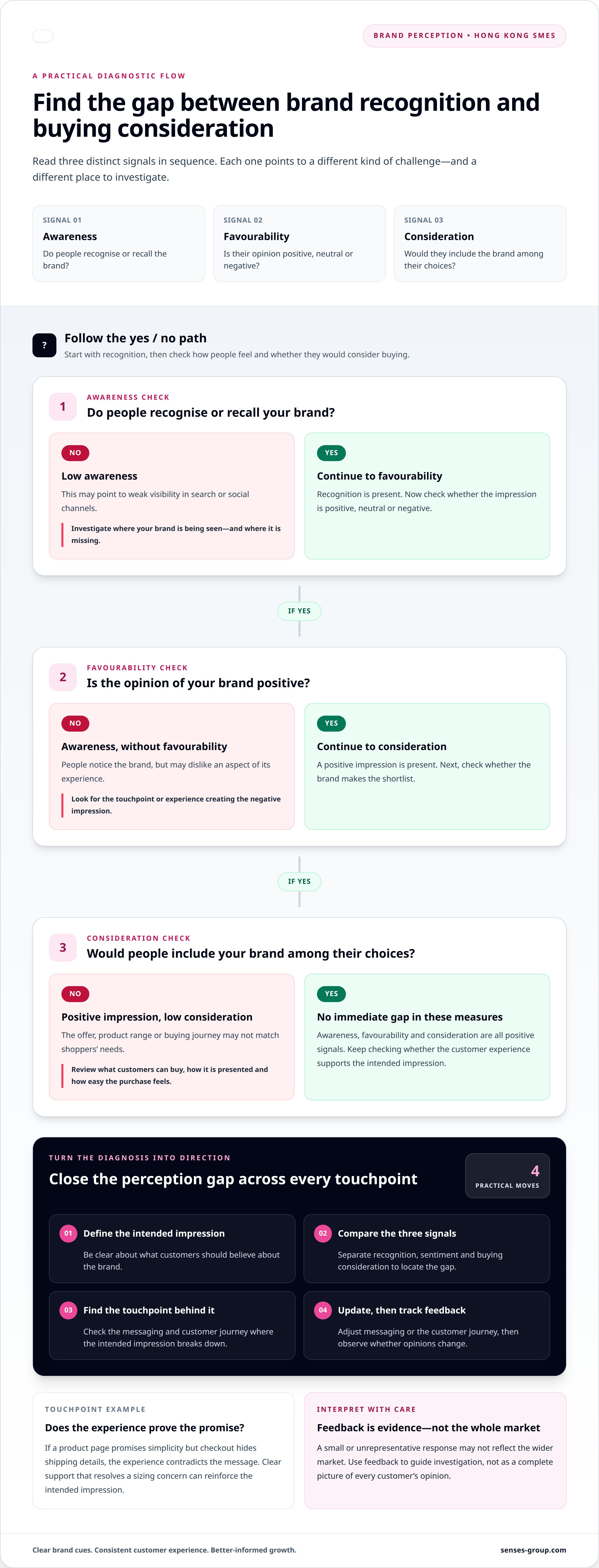
Three measures help define how people relate to a brand. Awareness shows whether they recognise or recall it. Favourability captures whether their opinion is positive, neutral or negative. Consideration indicates whether they would include it among their choices. For example, shoppers may recognise a local skincare label but favour another brand because its ingredients and delivery information are clearer.
These measures reveal different problems. Low awareness may point to weak visibility in search or social channels. Strong awareness with low favourability can suggest that customers notice the brand but dislike an aspect of its experience. Positive favourability with low consideration may indicate that the offer, product range or buying journey does not match shoppers’ needs. Comparing these signals gives perception management a practical direction.
Consistent messaging makes that direction recognisable. A brand selling Hong Kong-designed home goods might tell the same story about local design, careful materials and everyday use across its Shopify store, social profiles and packaging. The wording can adapt to each channel, but its central promise should remain stable. In overseas markets, clear language and relevant context help explain the offer without changing what the brand stands for.
Identity turns the promise into cues customers can recognise. Define the brand’s values, mission and unique selling proposition before applying its name, visual style, tone and product descriptions. Shared templates for product pages, campaign emails and social posts help teams maintain consistency as they add markets and sales channels. Without that foundation, different touchpoints can present competing versions of the same business.
Customer experience tests whether the story is credible. If a product page promises simplicity but checkout hides shipping details, the experience contradicts the messaging. If support clearly resolves a sizing concern, that interaction can strengthen the intended impression. Brand perception is shaped by the full journey, so storytelling must be supported by practical details and reliable communication.
To improve perception, define the intended impression, compare awareness, favourability and consideration, then identify the touchpoints creating a gap. Update the messaging or customer journey, and track feedback to see whether opinions change. Keep the limits in mind: monitoring cannot control every opinion, and a small or unrepresentative response may not reflect the wider market. Treat feedback as evidence to interpret, not a complete picture.
2. Measuring perception through social listening and media analysis
Social listening captures public conversations about a brand across social media and other online channels. It helps identify what people discuss, how they feel, and which topics shape their opinions. For a Hong Kong retailer, that might mean tracking comments about product quality, delivery updates, or a new campaign. These conversations add context that sales figures alone cannot provide.
Start with a focused listening plan. Choose the brand name, product names, common misspellings, campaign terms, and relevant category phrases. Then decide which channels matter, such as public social posts, forums, blogs, or online news. A Hong Kong business expanding overseas should include the names and terms customers use in each target market, rather than relying on one language.
Measure sentiment alongside conversation themes. A rise in positive mentions may accompany a product launch, while repeated complaints about unclear sizing can signal friction. Read the examples behind each sentiment label: automated analysis may misunderstand sarcasm, slang or Cantonese-English code-switching. Treat the label as a sorting aid, then interpret the original post and its context before drawing conclusions.
Media analysis broadens the view beyond social platforms. Track coverage and references in public articles, blogs, and industry discussions, then assess the language used to describe the business. For example, a Hong Kong accessories brand might find that local coverage highlights design, while overseas commentary focuses on shipping clarity. That difference can reveal where messaging needs stronger market-specific context.
Choose a monitoring setup that matches the channels and decisions the business needs to support. Native social media analytics can help assess activity on owned accounts; social listening and media monitoring tools can capture wider public mentions, filter themes and report sentiment. Costs vary by coverage, data history, user access and analysis features. Compare capabilities with the questions the business needs answered, not just a long feature list.
Turn observations into a repeatable review. Group mentions by theme, market, channel, and tone, then record examples that support each finding. Prepare monthly theme reports to distinguish a recurring issue from a brief reaction to one campaign. For instance, repeated questions about overseas delivery may point to missing information across product pages and campaign posts.
Listening has limits: public posts do not represent every customer, and a burst of comments may not reflect lasting perception. Combine volume with context, and use recurring themes to guide further investigation. If those patterns expose a gap between intended positioning and public opinion, a clearer brand strategy can help align the message across markets.
The right tools cover the channels and markets a business needs to monitor, capture relevant public mentions, and support theme and sentiment analysis. Native social analytics can complement them for owned accounts. Costs vary according to coverage, data history, user access and analysis features.
3. Online reviews and ratings
Online reviews give customers a public place to describe what happened, not just what they expected. A Hong Kong skincare shop might receive praise for product texture but criticism about unclear delivery updates. Ratings summarise reactions, while written comments explain the reasons behind them. Together, they offer practical insights into how the audience experiences the brand’s promises.
Monitor review platforms relevant to your business and markets, then group comments by theme. Common categories include product performance, packaging, payment, delivery, returns and support. Compare recurring themes with the values your brand communicates. If a company promises simplicity but customers repeatedly mention confusing checkout steps, the experience and message are misaligned.
Reviews are only one source of feedback. Combine review analysis with short customer surveys, support conversations and direct interviews to understand both recurring issues and their context. To measure perception, compare survey responses, social listening themes and review sentiment over time, then segment findings by channel or market. For example, overseas customers may comment on product information while local reviewers focus on service.
Respond to criticism with a clear process. Acknowledge the specific concern, show that you understand its effect, and explain the next action when appropriate. If a buyer reports a damaged item, a useful public response recognises the problem without exposing order details. Move personal case information to a private channel, then address the underlying cause internally.
A negative review is not automatically a crisis. Look for patterns, severity and spread. One complaint about a delayed parcel calls for a case response; repeated reports of a misleading product description may require changes to the listing and campaign messaging. During a wider issue, keep statements consistent, share confirmed updates, and avoid speculation or defensive replies.
For Hong Kong feedback collection, use a privacy-conscious process: explain why information is requested, collect only what is needed, and restrict access to customer details. Get permission before using identifiable comments in marketing, and keep review-based advertising accurate. For campaigns involving customer data or endorsements, consider the applicable privacy and advertising requirements before publication.
Build a review routine that turns comments into decisions. Record the theme, channel, market, sentiment and response, then note whether the issue recurs. For instance, several questions about overseas sizing could prompt clearer measurements on product pages. This makes feedback actionable without treating every individual opinion as a complete picture of the audience.
Decide whether feedback calls for a reply, a service fix or a change to the information customers see. Monitoring online reviews can help companies understand how customers perceive their brand and identify feedback that needs a response. Brand surveys can gather customer feedback and reveal how customers perceive the brand.
Assess perception by reviewing recurring feedback, how people describe the brand, what they believe it does well, and which interactions strengthen or weaken trust. Companies can improve brand perception by responding promptly to customer concerns and complaints.
4. Brand perception surveys
A survey captures what customers think at a defined moment, rather than inferring opinion from behaviour alone. For a Hong Kong ecommerce business, ask about awareness, quality, trust, value and likelihood to recommend. Keep each question focused on one idea. A customer who rates product quality positively but delivery communication poorly reveals a specific gap to investigate.
Begin with a clear decision. If the question concerns brand identity, ask which words or qualities people associate with the business. If it concerns a campaign, ask whether respondents recall it and what message they took away. Include an open-ended prompt, such as asking people to describe the brand in a few words. Unprompted answers can reveal associations a rating scale misses.
Use a consistent set of questions for brand tracking. Quarterly surveys make it possible to compare the same perception dimensions over time, provided the audience and wording remain comparable. Net Promoter Score measures loyalty by asking how likely customers are to recommend the brand on a scale from 0 to 10. A separate trust question can use a 1-to-10 scale, with a clear description of what each end means.
Interpret results alongside customer comments, review themes and social mentions. A more positive survey response may reflect a campaign’s immediate effect, while written answers show whether people understood the intended message. Compare findings across customer groups and markets where the sample allows. For example, Hong Kong shoppers and overseas buyers may recognise the same product but interpret its value proposition differently.
To compare perception with competitors, ask respondents about your brand and relevant alternatives using the same attributes, wording and audience. Competitive benchmarking twice a year can reveal relative positioning, such as whether your brand is associated more strongly with convenience or design.
Survey quality depends on question design and who responds. Leading wording can push answers towards a positive impression, while feedback from only highly engaged customers may miss quieter audiences. Keep questions neutral, avoid asking several things at once, and review how responses were collected. For a new overseas market, adapt examples and language so the questions remain clear without changing the measurement goal.
Turn findings into a decision, not just a dashboard. Identify the strongest perception gap, connect it to a customer touchpoint, and assign a practical change. If respondents value product craftsmanship but cannot recognise it in the online store, strengthen the relevant descriptions and visuals. Track the same measure in the next survey to see whether the intended association is becoming clearer.
Brand tracking gives businesses a structured way to test whether messaging and experience support the intended identity. Survey evidence is not the whole picture, but consistent questions can show where perception is shifting and which decisions deserve closer attention.
5. Brand perception, awareness and identity
Brand identity is what a business deliberately communicates; perception is what people conclude. Awareness is whether the public recognises or recalls the brand. These measures connect, but they are not interchangeable. A Hong Kong fashion label can have strong name recognition while customers still question its quality or value.
That distinction changes how teams interpret metrics. Reach and branded searches can indicate visibility, while consideration and customer feedback reveal whether recognition is influencing choice. Website traffic, bounce rates and engagement can add clues about online experience, but no single metric explains perception. A spike in visits after a campaign, for example, does not prove visitors understood the brand or formed a positive opinion.
Identity provides the intended signals: the brand’s values, purpose, visual language and tone. Perception develops as people encounter those signals through product pages, packaging, social posts and service interactions. If a Hong Kong homeware business presents itself as refined online but uses inconsistent imagery and unclear product descriptions, each touchpoint can create a different impression.
Social listening helps reveal how people describe the brand in public conversations. Compare those words with the qualities the business intends to own. If customers repeatedly mention convenience, but the brand aims to be known for craftsmanship, the gap calls for investigation. It may reflect weak storytelling, an experience that overshadows the product, or positioning that does not connect with customer priorities.
Negative perception can influence purchase decisions, reviews and recommendations. A recurring complaint about unclear overseas delivery information, for instance, may affect trust beyond the original customer. Trace the issue to its source before changing the identity itself. The problem may sit in a practical touchpoint, not the underlying brand promise.
To assess whether advertising shifts perception, a brand lift study compares people exposed to a campaign with a matched group who were not exposed. This helps distinguish campaign influence from broader changes in the market. Interpret results alongside awareness, consideration and customer comments, rather than treating ad engagement as proof of lasting brand change.
Perception takes time to move. Allow six to 12 months to assess meaningful movement, and keep the core questions and audience definitions consistent. That period helps separate a short-lived reaction from a more durable shift across customer touchpoints and markets.
The practical takeaway is to align identity, experience and measurement. Define the intended association, find where real interactions contradict it, and improve the relevant touchpoint before rewriting the whole story. For a clearer foundation, develop a more coherent brand identity that customers can recognise across channels.
Perception includes how customers and non-customers view a brand, including opinions about its quality, integrity and values. These impressions form through contact with digital assets, physical products and interactions with people.
Measure perception with social listening, media analysis, surveys and polls, review tracking and direct interviews. Companies should monitor it regularly and address issues that may harm the brand’s image. Nielsen reports that a one-point gain in brand metrics such as awareness and consideration drives a 1% increase in sales. Consumers with a positive perception are more likely to purchase, recommend the brand and become loyal customers.
Senses Group
Senses Group helps businesses turn customer perception insights into a clearer, more consistent brand experience. When feedback reveals a gap between the impression you want to create and what customers experience, Brand Strategy and Brand Identity Design can clarify your positioning and strengthen how it appears across customer touchpoints.
For businesses scaling through ecommerce, an Ecommerce Shopify Store and Klaviyo Email Automation can carry that direction into the shopping journey and customer communications. This connected approach is useful when local and overseas audiences encounter different parts of your brand but need to understand the same core promise.
Contact Senses Group to discuss how your brand can better align its intended identity with customer experience.
Make the next brand decision deliberate
Strong brands grow through deliberate choices, not constant reaction. Turn what you have learned into one clear priority: clarify the promise, strengthen a customer touchpoint, or adapt communication across markets. Effective brand perception management starts by choosing the issue with the strongest evidence and the closest connection to customer experience.
Give that decision a clear owner and a way to assess its effect. This keeps brand perception management connected to real business choices, rather than isolated reports or shifting opinions without direction. For a Hong Kong SME expanding through ecommerce, a consistent brand foundation helps local and overseas customers understand what the business stands for, even as channels and audiences differ.
You don’t need to change everything at once. Focus on the gap that matters most, make the response consistent, and let customer understanding guide the next decision. Discuss your brand’s next step with Senses Group, and move forward with greater clarity.
Frequently Asked Questions
What is brand perception?
Brand perception is the overall impression people hold about a business, shaped by their expectations and experiences. For example, a first-time shopper may judge an online store through its product descriptions, checkout clarity and post-purchase communication. Impressions can differ between customer groups, so consider how local and overseas buyers interpret the offer rather than assuming one audience’s view represents everyone.
What are the best tools for brand perception monitoring and how much do they cost?
Use social listening and media monitoring tools to capture public mentions, filter themes and assess sentiment; native social analytics can complement them for owned accounts. Costs vary by coverage, data history, user access and analysis features.
How does brand perception management differ from reputation management and brand management?
Brand perception management focuses on understanding people’s beliefs and improving the experiences that shape them. Reputation is the broader result of repeated impressions, while brand identity provides recognisable cues such as values, visuals and tone; the article does not define brand management separately.