
AI should sharpen marketing decisions, not make them on autopilot. For Hong Kong SMEs and startups, AI driven marketing solutions can help analyse customer behaviour, identify patterns in market data, personalise customer interactions and inform strategy across local and overseas ecommerce markets. Their value depends on how well they connect to clear business goals and reliable data.
It’s understandable to see AI as a way to save time and scale marketing with a lean team. But automation alone won’t fix unclear positioning, fragmented customer data or messaging that misses what buyers value. Human judgment remains essential for interpreting insights, spotting potential bias and keeping the brand’s voice consistent.
This guide explains how AI can support marketing research, analysis, customer interactions and strategic planning, and why integration, data hygiene and human oversight matter. You’ll learn how to assess use cases, build a practical roadmap and connect AI with a stronger brand and ecommerce experience.
Key Takeaways
- Use AI to identify patterns in customer and campaign data, while keeping records accurate enough to support sound decisions.
- Apply automation where it can improve marketing workflows and customer interactions, not as a substitute for a coherent brand experience.
- Build human review into AI-assisted work to catch biased outputs, protect trust and keep messaging aligned with your strategy.
- Assess your goals and existing platforms before integrating tools, then introduce and measure changes in a deliberate sequence.
- Connect research, brand positioning, ecommerce and customer follow-up so your marketing can support growth in Hong Kong and overseas markets.
AI-assisted marketing research and data analysis
AI can help Hong Kong businesses turn customer, campaign and sales data into research they can act on. Start with a defined decision, such as improving repeat purchases, then use analysis to guide the next step.
Predictive Customer Segmentation
Predictive analytics groups customers by likely future behaviour, not just past purchases. For example, an ecommerce business can distinguish first-time buyers from customers who may be ready to reorder, then tailor campaigns to each group.
Review the signals behind each segment, such as purchase history, browsing behaviour or email engagement. Duplicate or outdated records can misrepresent customers and weaken targeting.
Customer Insights and Decision-Making
Predictive analysis can connect customer activity with possible next actions. A retailer, for example, could use product-page visits and previous orders to identify items worth featuring in an upcoming campaign.
Use the output to compare options, not to treat a forecast as a customer’s confirmed intention. Check that a suggested action fits the business goal, then assess it against actual customer responses.
Tool Comparisons, Costs, and Campaign Metrics
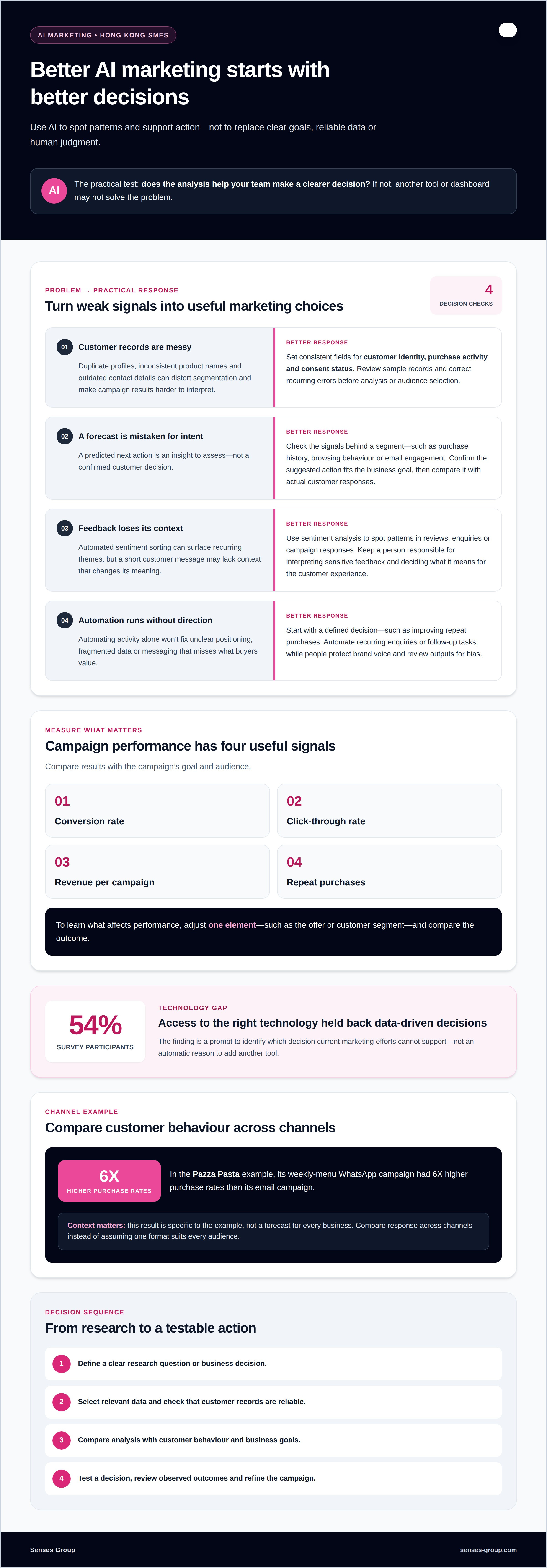
Traditional marketing tools often organise activity or report results. AI-enabled platforms can also detect patterns and assist with predictions. The practical test is whether that analysis helps your team make a clearer decision, rather than just adding another dashboard.
AI marketing tools have no single fixed cost in Hong Kong. Pricing depends on the platform, features, contact volume, integrations and subscription model, so compare total costs against the processes the tool can support.
To assess campaign performance, track conversion rate, click-through rate, revenue per campaign and repeat purchases. Compare results with the campaign’s goal and audience, then adjust one element, such as the offer or customer segment, to learn what affects performance.
Sentiment Analysis and Workflow Automation
Sentiment analysis sorts customer comments by tone or recurring themes, helping teams spot concerns across reviews, enquiries or campaign responses. Repeated questions about delivery, for example, may signal that product-page information needs clarification.
Automation can route recurring enquiries or organise follow-up tasks. Keep a person responsible for interpreting sensitive feedback, since a short message may lack context that changes its meaning.
Data Quality for Reliable Analysis
Before relying on a forecast, review how customer records enter your platforms. Duplicate profiles, inconsistent product names and outdated contact details can distort segmentation and make campaign results harder to interpret.
A practical first step is to define consistent fields for customer identity, purchase activity and consent status. Review sample records and correct recurring errors before using them for analysis or audience selection.
Research That Leads to Action
One market finding illustrates the technology gap: 54% of survey participants reported that lack of access to the right technology held back data-driven decisions. For a small business, the answer is not automatically another tool; first identify which decision current marketing efforts cannot support.
Set a clear research question, select relevant data and compare the analysis with customer behaviour. This sequence helps teams turn predictive insights into testable decisions, then refine campaigns based on observed outcomes.
AI applications across marketing, sales and customer service
AI can connect marketing, sales and customer service around the same customer journey. For a Hong Kong ecommerce business, that might mean tailoring product messages, prioritising enquiries and learning from customer responses across campaigns.
Customer Engagement Across Channels
AI tools can schedule social posts and email campaigns, then organise responses for follow-up. A small retailer launching a product could use engagement signals to see which audience responds to each message, then refine the next campaign’s timing or content.
The Pazza Pasta example illustrates how channel choice can affect response: its weekly-menu WhatsApp campaign had 6X higher purchase rates than its email campaign. That result is specific to the example, not a forecast for every business. For Hong Kong brands, the useful lesson is to compare customer behaviour across channels rather than assume one format suits every audience.
Personalisation Across the Customer Journey
Personalisation works best when each interaction reflects a relevant customer signal. An online shop could show complementary products after a purchase, then send a follow-up email based on items viewed or ordered. AI can help select content and timing, while the business decides which recommendations fit its brand and commercial goals.
Map the journey from product discovery to repeat purchase. A visitor who browses a product but leaves without ordering may need useful product information, while an existing customer may respond better to a related item. Tailored experiences should clarify the next step, not overwhelm customers with repeated prompts.
Sales Support and Lead Prioritisation
AI can score leads using interaction signals, such as product-page visits or responses to campaign messages. A sales team can prioritise follow-up for people showing stronger interest instead of treating every enquiry as equally urgent. Define meaningful engagement and review whether those signals align with completed purchases.
Predictive A/B testing can help compare campaign variations, such as different subject lines or offers. Use the results to guide learning, but keep human review for pricing, product claims and brand tone. A forecast may suggest which version could perform better; observed customer behaviour should inform the final decision.
Customer Service for Ecommerce
AI assistants can answer common questions about product details, ordering or store policies, while sentiment analysis can flag frustrated messages for human attention. Automated ticket prioritisation helps teams address urgent issues before routine enquiries. A customer reporting a payment problem, for example, should be routed differently from someone asking about product availability.
Set clear boundaries for automated responses. An assistant should provide approved information and hand complex or sensitive situations to a person. This keeps service useful without allowing a fluent but inaccurate answer to damage customer trust.
These applications work best when the store, messaging and customer journey reinforce one another. A connected ecommerce customer experience gives each interaction a clearer role, from discovery through post-purchase engagement.
Challenges including bias and over-reliance on automation
Automation can speed up repetitive marketing processes, but speed doesn’t guarantee sound judgment. A model trained on incomplete customer records may favour familiar buyers and overlook emerging audiences. A retailer expanding overseas, for example, could keep marketing to established customers while missing signals from new markets.
Bias can enter through historical data, audience definitions or assumptions built into a task. Review who appears in a recommended segment, which behaviours shaped the recommendation and whether the result serves the campaign goal. Test messaging with different customer groups before scaling it, then revise criteria if results reveal a blind spot.
Trust also depends on how automation feels to customers. In a customer survey cited by the research, 68% said advances in AI make it more important for companies to be trustworthy. A generic reply to a sensitive complaint can undermine that trust, even if an automated system responds faster than a person.
For Hong Kong businesses, marketing automation can personalise email or social campaigns using customer behaviour, such as product views or past orders. Keep sensitive information protected, define appropriate data inputs, and use human review for messages that affect customer expectations. Personalisation should make a relevant offer clearer, not make people feel watched.
AI agents can assist with repetitive work, including drafting campaign variations, sorting enquiries and preparing performance summaries. Set clear boundaries: use approved brand information, avoid unsupported product claims and route complex customer situations to a person. A fluent response is not proof of an accurate one.
There is no single AI marketing platform that suits every business. Common categories include email automation for audience segmentation and campaign workflows, advertising platforms for targeting and optimisation, and analytics tools for identifying patterns. Choose features to suit the task and your existing systems, rather than adopting tools for breadth alone.
Implement automation in a controlled sequence. Start with one repetitive, measurable process, such as organising email follow-ups, and map how customer data moves between platforms. Test the workflow in a limited campaign, review outputs and customer responses, then expand only when the integration and review process work reliably.
Human oversight should be part of the process, not an emergency fix. Assign responsibility for reviewing generated content, segment criteria and automated responses. Compare campaign outcomes with the original objective, and pause a workflow if it produces irrelevant messages or treats distinct customers as interchangeable.
Used with clear limits, AI-driven automation can enhance execution without taking over strategy. Keep people accountable for decisions, protect sensitive information, and let customer feedback shape ongoing learning. That balance helps Hong Kong SMEs scale marketing across local and overseas ecommerce audiences without making the experience feel impersonal.
Integration, data hygiene and preserving the human touch
AI tools are only as useful as the marketing workflows and data they can access. A Hong Kong ecommerce business might hold orders in its store, customer messages in email, and campaign results across advertising channels. If these systems use different customer fields, analysis can fragment the journey and obscure what drives a purchase.
Start with a workflow audit. Map how a customer moves from an advertisement to a product page, checkout and follow-up message. At each step, identify which platform captures the activity, who owns the data and where staff repeat manual work. This shows whether integration can resolve a real bottleneck or simply add another layer.
Data hygiene starts with consistent definitions. Decide, for example, whether “repeat customer” means a second order or a subscription renewal, then apply that definition across reports. Standardise product names, customer identifiers and campaign labels before using predictive analytics. Otherwise, one buyer or product may appear as several records, weakening targeting and marketing intelligence.
Review the infrastructure behind each connection. Confirm that the ecommerce platform, analytics tools and campaign systems pass the fields needed for a specific task. If an abandoned-cart workflow needs product and contact details, test a sample journey from browsing to message delivery. Record failed handoffs and correct them before expanding automation to other channels.
Data governance sets clear boundaries for these processes. Define which information each team may use, why it is needed and how long it should remain available. Protect sensitive information when using AI, and follow applicable consumer data regulations. For overseas campaigns, account for the markets targeted and the data practices relevant to those customers.
Access controls matter, too. Limit staff and tool permissions to the information needed for their tasks. Keep a record of the data sources used by an AI feature, and document who reviews its outputs. These measures make it easier to trace unexpected recommendations back to their inputs.
Preserving the human touch means designing workflows around meaningful judgment. An automated welcome message can handle a routine first contact, while a staff member responds to a complaint or unusual order request. Set escalation rules for unclear intent, negative feedback and account-specific questions, so customers are not trapped in an automated loop.
Finally, measure whether integration improves the underlying process. Compare manual corrections, missing records and unresolved handoffs before and after a workflow change. If recommendations still rely on inconsistent data, pause expansion and repair the source fields. Reliable intelligence comes from connected systems, clear governance and people who understand the customer context.
AI marketing strategy and roadmaps
A useful AI roadmap starts with a business decision, not a platform shortlist. For a Hong Kong ecommerce startup, the priority might be improving product-page conversion, retaining existing customers or preparing campaigns for overseas markets. Each goal calls for different data, workflows and measures of success.
SmartFinds recommends evaluating current marketing efforts before selecting applications that fit business goals and resources. Map the customer journey from discovery to purchase, then identify where a decision is slow, inconsistent or unsupported by evidence. This reveals whether AI could improve efficiency or simply automate a process that needs redesign.
Set a baseline before making changes. If the goal is conversion, record how the relevant landing page or campaign performs now. If the goal is efficiency, document the manual steps involved in producing or reviewing a campaign. These starting points help the team judge whether an AI-assisted process delivers a meaningful operational improvement.
For Hong Kong businesses choosing a solution within budget, compare the tool’s subscription and operating costs with the specific workflow it supports. Prioritise platforms that fit existing systems and address a defined need, rather than paying for capabilities the team won’t use. The right choice depends on the goal, data readiness, integration requirements and available staff time.
Build the roadmap in manageable stages:
- Define the outcome. Choose a clear objective, such as improving a campaign’s conversion rate or reducing repetitive reporting.
- Assess readiness. Review existing platforms, available customer data and the team’s ability to interpret results.
- Select one application. Start with a focused task, such as forecasting campaign demand or drafting content for human review.
- Measure and refine. Compare results with the baseline, identify what changed, and adjust the process before expanding.
Some AI-powered improvements can be introduced quickly, while broader initiatives require planning, integration and ongoing optimisation. A campaign-content workflow may be easier to test than a system connecting ecommerce, customer records and advertising data. Sequence work according to dependencies, not excitement about the latest feature.
Forecasts can inform decisions, but shouldn’t replace strategic judgment. A predicted rise in interest for a product, for example, can guide campaign planning while a marketer checks stock, positioning and customer relevance. Use AI to assist with decisions, and keep people accountable for what the brand promises and delivers.
For paid acquisition, connect Meta and Google advertising to a defined marketing strategy, landing page and conversion measure. For organic growth, AI should complement strategic SEO and content development, not replace them. Each channel needs its own role, audience and evaluation method.
Turn your priorities into a practical marketing strategy and AI roadmap that connects goals, platforms and measurable outcomes.
Senses Group
Senses Group helps Hong Kong SMEs connect marketing decisions with a clear brand and ecommerce foundation. When AI insights point to a need for sharper positioning, a more consistent identity or a better-connected customer journey, its work across Brand Strategy, Brand Identity Design, Shopify ecommerce stores and Klaviyo email automation can support that next step. The focus is not on adopting AI for its own sake. It is on ensuring the brand, store and customer communications work together as the business grows locally or expands into overseas markets. This is a practical fit for businesses ready to turn research and strategic priorities into a more coherent customer experience. To discuss how your marketing and brand foundations can support growth, contact Senses Group.
Make Your Next Marketing Decision Count
The next advantage won’t come from adding AI to every workflow. It will come from choosing a decision that matters to your business, then building a disciplined learning cycle around it. Select one customer or commercial outcome, assign someone to interpret the results and decide how those insights will shape your next move.
That focus helps AI driven marketing solutions contribute to a stronger market position, rather than becoming another disconnected tool. For Hong Kong businesses expanding through ecommerce, the strategic opportunity is to make every customer interaction reinforce why the brand deserves attention and trust.
Senses Group can help align your brand and ecommerce foundations with your growth direction. Contact Senses Group to discuss the next step for your business.
Build with intention, learn from real customer behaviour and let each decision create a stronger foundation for what comes next.
Frequently Asked Questions
What is AI used for in marketing?
AI helps marketing teams interpret information and carry out defined tasks. A retailer, for example, can use it to draft alternative product descriptions, identify themes in customer reviews or organise campaign reports for review. A marketer still decides which claims are accurate, which insights matter and whether the language fits the audience. AI is most useful as support for informed work, not as a replacement for the person responsible for the brand.
What are AI-driven marketing solutions?
AI-driven marketing solutions are tools or processes that apply artificial intelligence to marketing tasks, from analysing customer activity to assisting with campaign content. They may work within existing advertising, ecommerce, analytics or email platforms, or connect several systems. The term describes a capability, not a complete marketing strategy: businesses still need clear positioning, suitable customer data and people who can turn outputs into relevant decisions.
What steps are involved in implementing AI-driven marketing?
Begin by naming the business problem and assigning a team member accountability for the outcome. Choose one contained task, such as preparing product descriptions for editorial review, and record how it is handled today. Set rules for approved inputs, human sign-off and error handling before connecting a tool. After a pilot, review usefulness, accuracy and staff workload, then decide whether to adapt, extend or stop the workflow.
What are the risks and limitations of AI marketing, including bias and inaccurate content?
AI can produce confident but incorrect claims, reflect imbalances in its inputs or miss context a person would recognise. A product description might invent a material detail, while an audience model could repeatedly favour customers represented in older records. Reduce these risks by checking claims against approved product information, reviewing outputs across customer groups and escalating uncertain or sensitive content to a responsible person before publication.
What are the leading AI marketing platforms and their features?
AI marketing tools can automate email campaigns and social media schedules, score leads using customer behaviour, run predictive A/B tests, analyse sentiment and prioritise customer-service tickets. When comparing options, assess their fit with your channels, data needs, review controls and budget.