
A smoother sales funnel doesn’t begin with more traffic. It begins with removing the points of friction that stop the right customers from moving forward. For Hong Kong SMEs and startups, effective online sales funnel optimization connects brand messaging, product discovery, checkout and follow-up into one clear customer journey, whether you’re selling locally or preparing to reach overseas markets.
It’s easy to focus on the final purchase and assume more advertising will solve a conversion problem. But when customers encounter unclear offers, a disjointed store experience or messages that don’t match their needs, extra traffic may simply expose the same weaknesses at greater scale.
This article explains how to assess conversions between funnel stages, qualify leads and strengthen the customer journey. It also explores how a digital sales experience can make each next step clear and consistent, from a visitor’s first interaction with your brand to purchase and beyond.
Key Takeaways
- Track how visitors progress between funnel stages to identify where interest drops, then assess whether the issue is lead fit, messaging or the next step.
- Match content to customer intent, from early discovery through evaluation and purchase, so each interaction answers a relevant need.
- Strengthen revenue by improving the journey between stages, not just increasing traffic at the top of the funnel.
- Connect awareness, consideration, decision, retention and advocacy into a consistent experience that supports repeat business and recommendations.
- Design a digital buying experience with clear navigation, useful information and an easy path to purchase, especially for customers exploring your brand from Hong Kong or overseas.
1. Stage-to-stage conversion rates and lead qualification
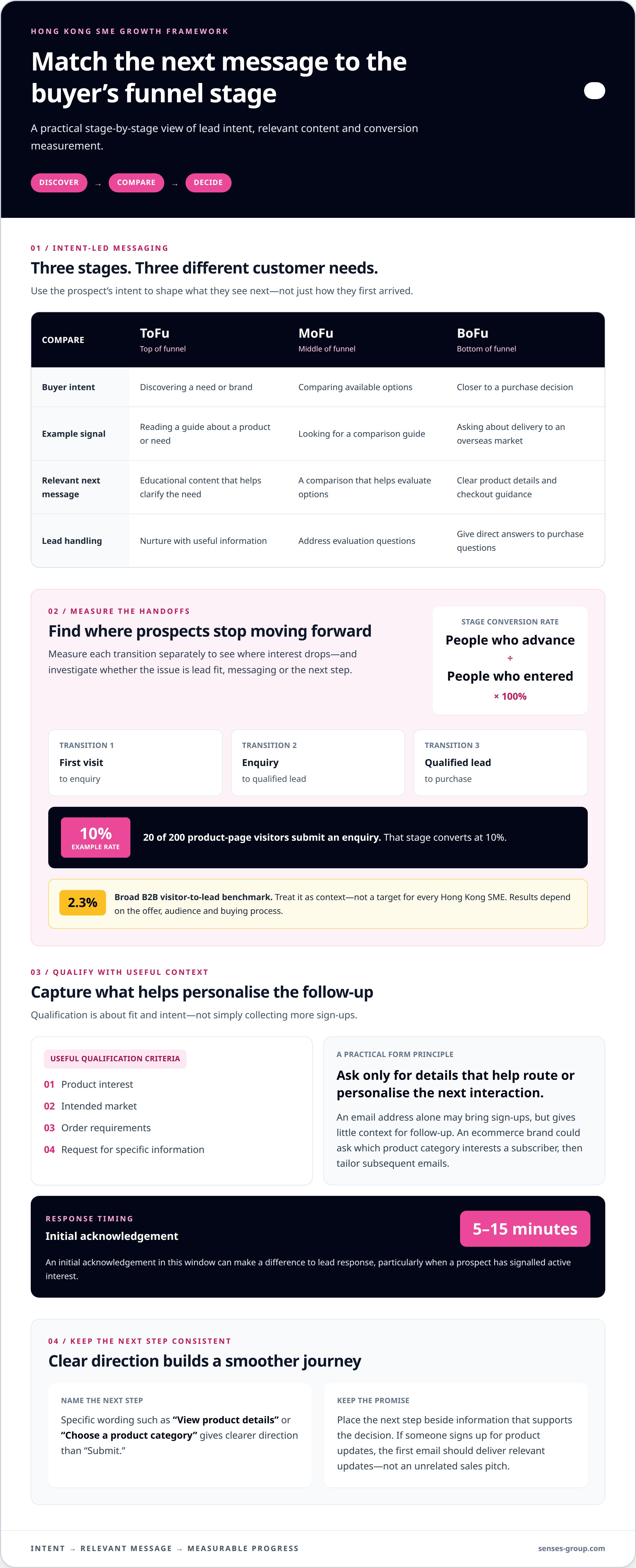
Conversion rates show where prospective customers move forward and where they leave. Measure each transition separately, from first visit to enquiry, from enquiry to qualified lead, and from qualified lead to purchase. Calculate a stage conversion rate by dividing the number who advance by the number who entered that stage, then multiplying by 100%. For example, if 20 of 200 product-page visitors submit an enquiry, that stage converts at 10%. A broad B2B benchmark puts visitor-to-lead conversion at 2.3%, but your own results depend on the offer, audience and buying process. Treat the figure as context, not a target for every Hong Kong SME.
Classify prospects by intent, not just by how they arrived. Top-of-funnel (ToFu) audiences are discovering a need or brand; middle-of-funnel (MoFu) audiences are comparing options; bottom-of-funnel (BoFu) audiences are closer to a purchase decision. Someone reading a guide is likely at an earlier stage than a shopper asking about delivery to an overseas market. Match the next message to that signal. A comparison guide can serve MoFu prospects, while clear product details and checkout guidance support BoFu buyers.
Lead qualification turns activity into a useful picture of fit. Set criteria around relevant behaviour and business needs, such as product interest, intended market, order requirements or a request for specific information. A form that asks only for an email address may increase sign-ups but offers little context for follow-up. Add fields only when they help route or personalise the next interaction. For example, an ecommerce brand could ask which product category interests a subscriber, then tailor subsequent emails accordingly.
Calls to action should name the next step. “View product details,” “Choose a product category” or “Request a consultation” gives a clearer direction than “Submit.” Place the CTA beside the information that supports the decision, and keep the form aligned with its promise. If a visitor signs up for product updates, the first email should deliver relevant updates, not an unrelated sales pitch. An initial acknowledgment within 5-15 minutes can make a difference to lead response, particularly when a prospect has signalled active interest.
Automated scoring can help prioritise leads when it uses meaningful signals. Give weight to actions such as viewing product information, returning to a key page or submitting a detailed enquiry. A single visit shouldn’t automatically make someone sales-ready. Use scoring to distinguish casual browsing from stronger intent, then trigger nurturing that fits the stage. ToFu leads might receive educational content; MoFu prospects can receive comparisons; BoFu leads can get direct answers to purchase questions. Review conversion by segment and refine the rules when patterns change. This makes online sales funnel optimization a connected process, not a series of disconnected campaigns.
2. What Is a Sales Funnel and How Can a Professional Optimize Your Funnel?
A sales funnel maps how people move from discovering a business to buying and returning. For a Hong Kong retailer, awareness content might introduce a product category, consideration content could explain differences between products, and conversion content could clarify product details and checkout steps. Loyalty content then supports relevant follow-up after purchase. Marketing creates the path; sales information and a clear buying experience help customers progress along it.
Professionals assess each stage rather than treating the funnel as one overall result. They calculate a conversion rate by dividing conversions by visitors, then multiplying by 100%. Click-through rate measures clicks divided by impressions, multiplied by 100%. These measures reveal different issues: weak clicks can indicate that an advert or search result misses the audience, while strong clicks but few purchases can point to a product page or checkout bottleneck.
Improving the funnel means turning those insights into specific changes. You might find that visitors reach a product page but leave before adding an item to their cart. Examine whether the page answers key questions, presents the offer clearly and gives visitors a relevant action. A/B testing can compare two versions of a page element, such as a product headline or call to action. Change one meaningful element at a time, then assess whether the result holds across comparable traffic.
Professionals use tools such as Shopify Analytics, Google Analytics and Klaviyo to examine store behaviour, traffic sources and email engagement. Project costs depend on the number of platforms, integration needs, data quality and the analysis or implementation required, rather than on one universal rate.
Checkout optimization can reduce abandonment by clarifying delivery costs and payment steps before customers reach the final stage. A shorter, more intuitive checkout and quick payment options can also remove friction between intent and purchase.
Common risks include changing several page elements at once, treating every visitor as equally ready to buy and optimising clicks without checking completed orders. These choices can produce misleading insights and divert investment from the stage causing the actual bottleneck.
For Hong Kong businesses, payment choices should suit local customers while supporting the markets targeted for expansion; language should make product and delivery information clear to each audience. Privacy practices also need to reflect how customer information is collected and used, especially across different markets.
When the funnel needs a more coherent structure, explore connected ecommerce strategy as part of a broader customer-journey plan.
3. Revenue funnel strategy and customer journey optimization
A revenue-focused funnel improves the whole customer journey, not just the first purchase. For an ecommerce business, that journey can run from a search result to a product page, checkout, delivery update and repeat order. Each touchpoint either strengthens confidence or introduces friction. Mapping those interactions helps identify where prospects hesitate, where customers need support and where relevant follow-up could encourage another purchase.
Start with the economics behind acquisition and retention. Customer acquisition cost (CAC) is total marketing and sales expenses divided by the number of new customers acquired. Customer lifetime value (CLV) estimates the revenue a business receives from a customer throughout the relationship. A CLV-to-CAC ratio of 3:1 or higher is typically required for sustainable growth. The ratio is a planning signal, not a standalone verdict: order frequency, margins, repeat purchases and campaign costs all shape its meaning.
For a Hong Kong SME expanding overseas, separate acquisition performance by market and channel. A campaign may bring prospects to the store, while localised product information or delivery details determine whether they continue. Compare acquisition costs with revenue from each customer group, then examine repeat orders and returns. This distinction prevents a high volume of first purchases from masking weak retention or expensive acquisition.
Journey mapping should include digital and post-purchase touchpoints. Trace a customer’s route from an advertisement or search result through navigation, product selection, payment confirmation and support. Mark where questions arise. For example, if overseas shoppers leave after viewing delivery information, clearer market-specific guidance may address uncertainty better than another awareness campaign.
Mid-funnel improvements can have a direct revenue effect. A five-point increase in mid-funnel conversion can generate more revenue than doubling top-of-funnel leads. A 2% increase in conversion at each funnel stage can also compound into substantially higher overall revenue. These findings reinforce a practical priority: examine the stage between initial interest and purchase before increasing acquisition spend.
Customer success starts after checkout. Clear order updates, useful product guidance and responsive answers help customers complete the experience they expected. For a subscription or replenishment business, a missed renewal or repeat order can signal a retention problem; for a one-time purchase, unanswered questions can undermine trust before the customer considers another product. Segment follow-up by purchase and customer need instead of sending the same message to everyone.
Navigation plays a commercial role in this system. Organise categories around how customers shop, use consistent labels, and make support and delivery information easy to find. When analytics show prospects repeatedly returning to a category page, clearer filters or product comparisons may help them decide. Strong online sales funnel optimization connects journey insights to revenue, retention and a more coherent experience across markets.
4. Awareness, consideration, decision, retention, and advocacy stages
A practical funnel follows customers beyond the first purchase. Its stages are awareness, consideration, decision, retention and advocacy. Each stage calls for a different message and next step. A Hong Kong skincare retailer, for example, might attract discovery through helpful search content, explain product differences during evaluation, and support repeat purchases with relevant post-purchase communication.
At awareness, potential customers recognise a need or encounter a brand for the first time. Search engine optimisation can help relevant audiences find useful information, while social content can introduce the brand’s point of view. A guide explaining how to choose a product category serves a different purpose from a product page. Measure whether the content brings suitable visitors, not just whether it attracts clicks.
Consideration is the research and comparison stage. Prospects may revisit product pages, read reviews or compare features before deciding. A well-structured category page and clear product information can answer those questions without forcing customers to search across multiple pages. Remarketing can reach visitors who haven’t decided, with messages tied to the product or content they previously viewed.
At the decision stage, remove uncertainty around the purchase. Make the offer, product details and next action easy to understand. For an online retailer, a product page can pair a clear description with delivery information and a direct purchase option. Marketing attracts and informs prospects; sales-focused content helps them complete the transaction. Keep the message consistent across advertisements, landing pages and checkout.
Retention begins after the order, not after the next campaign. A purchase confirmation, useful product guidance or an email about a relevant complementary item can support the customer’s experience. For example, someone buying a reusable bottle may value care instructions more than an unrelated promotion. Segment follow-up according to purchase and expressed interests, so each message has a clear purpose.
Advocacy develops when satisfied customers choose to recommend or review a brand. Invite feedback after a meaningful interaction, such as successful delivery, and make the action simple. Reviews can help future shoppers assess the product, while customer stories can show how it fits real needs. Advocacy is earned through the experience; it cannot be created by asking for a recommendation alone.
The AIDA framework offers another way to plan these stages: attention, interest, desire and action. A social post can earn attention, a product guide can build interest, reviews can strengthen desire, and a clear checkout action can support conversion. AIDA focuses on persuasive progression, while retention and advocacy extend the view beyond the initial action.
For Hong Kong businesses serving both local and overseas customers, align each stage across markets. Keep brand promises consistent, while adapting product details, language and customer support to the audience. This staged approach helps teams connect engagement to purchase, then build a more durable relationship.
5. Digital sales experience design
A digital sales experience is the connected path from discovery to checkout, not simply the design of an online store. For a Hong Kong retailer, it can include a search result, mobile product page, delivery information, payment and order confirmation. Each touchpoint should reinforce the same promise. If an advertisement promotes a specific benefit, the landing page should explain it clearly and make the next action obvious.
Design around what customers need to decide. A product page for a homeware brand might show dimensions, materials, care details and delivery information near the product description. A comparison table can help shoppers distinguish sizes or features without repeatedly switching pages. Clear category names and intuitive navigation also help customers find a suitable option, whether they browse on a phone in Hong Kong or from an overseas market.
Self-service matters because customers often want to research independently. A well-designed experience makes product details, frequently asked questions, delivery terms and contact options easy to find. Keep checkout steps focused, show relevant costs before the final stage, and provide quick payment methods where available. These decisions address common sources of uncertainty without adding unnecessary choices or making buyers search for essential information.
Trust is part of the interface. Reviews, consistent product photography and clear company information help shoppers understand who they’re buying from. For an emerging brand, a mismatch between an advertisement and its landing page can weaken confidence. Strong visual identity and consistent language connect the ad, store and post-purchase messages into one recognisable experience.
Personalisation should make the journey more relevant, not more complicated. A returning visitor who browsed a particular product category could see related products or useful guidance, while a first-time visitor may need a clear introduction to the range. Keep recommendations tied to genuine customer interests. Irrelevant messages or repeated prompts can distract from the purchase decision instead of supporting it.
Analytics connect design choices to customer behaviour. Review movement between landing pages, product pages, cart and checkout, then identify where visitors stop progressing. If customers view a product but leave before adding it to the cart, assess the content, imagery and clarity of the offer. If they reach checkout but exit, examine the steps, payment options and visibility of delivery costs. Change one key element at a time so the effect is easier to interpret.
For Hong Kong businesses expanding overseas, the platform should support a coherent brand experience while accommodating audience needs. Review language, currency display, product details and delivery information for each target market. A local shopper and an overseas buyer may need different context, but both should recognise the same brand and understand how to proceed.
Bring your store, identity and advertising into closer alignment with a more coherent digital sales experience.
Senses Group
Senses Group helps Hong Kong SMEs connect brand strategy with a coherent ecommerce journey, from how the business is positioned to how customers experience its online store. Turn to the team when conversion barriers stem from disconnected messaging, an unclear digital identity or a store that does not support the next stage of growth.
Brand Strategy and Brand Identity Design can establish a consistent foundation, while an Ecommerce Shopify Store and Klaviyo Email Automation can connect the shopping experience with relevant follow-up. The right combination depends on where prospects encounter friction and what the business needs to improve, whether that means clearer communication with local customers or preparing the ecommerce experience for overseas audiences.
To discuss how Senses Group can support your sales journey, contact Senses Group.
Build a stronger path to growth
Your next step is to identify the change that will make the customer journey more coherent. For a Hong Kong business preparing to scale locally or overseas, that may mean clarifying its market position, strengthening how the brand appears online, or creating a store experience that supports its commercial direction. Focus first on the gap that affects customer confidence and business priorities most.
Effective online sales funnel optimization isn’t a collection of isolated adjustments. It connects strategic positioning with a consistent identity and a store designed around how customers discover, assess and buy. Senses Group offers Brand Strategy, Brand Identity Design and Ecommerce Shopify Store development to help businesses build that connected foundation.
Bring your growth priorities and the challenges in your current customer journey into the conversation. Contact Senses Group to discuss your funnel and explore a clear direction for your next stage of ecommerce growth.
Frequently Asked Questions
What Is a Sales Funnel and How Can a Professional Optimize Your Funnel?
A professional starts by connecting funnel priorities to the business model, not by changing pages in isolation. For a startup with limited inventory, the priority may be attracting demand for products that can be fulfilled reliably. For a business entering a new market, it may be clarifying positioning before scaling acquisition. The work depends on commercial goals, available resources and the decisions customers need to make.
What Self-Serve Assets Accelerate Funnel Velocity?
Assets that resolve specialised questions can help buyers move forward independently. A wholesale catalogue can support retail enquiries, while a product selector can help shoppers choose between several configurations. A downloadable planning template may suit a considered purchase, such as furnishing a home or selecting equipment for a small business. The best asset answers a real decision question and gives the reader a useful next step.
What is an online sales funnel and how does it work?
An online sales funnel organises digital interactions around a commercial outcome. It helps a business connect channel activity, customer actions and sales records, rather than treating website visits as the final measure. For example, a campaign may create interest, while later analysis links it to qualified enquiries or completed orders. This view supports decisions about where marketing effort contributes business value.
How does a professional identify where prospects drop off in a sales funnel?
A professional first checks that tracking records reliable events with consistent definitions. Duplicate purchase events, missing campaign tags or different naming conventions can make a healthy journey appear broken. They can then compare customer cohorts by acquisition source, product group or new versus returning status. This helps distinguish a genuine experience problem from a measurement gap or a change in the audience reaching the store.
Which sales funnel conversion metrics and benchmarks should a professional track for your business?
Alongside conversion measures, a professional may examine gross margin by channel, refund patterns, repeat-purchase contribution and the quality of enquiries passed to sales. These measures show whether growth is commercially sound, not merely whether activity is increasing. Benchmarks are most useful when compared businesses share similar products, sales cycles and audience intent. Otherwise, internal trends and segment comparisons offer more relevant guidance.
How can a professional optimize landing pages for conversions?
A professional checks whether the audience, campaign promise and page purpose match. A campaign aimed at first-time buyers may need more context than one reaching existing customers, even if both promote the same product. The page should make its intended audience clear, avoid competing destinations and provide suitable proof for the claim being made. These choices help the page feel relevant before visitors consider taking action.
How can a professional improve lead capture and lead nurturing?
A professional can structure lead records so sales and marketing teams can act on them consistently. Useful practices include defining a qualified enquiry clearly, removing duplicate records and routing requests to the right team or product category. For example, a wholesale enquiry shouldn’t enter the same follow-up path as a consumer newsletter sign-up. This creates cleaner handoffs and makes later reporting more meaningful.
How do A/B testing and personalization improve funnel performance?
Testing and personalization are most useful when they address a defined audience need. A professional might compare different explanations of a product benefit among distinct customer segments, then assess whether each version attracts more suitable enquiries. Personalised experiences can also reflect a customer’s previous relationship with the brand, such as distinguishing a first-time visitor from an existing account. The goal is relevance, not variation for its own sake.