
More traffic alone won’t create durable ecommerce growth if customers buy once and disappear. Effective ecommerce growth strategies connect customer insight, brand positioning, and revenue drivers so each part of the business supports repeat purchases and stronger customer lifetime value.
For Hong Kong SMEs and startups, an ecommerce strategy is a coordinated plan for reaching the right customer segments, converting demand and building lasting relationships, locally and in overseas markets. Growth depends not on isolated campaigns, but on a clear brand, a considered shopping experience and marketing that responds to customer behaviour.
This article explains how loyalty, analytics, automated email, and core revenue drivers work together. You’ll learn what to measure, how targeted communications can encourage customers to return, and how product discovery, conversion, and a consistent brand experience can support growth.
Key Takeaways
- Build your ecommerce plan around distinct customer segments, clear product pages and a consistent brand experience across Hong Kong and overseas markets.
- Use loyalty and retention thinking to give customers relevant reasons to return, rather than relying only on new-customer acquisition.
- Choose growth metrics that connect acquisition costs with customer value, conversion and retention, then use performance changes to guide decisions.
- Structure automated email around customer behaviour so follow-up messages support the next step in the shopping journey.
- Assess revenue drivers together, from product discovery and checkout to pricing and availability, to identify where growth is being constrained.
1. What is an ecommerce strategy?
An ecommerce strategy is a connected plan for attracting the right customers, converting interest into purchases, and earning repeat business. For a Hong Kong SME, it should clarify which customer groups matter, what makes the offer distinctive, and how local and overseas customers will discover and buy. Professionals begin by reviewing customer behaviour, product range, brand positioning, and commercial priorities. They then align the store, content, advertising, and email around those findings.
On-site merchandising shapes how shoppers understand an offer. Improve product pages with clear descriptions, useful images, visible product options, and a straightforward route to checkout. For example, a skincare store might group products by customer need and feature complementary items alongside the main product. Check how the layout works on mobile, where crowded pages or unclear buttons can interrupt a purchase. Each change should support a defined goal, such as improving product discovery or removing checkout friction.
Understand customers before choosing channels. Examine customer segments, buying motivations, product questions, and differences between local and overseas audiences. Use those insights to shape messages for platforms such as Instagram, Facebook, and Google instead of publishing the same creative everywhere. Social content can demonstrate product use, answer common questions, and engage customers through a consistent brand identity.
Which ecommerce marketing channels deliver the best ROI in Hong Kong? There is no single best channel for every business; the right mix depends on its audience, offer, and buying journey. Professionals measure each channel against acquisition cost, conversion, and repeat purchases, then adjust investment based on performance.
What Hong Kong regulations apply to ecommerce advertising, privacy, consumer protection, and cross-border sales? Businesses should plan advertising, customer-data handling, and sales information around applicable Hong Kong requirements. Overseas expansion also means considering the requirements of each destination market, rather than assuming one set of terms fits every customer.
What are the costs and requirements for ecommerce shipping, returns, and payment options in Hong Kong? Shipping costs depend on destination, parcel dimensions, delivery speed, and service level; returns also involve reverse transport and handling. A store needs clear delivery and return information, plus checkout payment options supported by its platform and target markets.
Email and referral activity should support the same customer journey. Use tools such as Klaviyo to create automated messages for sign-up, product browsing, cart abandonment, and post-purchase follow-up. Each flow needs a relevant message and a clear next step, not repeated promotional copy. Referral marketing can then encourage satisfied customers to share products with people likely to value them.
Together, these channels form a measurable sales funnel: attract qualified traffic, present a persuasive offer, support purchase, and give customers reasons to return. Effective ecommerce growth strategies connect the whole system, then use customer and sales data to refine each stage.
2. How Do Loyalty Programs Increase Customer Lifetime Value (CLV)?
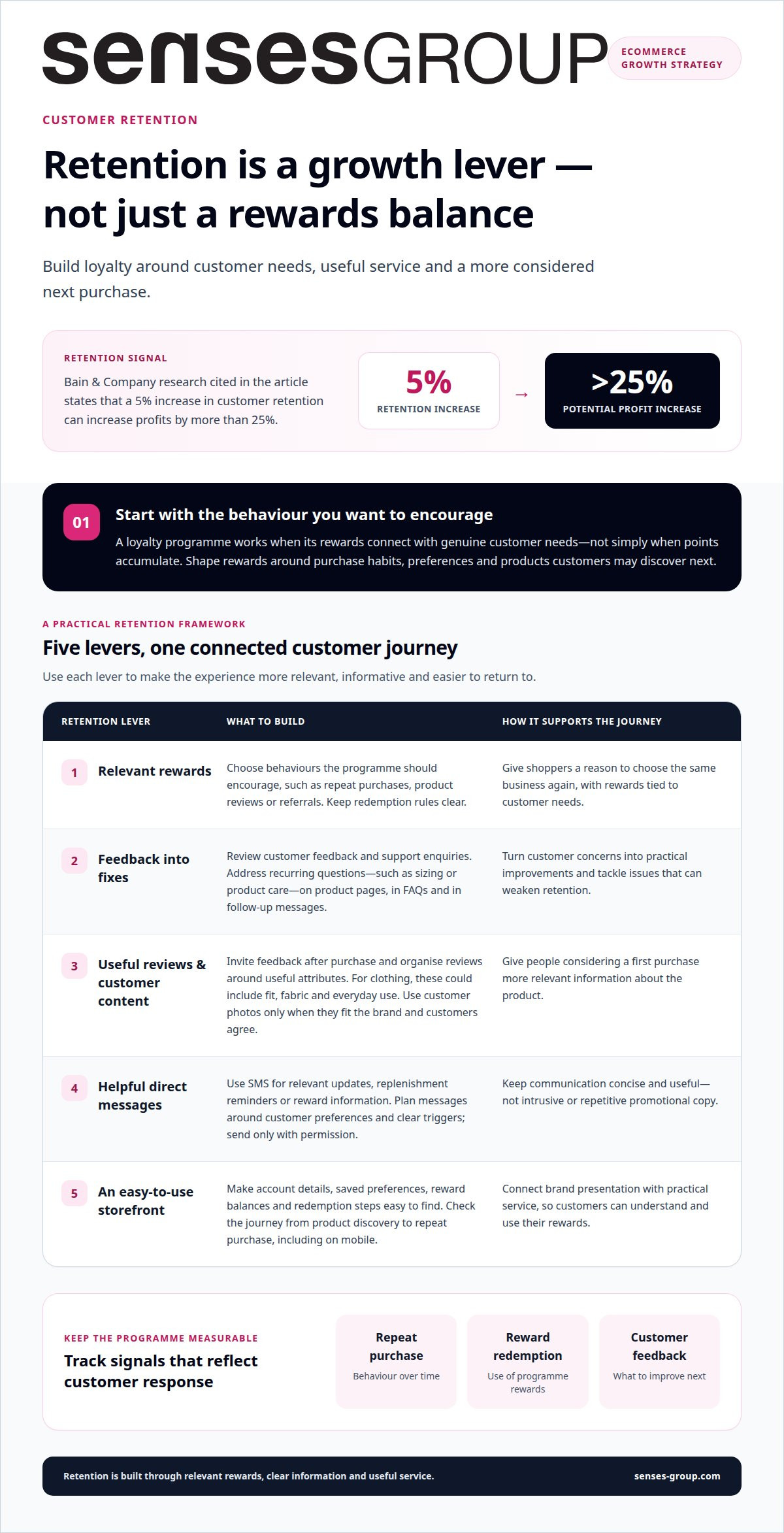
A loyalty programme creates a reason for shoppers to choose the same business again. Its value depends on whether rewards connect with genuine customer needs, not simply whether points accumulate. Bain & Company research states that a 5% increase in customer retention can increase profits by more than 25%. Professionals use this principle to shape rewards around purchase habits, customer preferences, and the products people are likely to discover next.
First, define the behaviour your programme should encourage. A homeware store might reward repeat purchases, product reviews, or referrals, while keeping redemption rules clear. Review customer feedback and support enquiries to identify recurring concerns, such as unclear sizing or product care. Address those questions on product pages, in FAQs, and through follow-up messages. This turns customer feedback into practical improvements and helps tackle issues that weaken retention.
Reviews and customer-created content can make shopping more informative. Invite customers to share feedback after purchase, then organise reviews around attributes shoppers care about. For a clothing retailer, useful details might include fit, fabric, and how an item works in daily life. Customer photos can add context when they fit the brand’s visual identity and customers have agreed to their use. This gives people considering a first purchase more relevant information.
Direct communication should be useful, not intrusive. SMS can provide an order update, a replenishment reminder, or information about a reward. Plan messages around customer preferences and clear triggers, keeping the copy concise and relevant. For example, someone who buys coffee beans could receive a timely reminder based on the product’s expected usage cycle. Respect customers’ communication choices and don’t send messages without permission.
Digital storefront design also shapes loyalty. Professionals make account details, saved preferences, reward balances, and redemption steps easy to find. They check the journey from product discovery to repeat purchase, including how the store works on mobile. If a reward’s terms are difficult to understand or use, shoppers may lose confidence before checkout. A considered storefront connects brand presentation with practical service, helping customers recognise the business and navigate their next purchase.
Measure the programme through repeat purchase behaviour, redemption, customer feedback, and the value of returning customers. These signals help professionals distinguish active engagement from rewards that are merely claimed. They can then refine programme messages, reward choices, and storefront communication based on what customers actually do. For a more cohesive customer journey, consider a storefront designed around customer experience and loyalty.
3. Growth metrics and analytics tools
Useful reporting starts with a decision, not a dashboard. Professionals identify the business goal, select metrics that reflect it, then connect store, campaign, and customer data. For example, a Hong Kong retailer entering an overseas market could track traffic, conversion rate, and repeat purchases by destination. That view helps distinguish weak demand from a store journey that fails to convert.
Metrics should reflect the whole commercial system. Compare customer acquisition cost with average customer lifetime value to assess whether new-customer growth supports long-term profitability. Track unique visitors, click-through rate, and market share to understand marketplace presence. For digital performance, review conversion rate, content score, and review quality. Each metric answers a different question, so don’t treat traffic alone as proof of progress.
Operational indicators can reveal constraints on customer experience and sales. Track in-stock percentage, shipping time, and return rate alongside sales results. For example, rising product-page visits alongside frequent stockouts point to an availability issue, not necessarily weak marketing. Connect these measures to the products, campaigns, and customer segments they describe.
What are the main risks of rapid ecommerce growth, including cash flow, inventory, and platform dependence? Faster sales can strain cash flow when stock, advertising, or fulfilment costs arise before customer payments arrive. Inventory may fall short of demand or tie up working capital, while reliance on one platform can expose a business to changes in its tools, costs, or reach.
Build reporting around a small set of decision-ready KPIs. Define each metric, its data source, and the action it should inform. A drop in conversion rate, for instance, should prompt a review of product pages, checkout steps, device performance, and traffic quality. This approach turns observed customer behaviour into a practical next step instead of producing reports without direction.
Reporting needs a consistent review rhythm. Compare current performance with the business’s own previous periods, identify meaningful changes, and investigate dips before changing campaigns. Separate results by product, channel, and customer segment, too. A campaign may bring visitors but attract few likely buyers; segment-level reporting makes that pattern visible.
Choose analytics tools based on the questions the business needs to answer. Assess whether platforms can connect store orders, advertising activity, customer records, and reporting without creating conflicting definitions. Assign clear ownership for data quality and KPI updates. A well-designed measurement system turns growth metrics into decisions about budget, product availability, customer acquisition, and retention.
4. Automated email and loyalty programmes
Automation helps brands maintain consistent customer relationships as order volume grows. Start by mapping customer events to useful messages, then connect the email platform with store, product, and order data. Someone who buys a refillable product, for example, can receive relevant care guidance and a reminder based on its replenishment cycle.
Strong flows respond to customer intent rather than sending every shopper the same promotion. A professional team can build separate journeys for new subscribers, first-time buyers, repeat customers, and inactive customers. Each segment receives content suited to its relationship with the brand, such as product education after a first purchase or new-arrival information for customers interested in that category.
Automation also needs a clear sequence. A welcome flow can introduce the brand, explain a product’s distinctive features, and direct readers to a relevant collection. A cart flow can address common purchase barriers, such as delivery details or product fit. Set the message order, timing, and frequency, then check that messages remain useful and don’t compete with one another.
Loyalty programmes work better when email reflects each customer’s progress. For example, a store can send a points balance after a qualifying order, explain available rewards, and follow up when a customer has enough points to redeem. Make eligibility and redemption steps easy to understand. Otherwise, customers may ignore rewards or feel uncertain about their value.
Technology implementation starts with the customer journey and the data needed to support it. Map which platform holds order history, product preferences, and email engagement, then configure reliable connections between systems. Define consistent names for events, segments, and flows. This structure makes it easier to expand into new product lines or overseas markets without rebuilding every automation.
Before launch, test each journey with sample customer profiles. A test order can confirm that purchase details enter the right segment, the correct product appears, and a repeat message stops after another order. Review mobile readability, links, and personalisation fields as well. These checks help prevent automated messages from displaying an empty greeting or irrelevant recommendation.
Once live, automation needs active management. Review delivery, engagement, conversion, unsubscribes, and repeat-purchase patterns for each flow. If a product recommendation performs poorly, adjust the segment or content instead of increasing message volume. This measured approach improves personalised communication while protecting customer trust and maintaining a coherent brand experience.
5. Ecommerce revenue growth drivers
Revenue grows when more of the right audience discovers a product, converts, and returns. The ecommerce equation makes the levers visible: revenue equals traffic multiplied by conversion, price, and availability. Professionals use this model to identify the constraint. More traffic won’t solve weak product pages, and strong conversion cannot sell items that remain out of stock.
What are the most effective ecommerce growth strategies for 2026? Focus on the revenue drivers behind your business, then connect customer acquisition, conversion, product availability, and repeat purchase. For a Hong Kong brand expanding overseas, professionals assess each market’s audience and buying journey before adjusting channels, product information, and campaigns.
Start discovery with channels that match customer intent. Search content can help shoppers find specific products, while paid advertising can bring qualified audiences to relevant landing pages. Align the message across channels, then assess whether visitors browse, add products to their carts, and purchase. For example, an ad for a gift set should lead to a page that clearly explains its contents and use.
Conversion depends on removing friction and building confidence in the product. Review descriptions, imagery, navigation, and checkout steps to find gaps between customer questions and store content. A home accessories page might clarify dimensions, materials, and styling context. Clear information helps shoppers decide; a confusing or incomplete page can waste traffic that marketing has already earned.
Availability and pricing shape the value of each order. Professionals review stock patterns, product margins, and discount performance before recommending a promotion. A discount may generate purchases yet reduce revenue quality if it trains customers to wait for offers. Product bundles or complementary recommendations can instead encourage a larger basket when they genuinely fit the shopper’s needs.
Repeat revenue depends on a coherent experience after the first purchase. Relevant follow-up content, useful product education, and a consistent brand experience can give customers reasons to return. Referrals can extend reach through trusted customer relationships. The United Nations identifies affiliate marketing as a cost-effective way for businesses to expand reach and drive sales. Assess partner fit and referral results alongside other acquisition channels.
Growth requires trade-offs. A Hong Kong retailer entering another market should compare channel performance with product availability, fulfilment capacity, and customer response. Professionals use those signals to decide where to invest, what to improve, and which offers to refine. Revenue growth is not simply more traffic; it is a stronger connection between discovery, purchase, margin, and loyalty.
To align your storefront and marketing around these revenue drivers, plan your ecommerce growth with a connected strategy.
Senses Group: Ecommerce Shopify Store
Senses Group helps Hong Kong SMEs and startups build a connected ecommerce foundation through an Ecommerce Shopify Store, supported by Brand Strategy and Brand Identity Design. This is a natural next step when customer acquisition, repeat sales, and the storefront experience need to work as one system, especially when expanding into overseas markets.
For businesses ready to strengthen customer relationships after purchase, Klaviyo Email Automation connects customer activity with relevant follow-up. The focus is strategic alignment: a distinctive brand, a considered Shopify store, and email journeys that support measurable growth rather than isolated campaigns.
Contact Senses Group to discuss your ecommerce growth priorities.
Build the next stage of growth with intent
Expansion is strongest when each investment reinforces the same commercial direction. Before adding a campaign or entering a new market, decide which customer relationship your business needs to strengthen and what the next stage should make possible. That focus gives your ecommerce growth strategies a clear role: connect the brand promise with the experience customers receive, then build on what best serves the business.
For a Hong Kong SME or startup, the next step may be clarifying market positioning, sharpening the identity customers recognise, or creating a store that supports a more deliberate buying journey. A focused conversation can help turn those priorities into a practical direction for growth.
Contact Senses Group to discuss growth and explore the right foundation for your next stage. With a clear direction and a connected customer experience, your business can move forward with greater purpose.
Frequently Asked Questions
What is an ecommerce strategy?
An ecommerce strategy is a set of commercial choices that guides how an online business attracts customers and earns revenue. It connects decisions about target markets, product positioning, digital channels, and the shopping experience. For example, a startup preparing to sell overseas might prioritise one product category and destination market, then align its messaging, store content, and campaign measures with that audience.
How Can Paid Advertising Accelerate Your eCommerce Sales Growth?
Paid advertising can accelerate sales by putting relevant offers in front of audiences who may not yet know the brand. Plan campaigns around a specific goal, such as attracting first-time buyers or promoting a seasonal product, then connect each advert to a matching landing page. Measure conversions and revenue alongside traffic, refining the creative, audience, or destination page when campaigns attract attention without meaningful purchase activity. Ads must comply with Google Ads policies and applicable local advertising requirements.
How Can User-Generated Content and Social Proof Drive Repeat Sales?
Customer reviews, product photos, and practical testimonials can help shoppers understand how an item meets real needs. For example, a customer photo showing a home accessory in use may add useful context beyond a studio product shot. Invite customers to contribute feedback after purchase, then feature relevant content on product pages or in campaigns with appropriate permission. Honest, specific reviews also help returning customers compare products.
How Can You Optimize Your eCommerce Website for Higher Conversions?
Improve conversion by identifying where shoppers hesitate or abandon the buying journey. Review analytics and customer feedback, then test focused changes, such as clearer checkout costs, fewer unnecessary form fields, or more visible delivery information. A guest checkout option can reduce barriers for customers who prefer not to create an account. Each adjustment should address an identified friction point, with results measured against the same conversion metric.
How Do Loyalty Programs Increase Customer Lifetime Value (CLV)?
Loyalty programmes can support customer lifetime value by giving returning shoppers relevant reasons to buy again. A points system is one option; benefits might also include early access to new products or useful member content. Choose a structure that suits purchase frequency and product economics. For instance, a business selling occasional purchases may prioritise referral benefits, while a replenishment brand may reward repeat orders.
How Do You Scale eCommerce Operations for Sustainable Growth?
Scale operations by matching marketing demand with stock planning, fulfilment capacity, customer support, and platform capability. Before expanding a campaign, assess whether popular products can remain available and whether order handling can sustain higher volume. Keep essential customer and sales records accessible beyond a single marketing channel. This reduces operational strain and supports continuity as sales channels and markets expand.
How Does Market Research Shape Your eCommerce Growth Plan?
Market research helps a business identify which customers, products, and messages merit investment. Combine customer interviews, search behaviour, sales patterns, and competitor positioning to understand unmet needs. For example, overseas shoppers may describe a product differently from local customers, affecting campaign language and product content. These findings help shape ecommerce growth strategies around evidence of demand rather than assumptions about a new audience.
How Does Personalization Enhance the Customer Shopping Experience?
Personalisation makes shopping more relevant by using appropriate customer signals, such as stated interests, past purchases, or viewed product categories. Someone browsing travel accessories could see related items or guidance instead of a generic promotion. Set clear rules for recommendations and test whether they help shoppers find useful products. Personalisation should clarify choices, not overwhelm customers with repeated or unrelated messages.