
A Shopify store can look complete and still lack the foundations to support growth. Shopify platform experts help businesses build, improve and maintain their stores, from setup and design to integrations and performance improvements. The title can be confusing: Shopify retired the Shopify Experts brand and its Experts Marketplace in December 2023, so “expert” alone isn’t an official credential.
For Hong Kong SMEs and startups, choosing the right support involves more than technical skill. Your store needs to serve customers clearly while giving the business room to expand into overseas markets, with the brand, customer journey and sales systems working together. A specialist may handle a defined task, while broader growth challenges can require expertise across connected disciplines.
This article explains what Shopify specialists do, how Shopify Partners differ from the former Experts designation, and what evidence can help you assess experience. You’ll also learn when outside expertise may be useful and how to match the scope of support to your business’s next stage.
Key Takeaways
- Shopify specialists can support store design and development, but the right scope depends on whether you need a focused fix or a connected growth system.
- “Shopify Expert” and “Shopify Partner” aren’t interchangeable labels. Understand what each term means before using it to judge a provider’s credentials.
- Assess relevant experience through the work completed, the problems solved and how the specialist explains their approach, not a title alone.
- Different specialists focus on different needs, from store design and development to advertising or email automation. Match the expertise to the challenge your business needs to solve.
- Consider professional support when technical demands, a stalled store or expansion plans are limiting progress, while first identifying whether the root issue is the offer, traffic or store experience.
1. What do Shopify experts do?
Shopify specialists shape the store behind a business’s commerce strategy. Their work can cover design, development, integrations, migration and staff training. For a Hong Kong retailer selling locally and overseas, the store must present products clearly, support a coherent buying journey and handle different customer needs. Shopify platform experts connect those requirements to the platform’s structure, rather than treating the website as a collection of attractive pages. A product page, for example, needs clear information, usable options and a direct route to checkout.
Store design and Shopify theme development turn brand direction into a usable storefront. A specialist may configure an existing theme, adjust its layout or develop a custom theme when standard options cannot support the required experience. Product collections, navigation, mobile layouts and checkout pathways all affect how customers find and assess products. For example, a skincare store might organise collections by concern, while a homewares store might prioritise room or product type. Each choice should make browsing easier and support conversion.
Custom Shopify app development addresses requirements that a theme or existing app cannot handle well. The Shopify app ecosystem has over 10,000 apps, but adding more tools is not automatically the right solution. A specialist can assess the actual workflow, then develop an integration or app where the business has a distinct need. For example, a store may need product information to move between Shopify and another business system. Clear requirements and testing help prevent a custom feature from creating new friction for customers or staff.
Shopify development also covers store improvements and migration. A migration moves products, customer records, content and other store elements from an existing platform into Shopify. The work includes mapping data, rebuilding key page structures and planning redirects so old page addresses can lead customers to relevant new pages. For a retailer moving a large catalogue, careful testing helps surface missing product details, broken links or checkout issues before launch. A migration is a systems change, not simply a visual redesign.
Specialists also build the team’s ability to manage Shopify stores after launch. They can document recurring tasks, explain how to update products and collections, and train staff on the tools the store uses. This knowledge matters when a Hong Kong startup adds products, changes campaign landing pages or prepares to sell in overseas markets. A useful handover gives staff practical steps for routine updates, while identifying which technical changes need development support. The aim is a store the business can operate confidently, not a system only its original developer understands.
2. Shopify Experts versus Shopify Partners
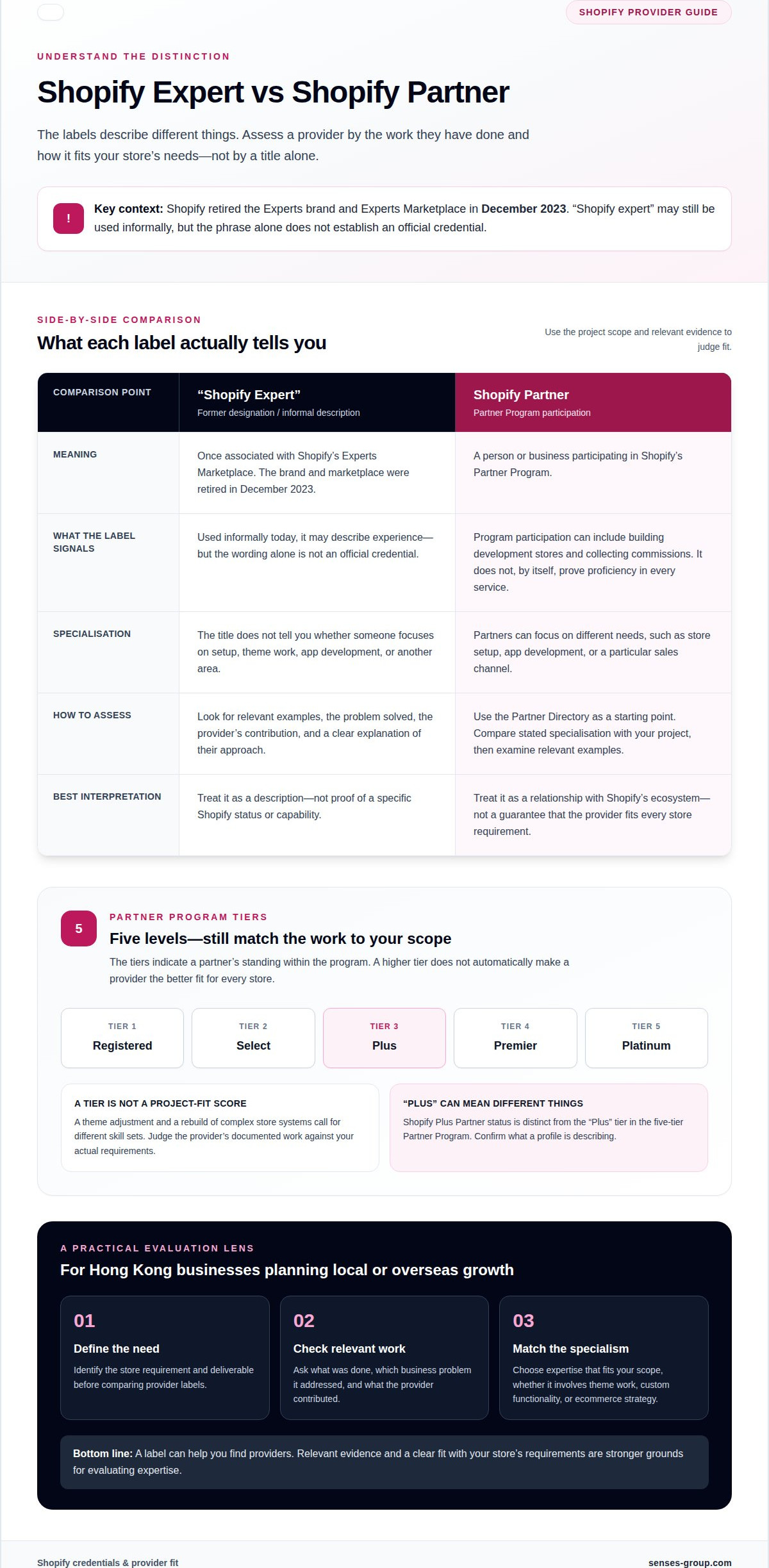
“Shopify Expert” once referred to a designation associated with Shopify’s Experts Marketplace. Shopify retired that brand and marketplace in December 2023. Today, people may still use “Shopify expert” informally to describe their experience, but the phrase alone doesn’t establish an official credential. For a Hong Kong business assessing ecommerce support, distinguish a specialist’s proven work from a title they use.
“Shopify Partner” refers to participation in Shopify’s Partner Program, not a synonym for an expert designation. A person can join the program, build development stores and collect commissions. Participation shows a relationship with Shopify’s ecosystem, but does not by itself demonstrate proficiency in every service. One Partner might specialise in store setup, while another focuses on app development or a particular sales channel.
The Shopify Partner Directory can help identify providers and their stated areas of work. Treat a directory profile as a starting point, not a complete measure of capability. Compare the listed specialization with the project you need, then examine relevant examples. A Hong Kong retailer planning an overseas launch, for instance, needs evidence of experience with the store requirements involved, not just a general ecommerce profile. Look for clear descriptions of the work, the business challenge and the specialist’s contribution.
The Partner Program has five tiers: Registered, Select, Plus, Premier and Platinum. These levels indicate a partner’s standing within the program, but a higher tier does not automatically mean a better fit for every store. A small business adjusting its theme may need a different skill set from a company rebuilding complex store systems. Match the provider’s documented work to your scope, then discuss how they would approach your specific requirements.
Shopify Plus Partner status also deserves careful interpretation. Don’t confuse it with the “Plus” tier in the five-tier Partner Program. These are distinct labels, so establish what status or capability a profile describes. For a Shopify Plus project, relevant experience with that platform tier matters more than assumptions based on similar-sounding names. The practical test is whether the provider can explain how their work addresses your store’s needs.
Think of Shopify’s partner ecosystem as a network of different specialisms, not a single standard of expertise. One provider may handle theme work, another may develop custom functionality, and another may support ecommerce strategy. The right choice depends on matching the role to the problem. Before appointing someone, define the deliverable, expected handover and measures of completion. Those specifics make credentials more meaningful than labels alone.
3. Shopify agency credentials and expertise
Shopify specialists may work independently, within an agency, or as part of your in-house team. A freelancer usually owns a narrower scope directly, while an agency can bring several disciplines together; “expert” describes experience, not a separate team structure. For a Hong Kong startup preparing a store launch, the right choice depends on whether the project needs one defined skill or coordinated work across design, development and marketing.
Credentials matter most when they connect to relevant evidence. Review case studies that explain the business challenge, the specialist’s role and the work delivered. For example, a portfolio showing a redesigned product page is more useful if it also explains what changed in navigation, product information or checkout. Ask how the team would approach specific requirements, such as adapting a store for overseas customers. A clear method is stronger evidence than a broad claim of expertise.
In-house teams offer direct familiarity with products, customers and day-to-day operations. They can suit merchants with ongoing Shopify work and staff who can own decisions across departments. An agency, by contrast, can coordinate several disciplines for a defined launch or complex project. A retailer rebuilding its store while developing new marketing assets may need coordination that one internal specialist cannot provide alone.
Freelancers can be a good fit when the brief is focused, such as resolving a theme issue or implementing a particular feature. An integrated agency can suit projects requiring connected expertise, such as store development alongside brand design and customer communications. Neither model guarantees better work. Assess the deliverables, decision-making process and handover plan against the task, rather than choosing by provider type alone.
Team size should match the work. An integrated agency may assign a strategist, designer and developer to a store project; a larger team may add specialists in ecommerce marketing or technical integrations. The important question is how those roles connect. A designer, for example, should understand the developer’s implementation constraints, while the project lead keeps the launch scope and decisions aligned. Ask who owns each deliverable and how changes are handled.
For ongoing support, clarify whether the same people will remain involved after launch. A freelancer may offer continuity through one direct relationship, while an agency may distribute work across specialists. Both can work well if responsibilities are explicit. Define who maintains the store, who approves changes and how the team documents completed work. That structure helps Hong Kong merchants keep daily operations moving while preparing for new products, campaigns or overseas expansion.
4. Examples of Shopify Experts and their services
Shopify specialists address distinct needs, from store builds and integrations to conversion optimisation. One may focus on improving a retail brand’s product pages, while another connects Shopify with inventory or email tools. The useful comparison is the work itself: identify the commercial problem, the service required and the experience that supports it. A polished portfolio matters, but the most relevant example shows how the specialist addressed a similar business need.
Expert Village Media offers a named example from the Shopify ecosystem. It was founded in 2011 and said it became a Shopify Expert in 2014. The company reported a user base of 23,000 active merchants. Those figures provide background, not a complete assessment of fit: a business still needs to understand which services the provider delivers and how its experience relates to the project. For a store redesign, examine design work; for integrations, look for relevant technical examples.
For stores serving local and overseas customers, an expert should configure payment options, delivery zones and charges, tax settings and localised content to suit the business’s operations and target markets. They should test the customer journey from product discovery through checkout confirmation for each relevant market.
There is no universally best Shopify agency for every Hong Kong business. The strongest fit is the provider whose documented work, service scope and project approach match your store’s requirements and target markets.
Some specialists extend their work beyond development as a brand grows. A store launch may need product architecture and a clear shopping journey; later, the business may need integrations connecting sales and customer communication. For example, a retailer adding product lines may need clearer collection structures and consistent product information across its storefront. Define the outcome first, then select services that address it rather than adding tools without a clear role.
Conversion services focus on reducing friction between a customer’s arrival and completed purchase. A specialist might review navigation, product-page clarity, mobile usability and checkout steps, then prioritize changes based on the store’s traffic and customer behaviour. For a Hong Kong fashion brand, clearer sizing information or more visible delivery details could address a specific hesitation. The work should connect each proposed change to an observable customer problem, not rely on a generic redesign.
Before a project begins, set out the deliverables, required integrations, launch responsibilities and handover materials. A migration project, for example, needs an agreed plan for product data, key page destinations and testing. A conversion engagement needs a defined set of pages or journey stages to review. Clear scope helps businesses compare proposals on substance and gives the specialist a practical basis for delivery.
5. Reasons to hire Shopify professionals
Find Shopify specialists through the Shopify Partner Directory, then assess their portfolios against your project. In Hong Kong, verify experience through relevant case studies, clear deliverables and a practical explanation of how the work will address your store’s needs.
Bring in professional support when a specific obstacle is consuming time or limiting progress. If Shopify development and maintenance takes 10 or more hours per month, outsourcing may free your team to focus on products and customers. A conversion rate that remains flat or declines for three or more months can also justify an expert audit. For brands earning under HK$20,000 per month, first examine product-market fit, traffic quality and the offer before assuming technology is the cause.
A migration is another moment to consider specialist help. Incomplete redirect mapping has been associated with merchants losing 40 to 60 percent of organic traffic after migrations. A migration plan should account for important page destinations, data transfer and pre-launch testing. Shopify professionals can also help build automation when repeated manual tasks, such as customer follow-up, begin disrupting daily operations.
Hiring risks include unclear ownership, changes that disrupt store functions, and unnecessary access to customer or business data. Reduce these risks by defining the scope in writing, granting access only for required tasks, and agreeing who approves changes. Keep control of the store’s primary account, document integrations and settings, and test significant changes before launch. For example, a theme update should be reviewed across key product pages and checkout before it goes live.
To hire effectively, begin with a short brief describing the problem, desired outcome and affected parts of the store. Review portfolio examples that match the work, then compare each proposed approach, deliverables, timeline and handover. Ask the specialist to explain how they will manage the current version of the store while making changes. A provider who connects each task to a business need gives you a clearer basis for assessing the proposal.
Agree on how progress and completion will be evaluated before work starts. A store redesign might require an agreed list of pages and functions; an automation project might define the customer journey it supports. For ongoing work, specify who handles updates and how decisions are documented. These details help Hong Kong SMEs coordinate launch activity without leaving staff uncertain about ownership.
If your store needs a clearer foundation for its next stage, plan your Shopify store improvements around the customer experience, brand and operational priorities.
A strong choice is a Shopify Partner Directory specialist with relevant case studies and a proposal that clearly defines the approach, deliverables, timeline and handover. Compare candidates on how well they address your store’s specific needs and manage changes safely.
Senses Group: Ecommerce Shopify Store
Senses Group helps Hong Kong businesses build Shopify stores with a clear commercial and brand foundation. Its work can bring the store experience together with Brand Strategy and Brand Identity Design, so the customer journey reflects what the business stands for and supports plans to reach local or overseas markets.
Turn to Senses Group when you’re preparing to launch, reshaping an existing store or connecting the shopping experience with customer follow-up. Klaviyo Email Automation can support that follow-up, while a well-planned Shopify store gives customers a clearer route from product discovery to purchase. The goal is not simply to put products online, but to align the store, brand and customer communication around the business’s next stage.
If you’re planning a Shopify project, contact Senses Group to discuss your goals and requirements.
Set the direction for your next stage of growth
Your next decision isn’t simply who can build a Shopify store. First decide what the store needs to make possible for your business: a more coherent customer journey, stronger market positioning or a clearer path into overseas markets. That priority gives the project a commercial purpose and keeps decisions focused.
Shopify platform experts are most valuable when their work supports that direction. A well-defined goal helps align the project team around what matters to your business, from the experience customers encounter to the foundations needed for future growth.
If you’re ready to define your next step, start a conversation with Senses Group. A clear direction can help you build with confidence.
Frequently Asked Questions
What do Shopify experts do?
Shopify platform experts help businesses shape store operations around a specific commercial goal. That might mean improving product discovery, resolving a theme issue or connecting Shopify data with another business system. For example, a retailer preparing a seasonal launch may need product collections, campaign pages and customer follow-up aligned. Start by identifying the business constraint, then match the specialist’s role to that need.
How much does a Shopify agency cost?
A Shopify agency’s fee depends on the project scope and is provided after a quote request. Cost factors include the store’s current state, the number of design and development tasks, integrations, data complexity and whether ongoing support is included. A defined theme adjustment differs from a full store build or complex migration. Compare proposals by deliverables and responsibilities, not by a headline figure alone.
What does a Shopify platform expert do?
A Shopify platform specialist translates business requirements into store configuration or technical work. If a brand needs customer data to flow between Shopify and Klaviyo, for example, the specialist maps the workflow, selects an appropriate integration approach and tests the resulting data flow. The role can also include documenting decisions, so the internal team understands how the setup works and which processes it supports.
How much do Shopify experts in Hong Kong charge?
Fees for Shopify work in Hong Kong depend on the scope and are provided after a quote request. Key factors include whether you need a specific development task, a new store, integration work or ongoing support, as well as the complexity of the products and workflows involved. A useful brief describes your business goal, existing setup and required deliverables, making the proposed work easier to assess.
What services do Shopify experts offer, such as store setup, design, and development?
Services can include Shopify store setup, theme configuration or development, product and collection structure, custom functionality, integrations, migration and post-launch improvements. A startup with a new product range, for instance, may need store foundations and a coherent visual system, while an established retailer may need a particular workflow connected to its marketing tools. Confirm that the proposed tasks match the problem and include a clear handover.
What should I check before hiring a Shopify expert?
Check that the portfolio includes work relevant to your project, and make sure the proposal defines deliverables, approvals, testing and handover. Agree on who controls the store account and how changes will be reviewed. For integration or migration work, review app access permissions, protect credentials and limit staff access to what each person needs. Remove app access when the work is complete, and document important settings.