
A Shopify store has no single set cost for a Hong Kong D2C brand: the price depends on the project and is provided after a quote request. The main cost drivers are the level of theme customisation, product and store structure, migration needs, and the apps or integrations required. Shopify development for D2C brands should be scoped around the business model, not just the storefront’s appearance.
It’s understandable to want a clear budget before committing. But the right setup is the one that supports how customers discover products, make a purchase and return, while giving the business room to expand into overseas markets. This guide explains how to scope a store, organise products, measure implementation results, assess an agency’s approach and plan for purchase models beyond a standard add-to-cart journey.
Key Takeaways
- Scope a store around the customer and business needs first, then choose native features, apps, integrations or custom development for each requirement.
- Organise products and navigation around how shoppers browse and decide, making each page help build trust, answer questions or guide the next action.
- Set a clear success measure before launch, test real customer journeys and review performance after traffic arrives.
- Assess an agency’s Shopify and D2C experience alongside its approach to mobile usability, search, SEO, testing and handover.
- Consider whether subscriptions or other repeat-purchase options fit your products and customers, rather than relying only on standard add-to-cart.
1. How much does a Shopify store cost?
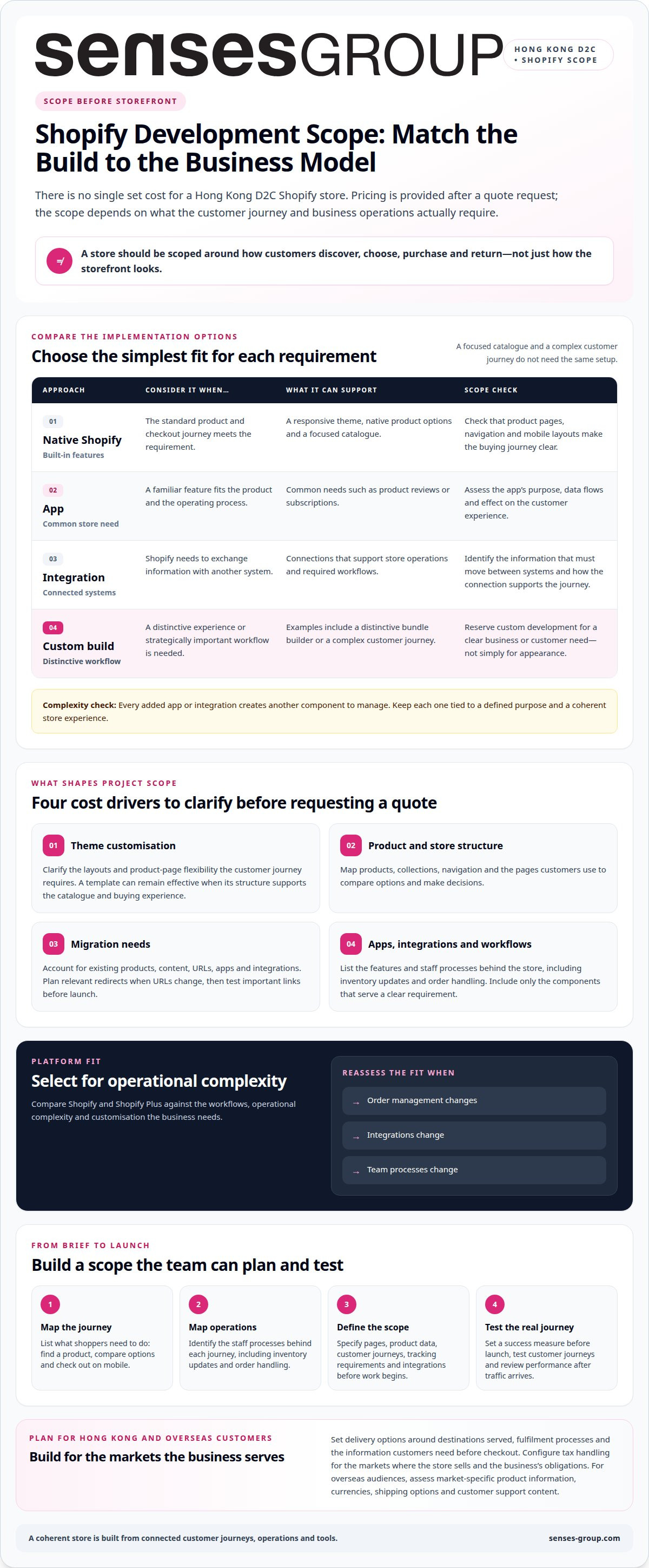
For a business in Hong Kong, Shopify development costs depend on the store’s scope, not a universal package price. Pricing depends on project scope and is provided after a quote request. Key factors include theme customisation, product structure, migration, integrations and required workflows. A catalogue with standard product pages has different needs from a store with subscriptions or complex inventory connections.
Choose the simplest solution that meets the requirement. Start with native Shopify features when the standard product and checkout journey works. Use an app for a common need, such as reviews or subscriptions, when it fits the product and operating process. Use an integration when Shopify must exchange information with another system. Reserve custom development for distinctive experiences or strategically important workflows.
For example, a brand with a focused catalogue may use a responsive theme, native product options and an app for a familiar feature. A store with a distinctive bundle builder or complex customer journey may need custom development. Every added app or integration creates another component to manage, so assess its purpose, data flows and effect on the customer experience before adding it.
Shopify and Shopify Plus should be compared against operational complexity, required workflows, and the level of customisation the business needs. A growing D2C brand should select the option that supports its current commerce model without adding unnecessary complexity. Reassess the fit when order management, integrations, or team processes change.
For Hong Kong D2C brands, suitable Shopify plans and features depend on sales operations, team requirements, and the checkout and integration needs of the business. Begin with the essential customer journey, then add features that support local operations or planned overseas growth. Shopify offers customisable themes, so assess mobile layouts, product-page flexibility, and navigation before selecting one.
A DIY or template store can remain effective if its structure supports the catalogue and customer journey. Consider a custom build when repeated workarounds, limited layouts or disconnected tools obstruct a clear purchase experience. Before rebuilding, map existing products, content, URLs, apps and integrations. This keeps useful assets in view and clarifies which limitations the new store needs to solve.
Build timing follows the same scope logic. A focused theme setup requires less design and development work than a migration involving custom templates and multiple integrations. Define the pages, product data, customer journeys, tracking requirements and launch tests before work begins. That scope gives the team a practical basis for planning delivery and managing changes.
Finally, connect the budget to customer experience and operations. List the tasks shoppers must complete, such as finding a product, comparing options, and checking out on mobile. Then map the staff processes behind each task, including inventory updates and order handling. Shopify development for D2C brands works best when the theme, apps, and integration support one coherent store rather than isolated features.
2. Shopify store structure and product categorisation
A Shopify store should make the next useful action obvious. Group products according to how customers compare and choose, rather than internal stock codes. A skincare store, for example, could organise its catalogue by concern, product type and routine, then use filters to narrow the options. Keep categories distinct enough to guide browsing without creating overlapping paths.
Build navigation around the customer’s first decision. A clear menu might link to product categories, bestsellers, new arrivals and practical buying guidance. Each collection page should help shoppers compare relevant items, while product pages answer questions about use, ingredients, sizing or compatibility. The structure should lead naturally from discovery to product details and checkout, making decisions easier.
Choose a Shopify theme whose layouts support those journeys. A theme may look polished in its preview yet make key information difficult to find on mobile. Review the collection page, product page, navigation and checkout as one connected experience. If customers need to compare product sizes, for instance, make those details easy to scan before they add an item to their basket.
For shipping and fulfilment in Hong Kong, configure delivery options around the destinations served, the fulfilment process and the information customers need before checkout. Set tax handling to reflect the markets where the store sells and the business’s obligations there. Settings should match actual operations rather than rely on a generic configuration.
International expansion brings additional structural decisions. A Hong Kong brand selling overseas may need market-specific product information, currencies, shipping options and customer support content. Decide whether one storefront can serve those audiences clearly or whether separate market experiences would better support different assortments and buying journeys. Keep shared product data consistent while adapting details that affect local customer understanding.
A migration needs the same care. Map existing product pages, collections, navigation and public URLs before moving content. When a URL changes, create a relevant redirect from the old address to its closest new page. This helps returning visitors and search engines reach the right destination. Include redirects in the migration plan, then test important product and collection links before launch.
Store maintenance should support growth, not become a cycle of emergency fixes. Assign responsibility for product updates, app changes, content reviews and integration checks. After launching a new collection, review whether navigation still reflects the catalogue and whether product information remains accurate. Planned reviews help keep the customer experience and store operations aligned as the business evolves.
Strong structure connects merchandising, discovery, and conversion. A Shopify store structure and growth plan can bring those decisions together, from product categorisation to the paths customers follow through the store.
3. How do you measure whether the implementation worked?
A launch is a starting point, not proof of success. Before development begins, define the customer problem and the change the implementation should produce. For example, a redesigned product page might make details easier to find. Record a relevant baseline, such as add-to-cart activity, conversion or support contacts, so the post-launch review has a clear comparison.
Scope makes those measures meaningful. Document the Shopify templates, apps, integrations, analytics events and operational teams affected by the work. Set acceptance criteria for important journeys, including product discovery, checkout and order confirmation. Agree on how revisions are handled, what counts as a scope change and which deliverables are included at handover. Clear boundaries reduce misunderstandings during delivery.
Before release, test both everyday journeys and failure cases. Check buttons, forms, checkout steps, mobile layouts and analytics events. Then test edge cases, such as invalid form entries or unavailable products, to make sure customers receive clear guidance. Prepare a rollback and support process for launch so the team knows how to respond if a critical journey stops working.
After launch, compare actual performance with the baseline and intended change. Track the primary KPI tied to the project, then review supporting measures such as average order value, repeat purchases, contribution margin, page performance, returns and support issues. For example, assess a new search filter through search success and product discovery, not only overall sales.
Review performance again after real customer traffic arrives. Separate changes related to the implementation from other factors, such as promotions or shifts in traffic sources. If customers abandon a new checkout step, investigate the journey and supporting analytics before changing the design. Optimisation should address observed friction, not personal preference.
For multichannel commerce, assess how the store supports the wider customer journey. A customer might discover a product through social media, buy through Shopify, then receive a post-purchase email. Measure whether tracking connects these steps and whether follow-up messages help customers understand product use or return to buy. Keep campaign attribution and customer records consistent across channels.
Hong Kong D2C brands should consider risks from unclear scope, untested integrations, missing analytics, and changes that disrupt checkout or public URLs. Ongoing maintenance costs depend on the work required, including app subscriptions, integration upkeep, performance fixes, and content or theme changes; project costs depend on scope and are provided after a quote request.
At handover, document theme and app changes, analytics setup, key workflows and access responsibilities. Assign an owner to monitor errors, review customer feedback and prioritise fixes. This makes post-launch support a deliberate operating process, with each adjustment tied to evidence and a defined business outcome.
4. What Mistakes Should Businesses Avoid When Hiring a Shopify Agency?
A polished desktop mock-up can conceal a weak mobile shopping journey. Start the design with the mobile experience, then adapt the layout for larger screens. On a phone, shoppers need readable product details, clear buttons and navigation that works with touch. Test a product page, collection page and checkout on mobile before approving the design.
Shopify stores should be optimized for mobile conversion, SEO, and speed by combining responsive layouts, fast-loading pages, clear navigation, and technically sound product content. Review the full journey, from search result to checkout, rather than treating each page as a separate design task. Mobile load times over 2 seconds can be a potential problem for SEO and sales.
Speed is a commercial requirement, not a decorative enhancement. Store performance can be affected by large product images, theme code and inefficient apps. Review these elements together before launch: compress images, remove unnecessary app features and test key templates. A feature that adds visual polish but delays product discovery may weaken the customer experience.
Navigation and site search should help customers reach the right product with less effort. Organise menus around customer needs, use collection filters to support product comparison and make search results useful for common product terms. For example, a homeware store should help shoppers distinguish product types and sizes. Test searches that return results, searches with no matches and filters on mobile.
Avoid evaluating an agency on visual presentation alone. Assess its Shopify experience, D2C understanding, SEO knowledge, and conversion optimisation approach. The delivery process should account for mobile behavior before finalising desktop details. It should also identify how changes to URLs, navigation, or product information could affect organic discovery. Include SEO and crawlability requirements in the implementation scope.
Performance work should cover more than image compression. A structured review can examine theme performance, app efficiency, code quality and Core Web Vitals. Ask for a clear explanation of what will be tested before handover, including mobile layouts, buttons, forms and checkout flow. A five-day or seven-day build is meaningful only when its testing and delivery scope are clear.
Do not let a visually attractive prototype replace functional checks. Test touch targets, menu behaviour, form validation and the path from product page to checkout. Review product pages using real catalogue content, since long titles or varied images can expose layout issues. Confirm that search and navigation remain usable on smaller screens.
Finally, connect design choices to measurable customer behavior. If mobile traffic reaches product pages but shoppers struggle to find relevant items, review search, filters, and navigation before adding more interface elements. A focused mobile experience, supported by sound SEO structure and disciplined performance work, gives Hong Kong brands a stronger foundation for local and overseas commerce.
5. Purchase models beyond standard add-to-cart
A D2C business sells products directly to customers through its own channels, rather than relying on a retailer. That direct relationship gives a brand more control over product presentation and customer communication. B2C describes a broader business-to-consumer relationship, which can include sales through retailers and marketplaces as well as a brand’s own store. Many businesses combine these routes.
Standard add-to-cart suits customers who want to select a product and make a one-time payment. Other models may better match how customers use a product. A replenishment brand might offer subscriptions, while a gift business could create product bundles. Choose based on customer needs, buying frequency and fulfilment capacity, not simply the appeal of adding another feature.
Subscriptions work best when customers prefer regular delivery or ongoing access. Before adding one, define the available intervals, renewal communications, payment process and how customers can manage changes or cancellations. Make the terms visible on the product page and at checkout. A subscription should simplify repeat purchasing, not create uncertainty about future charges or deliveries.
Alpha Box & Dice provides a useful example of a subscription model supporting D2C sales. Since moving to Shopify, its subscription revenue has grown by 700%, and subscriptions account for 30% of its total D2C revenue. The figures illustrate why brands should assess recurring orders as a distinct purchase model, rather than treating them as a minor checkout variation.
Bundles can serve customers who want a coordinated selection or a convenient starting point. A brand could group complementary products, explain what each item contributes and present the bundle as a clear option alongside individual products. Track bundle selection and average order value, then assess whether the offer supports margin and customer understanding. Avoid bundles that make product choices harder.
A hybrid D2C and B2C strategy can assign different roles to each channel. A brand may use its own store to test a new product or offer an early release, while retail partners carry the core catalogue. This approach helps shape the target audience and assortment by channel. Keep product availability and campaign messaging aligned, so customers receive a consistent view.
Choose a model by mapping its effect on the whole operation. Consider payment handling, inventory updates, customer communications, returns and service workload before launch. For example, recurring orders require reliable renewal messages and a process for failed payments. If a model creates operational friction without improving customer value, keep the simpler purchase path.
Build a purchase journey around the model your customers prefer, then connect the store experience to the follow-up communication. Plan a Shopify store for flexible purchase models that supports one-time orders, subscriptions, or bundles with a coherent customer journey.
Senses Group: Brand Strategy
Senses Group helps Hong Kong D2C businesses align brand direction with the customer journey and store experience. Turn to the team when your Shopify store needs more than a visual refresh, such as clearer positioning, a stronger identity, or a structure that can support local and overseas growth.
Brand Strategy defines the commercial foundation; Brand Identity Design expresses it consistently across the store. An Ecommerce Shopify Store connects that direction to product discovery and purchase, while Klaviyo Email Automation supports relevant post-purchase communication. Together, these capabilities help build a coherent system rather than a set of disconnected marketing tasks.
Ready to shape a clearer brand and ecommerce direction? Contact Senses Group to discuss your business goals and build an integrated growth system.
Build your next stage with intention
Your next store decision should reflect where the business is going, not only what it needs today. For Hong Kong brands preparing to reach new customer groups or overseas markets, that means treating Shopify as part of a wider commercial system. The product experience, brand positioning, and customer relationship should reinforce one another as the business evolves.
That perspective shapes effective Shopify development for D2C brands. A clear strategic direction helps guide decisions about what to build now, what can wait, and how the store should grow alongside the business. The result is a more purposeful foundation for future product launches, new customer journeys, and changing market priorities.
Senses Group can help connect your brand direction with the ecommerce experience through Brand Strategy, Brand Identity Design, and an Ecommerce Shopify Store. Contact Senses Group to discuss your Shopify store and the direction you want to take next.
With a clear next step, you can build towards growth with greater confidence.
Frequently Asked Questions
How much does a Shopify store cost?
The cost depends on project scope and is provided after a quote request. A store using a theme and standard features has different requirements from one involving migration, custom workflows or complex integrations. For a useful estimate, define the catalogue, required customer journeys, operational connections and launch deliverables first. Separate ongoing app subscriptions and maintenance from the initial development scope, since they affect continuing operating costs.
Why Do D2C Brands Choose Shopify?
D2C brands choose Shopify to manage online selling through a central store with mobile-friendly design and app integrations. For example, a growing brand can use its storefront to present its products directly, while connecting tools that support marketing or customer communication. The platform can support different business sizes, but its value depends on how well the store configuration fits the brand’s products, internal processes, and plans for reaching new markets.
How do you measure whether the implementation worked?
Measure success against the specific business problem the implementation was meant to solve. If the work simplified product discovery, review how shoppers use search and product pages alongside conversion data. If it connected a marketing tool, confirm that the intended customer and order information flows accurately. Record changes and review customer feedback with analytics, so later adjustments respond to observed behaviour rather than assumptions.
How to start your D2C eCommerce business?
Start by defining the customer, product range, and reason to buy directly from your brand. Next, map the basic operating model: product information, pricing, payment, fulfilment, returns, and customer support. Build a focused storefront around the first customer journey, then establish how you’ll attract and retain customers. A Hong Kong business planning overseas sales should also decide which markets and customer needs its initial store experience will serve.
What Does a Shopify Development Company Do?
A Shopify development company turns a business’s commerce requirements into a functioning online store. Its work may include configuring themes, structuring product pages, setting up app connections and adapting the customer journey to the brand’s needs. For example, a team might connect Shopify with an email platform so customer activity can support relevant follow-up. Clear scope, testing, analytics and handover help keep the store manageable after launch.
What Mistakes Should Businesses Avoid When Hiring a Shopify Agency?
Avoid choosing solely on the strength of a visual mock-up or a fast-delivery claim. Ask how the work addresses mobile behaviour, data flows, search visibility, testing and handover. For a store migration, clarify how product and customer information will be handled and how access permissions will be controlled. A strong project scope identifies what the build includes, which decisions the business must make and how changes are managed.
What does D2C mean?
D2C means direct-to-consumer: a brand sells to customers through channels it owns, such as its ecommerce store, instead of relying only on retailers. A Hong Kong skincare brand selling through its own Shopify storefront is using a D2C channel. It can also sell through retail partners or marketplaces. The strategic choice is how each channel supports customer access, product discovery, and the brand’s relationship with buyers.
What Shopify development services do D2C brands typically need?
Needs vary by business stage, but often include store setup, theme adaptation, product and collection structure, app configuration, integrations, and migration support. A brand with repeat-purchase products may also need a suitable subscription workflow, while an expanding business may prioritise connections between Shopify and its marketing systems. Shopify development for D2C brands should match the customer journey and operating model, rather than adding features without a clear purpose.