
A Shopify Plus agency doesn’t necessarily work only with Plus merchants. Some also support businesses on other Shopify plans, depending on the project and their expertise. The label describes the agency’s platform experience, not an exclusive client list.
For Hong Kong SMEs and startups, the right Shopify Plus agency can help address the real complexity behind a store project, from migration planning to integrations and overseas market expansion. The key is to match the agency’s experience to your business needs, rather than choosing by title alone.
This guide explains what these agencies do, whether they work with merchants on other plans, and how to assess their fit. You’ll learn what to look for in an agency’s approach, proposal, and launch planning before deciding on your next step.
Key Takeaways
- Compare agency credentials against the demands of your project, including platform expertise, integrations and relevant implementation experience.
- Assess a project quote by its scope, technical requirements, migration needs and ongoing responsibilities, not by the headline figure alone.
- Look for a proposal that clearly defines deliverables, responsibilities, integrations, testing and how project success will be assessed.
- Plan a migration or launch around discovery, build, data preparation, testing and launch readiness; the sequence and timeline depend on project complexity.
- Align your store with a clear brand strategy so customer experience and marketing support expansion in Hong Kong and overseas.
Agency support for complex commerce projects
A Shopify Plus agency can connect a store to business systems and customize its storefront, workflows, and commerce features. Typical projects include ERP, CRM, inventory, and payment integrations, as well as bespoke storefront components designed around customer journeys.
Complexity comes from how these parts interact. For a Hong Kong retailer selling locally and overseas, product data, stock availability, market-specific storefronts, and order processing need a coherent structure. An experienced Shopify Plus agency can configure Shopify Markets, automation tools, and integrations around the business’s operating model.
Enterprise B2B commerce adds another layer. A wholesale operation may need company accounts, buyer-specific catalogues, negotiated pricing, and repeat-order workflows. Shopify Plus includes Shopify B2B, while implementation connects those capabilities to product data, customer records, and existing processes. The design should account for how sales teams manage accounts and buyers place orders.
Integrations are valuable when they reduce fragmented work, not simply add software. An agency can map data flowing between Shopify and systems such as an ERP or CRM, then define which system owns product, customer, inventory, and order records. For example, an inventory integration should clarify how stock changes in the source system appear in the online store.
Headless commerce separates the storefront presentation layer from the commerce backend. This can support a bespoke front end, but it also adds development and maintenance decisions. The project team must define how the storefront retrieves Shopify data, how content is managed, and how changes are tested. Headless architecture isn’t an automatic performance upgrade: speed depends on implementation, content, scripts, and delivery choices.
Useful performance work includes reviewing theme structure, app scripts, image handling, and third-party integrations. A slow product page may be caused by competing scripts rather than a platform limitation. The team should identify the cause before recommending a rebuild, then test journeys such as product discovery, cart updates, and checkout on mobile devices.
Customizations should solve a defined commercial need. Examples include a product finder for a broad catalogue, a tailored landing page for an overseas market, or a B2B ordering flow for repeat buyers. Shopify Plus also provides expanded staff permissions and a broader theme and app environment, giving teams more options to shape workflows and storefront experiences.
A Shopify Plus agency can scope work around these connected areas:
- Platform and data: migrations, product records, customer data, and system integrations.
- Commerce model: Shopify B2B requirements, buyer journeys, and account workflows.
- Storefront: theme customization or headless architecture, based on business needs.
- Performance: testing pages and purchase journeys before and after implementation.
Charle has completed 75+ Shopify Plus implementations, bringing experience to complex commerce projects involving integrations, workflows, and tailored storefronts.
Shopify Plus agency rankings and evaluation criteria
A ranking can narrow your options, but it can’t decide which agency fits your commerce project. Compare its criteria with your priorities, such as a B2B rollout, a migration, or expansion from Hong Kong into overseas markets.
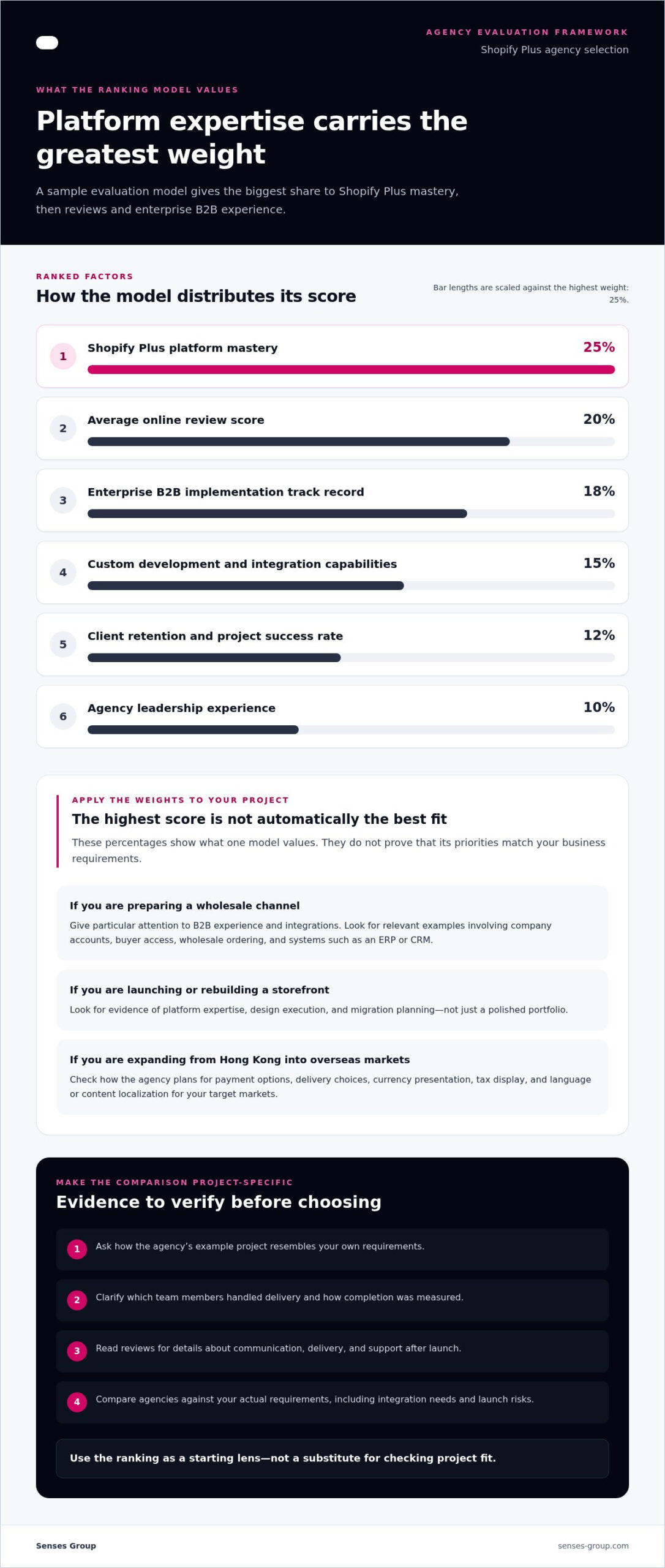
One evaluation model weights Shopify Plus platform mastery at 25%, average online review score at 20%, enterprise B2B implementation track record at 18%, and custom development and integration capabilities at 15%. Client retention and project success rate account for 12%, while agency leadership experience contributes 10%.
These percentages reveal what the model values, not whether its priorities match your project. A Hong Kong startup preparing a wholesale channel may prioritize B2B experience and integrations. A brand launching a new storefront may need stronger evidence of platform expertise, design execution, and migration planning.
- Platform mastery: Look for examples involving the functions your project needs, such as Shopify B2B or international storefronts.
- B2B track record: Review whether past implementations address company accounts, buyer access, and wholesale ordering.
- Development and integration: Check for relevant work connecting commerce platforms with systems such as an ERP or CRM.
- Reviews and retention: Read feedback for details about communication, delivery, and support after launch.
- Leadership experience: Understand who guides decisions when scope, data, or technical dependencies change.
For a fair comparison, ask each shortlisted Shopify Plus agency the same questions. How does its example project resemble yours? Which team members handled delivery, and how was completion measured? A polished portfolio can show visual quality, but not how an agency manages integrations or launch risks.
Key risks include unclear scope, weak data ownership, integration delays, and a storefront that misses business needs. Manage them with written deliverables, named decision-makers, test plans, and agreed responsibility for each connected system.
For Hong Kong customers, the project should account for payment options, delivery choices, currency presentation, tax display, and language or content localization. The agency should map each element to your target markets and business setup, rather than assume one checkout configuration suits every customer.
Before choosing, score each agency against your actual requirements, not just its ranking. A concise project brief can clarify priorities, while a focused discussion with a Shopify Plus agency can help shape them. Shopify store planning can also help define the experience your project needs.
How much does a Shopify Plus agency charge in Hong Kong?
There’s no single fee that fits every Shopify Plus project in Hong Kong. A store redesign, a platform migration, and an enterprise B2B build require different work, resources, and levels of coordination. Compare proposals by scope and deliverables, not by the headline figure alone.
Pricing structures vary. A defined project may use a fixed fee for agreed deliverables, while a phased engagement may price each stage separately. Time-based billing can suit evolving work, such as troubleshooting an integration. Each structure allocates risk differently, so match it to how clearly you have defined the requirements.
The price depends on the project and is provided after a quote request. Key cost factors include scope, design requirements, data migration, integrations, custom development, and testing.
For a Hong Kong retailer moving from an existing platform, the quote should account for product and customer data, catalogue structure, redirects, and order history requirements. An overseas expansion may add market-specific storefront content, currencies, and checkout configuration. A B2B implementation may require distinct buyer journeys and account workflows. These are different workstreams, not minor line items.
Review the proposal for clear boundaries. A lower initial fee may exclude work needed for a complete launch, while a broader scope may combine strategy, build, migration, and post-launch support. Ask what each line covers, which assumptions shape the estimate, and how changes are handled. This makes proposals easier to compare.
- Discovery: business goals, customer journeys, technical requirements, and project dependencies.
- Design and build: storefront layouts, theme customization, and agreed commerce features.
- Migration: data mapping, content transfer, redirects, and validation of migrated records.
- Integration: connected systems, data ownership, and testing of information flows.
- Launch and support: quality assurance, launch readiness, issue handling, and agreed follow-up.
Budget beyond the agency fee. Shopify subscription charges, paid apps, payment processing, and internal staff time can affect the total project investment. Treat these as separate cost categories and identify who owns each decision. Custom features may also create future maintenance work, so weigh their business value against ongoing complexity.
Before approving a proposal, align the scope with a practical launch outcome. Define the required customer journeys, systems, markets, and launch checks. A Shopify Plus agency should explain how those requirements translate into work, milestones, and responsibilities, giving your team a sound basis for assessing the investment.
What should a Shopify Plus agency proposal include?
A useful proposal turns commerce goals into defined work, decisions, and deliverables. For a Shopify Plus project, it should explain what the agency will build, what your team must provide, and how both sides will judge completion. A proposal that says “redesign the store” without describing product templates, navigation, or checkout leaves important scope unresolved.
Start with the business objectives and customer journeys. A Hong Kong retailer expanding overseas might need distinct market content, currency presentation, and product availability rules. The proposal should connect each requirement to a deliverable, such as market landing pages or a documented storefront configuration. This makes it easier to distinguish essential launch work from later enhancements.
Scope should identify the Shopify components and systems involved. If the project includes an ERP integration, the document should name the data flows, such as inventory updates and order records. If it involves Shopify B2B, it should describe the buyer experience and account workflows. Specific boundaries help prevent assumptions from becoming unexpected work.
- Discovery: business goals, customer journeys, technical constraints, and decisions required from your team.
- Design: page types, navigation structure, content responsibilities, and approval stages.
- Development: theme changes, custom features, integrations, and any excluded functionality.
- Data: products, customers, orders, and the migration or validation responsibilities for each.
- Testing: mobile layouts, product discovery, cart behaviour, payment flow, and integration checks.
- Launch: readiness criteria, launch responsibilities, and the process for addressing defects.
Milestones should show dependencies, not just dates. For example, product-page development may depend on approved content and product data. An ERP connection may require access to the source system before testing. The proposal should identify these dependencies and name the decision-maker for each approval. That gives a Hong Kong SME a clearer view of where internal delays could affect delivery.
Commercial terms need clear definitions too. The proposal should state the billing structure, payment schedule, assumptions, change-control process, and how additional requests are assessed. It should separate agency work from third-party costs, such as paid apps or Shopify subscription charges. This helps finance teams understand commitments without confusing software expenses with implementation fees.
Finally, define ownership and post-launch responsibilities. The document should clarify who controls Shopify access, design files, custom code, and connected accounts. It should describe any agreed handover, documentation, training, and support period. Your team should know who updates product content after launch and where to report a checkout defect.
Compare proposals by testing whether each requirement has an owner, deliverable, and acceptance condition. A Shopify Plus agency proposal should make the project understandable before work begins, especially when your Hong Kong store must support local customers and overseas growth.
What are the steps and timeline for a Shopify Plus migration or store launch?
A migration or launch follows a sequence: discovery, planning, design, development, data preparation, testing, and release. The timeline depends on catalogue size, data quality, integrations, customization, and how quickly decisions are approved. A straightforward theme launch has different dependencies from a migration involving ERP records and international storefronts.
Start with discovery. The project team reviews the current platform, business goals, customer journeys, and technical requirements. A Hong Kong retailer might map local checkout needs alongside a planned overseas market. This stage identifies which content, products, customer records, and workflows must move or change.
Then define the target structure before building. Confirm Shopify store architecture, product categories, navigation, market setup, and any B2B requirements. Agree on who supplies product descriptions, images, and translated content. Delays in these decisions can affect design and development because teams need approved material to complete page templates.
- Audit and map: document products, customers, orders, URLs, apps, and connected systems. Map each data field to its destination in Shopify.
- Design the experience: establish page layouts, navigation, and mobile journeys. A product detail page should present useful information before the customer reaches the cart.
- Build and connect: configure the theme, agreed features, and integrations. Test how systems exchange product, inventory, and order information.
- Prepare the migration: clean records, organize product data, and plan URL redirects. Sample migrated products and customer records before transferring the full dataset.
- Test the store: check product discovery, search, cart, payment flow, forms, and mobile display. Verify integrations using realistic orders and inventory changes.
- Launch and monitor: confirm launch responsibilities, publish the store, and review customer journeys. Track errors and resolve issues through an agreed process.
Testing should reflect actual business scenarios, not just whether pages load. For example, test a Hong Kong customer placing an order, a staff member updating inventory, and an overseas buyer viewing the correct market content. Check redirects from valuable existing pages so customers and search engines reach the intended Shopify destinations.
Set launch-readiness criteria before release. These may include approved content, completed payment tests, verified order notifications, and access for staff responsible for daily operations. A migration should also establish ownership for post-launch updates, so product and content changes have a clear process.
Build a project schedule around dependencies, approval points, data readiness, and integration testing, not an arbitrary launch date. Plan your Shopify store migration and launch around these stages to give the project a clear path from discovery to release.
Shopify Plus Partners typically support complex projects involving larger builds, platform migrations, technical integrations, international selling, B2B requirements, checkout considerations, and growth strategy, making their expertise relevant to complex migration or launch planning.
Senses Group: Brand Strategy
Senses Group helps Hong Kong businesses connect their market position with a clear brand and ecommerce experience. Turn to its Brand Strategy when your store is expanding into overseas markets, repositioning for growth, or struggling to communicate why customers should choose it.
That strategic foundation can guide Brand Identity Design and an Ecommerce Shopify Store, aligning the visual experience with the customer journey. Klaviyo Email Automation can then support consistent post-purchase communication and encourage customers to return.
For a growing SME or startup, the aim is more than launching a Shopify store. It’s to create a coherent system where the brand, storefront, and customer communications reinforce the same promise across markets.
Visit senses-group.com to explore how Senses Group can support your brand and ecommerce direction.
Build your next stage of commerce with purpose
Your next decision is bigger than choosing a platform or signing a project plan. Decide what your store must make possible for customers and your team, then align the experience with that commercial direction. A business preparing to grow locally or overseas needs a Shopify Plus agency that understands how the brand promise carries through the storefront and customer journey.
Senses Group brings that perspective through Brand Strategy, Brand Identity Design, and Ecommerce Shopify Store work. These disciplines connect why customers choose your business with how they discover, experience, and buy from it online. A clear strategic foundation can make future commerce decisions more coherent as your business evolves.
Share your priorities and explore a considered direction for your store. Contact Senses Group to discuss your project. The right next step is the one that gives your business a stronger foundation for growth.
Frequently Asked Questions
Does a Shopify Plus agency solely works with Shopify Plus merchants?
No, a Shopify Plus agency doesn’t necessarily work only with Plus merchants. Some also support stores on other Shopify plans, depending on their capabilities and the project’s needs. A brand planning a future move to Plus, for example, may first need to strengthen its current storefront. What matters is whether the agency’s experience matches your requirements, not whether every client uses the same plan.
What’s the difference between Shopify Experts and Shopify Plus Partners?
“Shopify Experts” and “Shopify Plus Partners” refer to different labels, not interchangeable proof of the same capability. Shopify Experts were considered part of the broader Shopify Partner directory as of October 2023. Shopify Plus Partners typically support more complex commerce work, such as enterprise builds and integrations. For a business assessing expertise, focus on demonstrated experience relevant to its project rather than relying on a directory label alone.
What does a Shopify Plus agency do?
A Shopify Plus agency helps businesses plan, build, or improve commerce experiences using Shopify Plus. Its work can connect commercial objectives to storefront design, technical implementation, and the systems supporting sales. A retailer, for example, may need a consistent product experience across its online store and wholesale channel. The agency translates that need into a workable scope, coordinates decisions, and delivers the agreed project.
How do you choose a Shopify Plus agency?
Choose an agency by matching its experience to the business problem you need to solve. A brand preparing for overseas sales, for example, should prioritize relevant international commerce work over a portfolio focused only on local storefront design. Compare project examples, technical strengths, communication approach, and how the team handles changing requirements. Consider, too, how the proposed work supports your brand positioning and desired customer experience.
How can you verify a Shopify Plus agency’s credentials, case studies, and client results?
Verify credentials by checking whether the agency’s stated status appears in Shopify’s partner information, then assess project evidence separately. A useful case study identifies the business challenge, the agency’s specific contribution, and the result without relying on broad claims. Look for a clear connection between the work and the outcome. A store redesign, for example, should explain what changed in the customer experience, not just show attractive screenshots.