
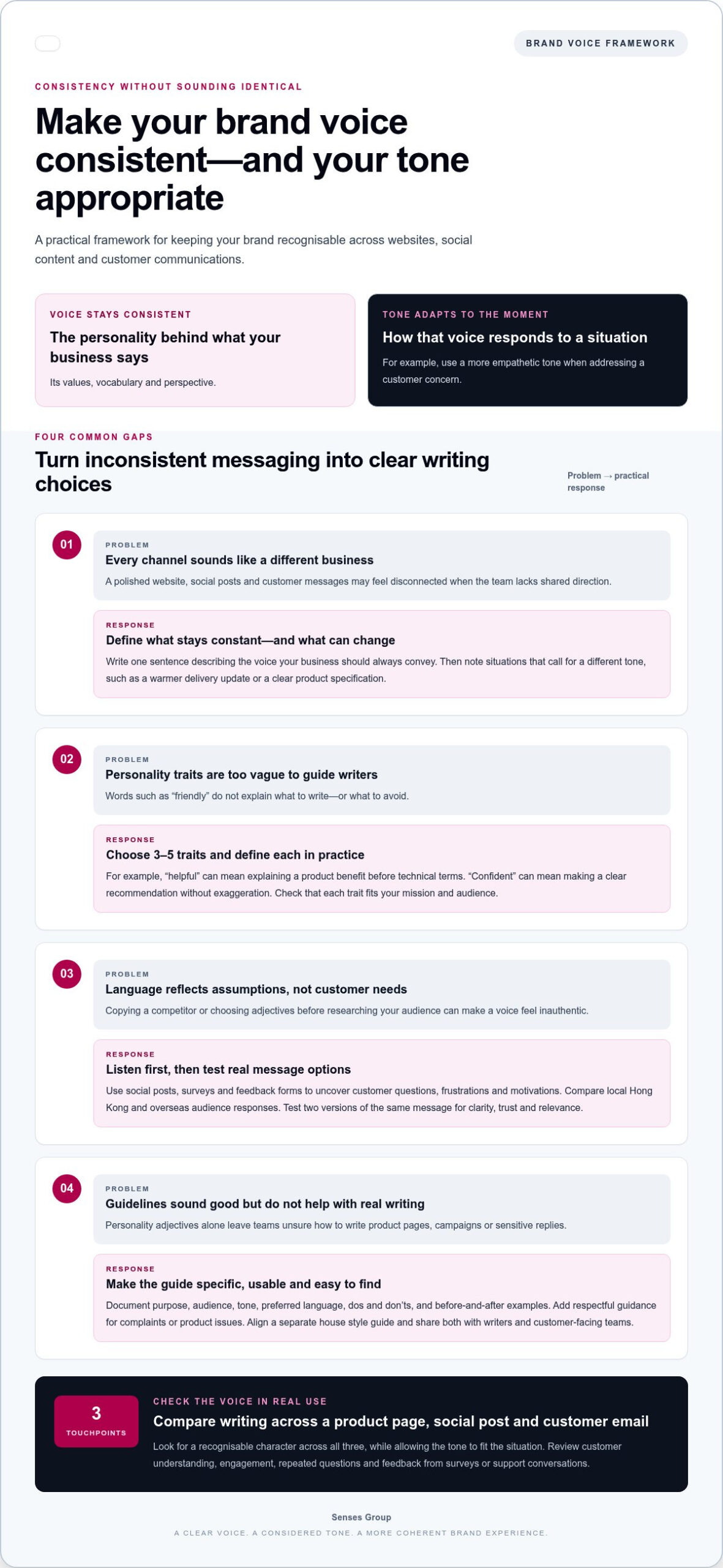
Your brand’s voice should stay recognisable, while its tone changes with the moment. That distinction is the starting point for brand voice development: voice is the consistent character behind what your business says and how it says it; tone adapts that expression to the situation.
If your website sounds polished but your social posts or customer messages feel as though they come from a different business, the issue may not be the writing itself. Your brand voice may be unclear, or your team may lack shared guidance on how to use it.
A strong voice creates a consistent experience while leaving room to respond appropriately, whether you’re explaining a product, addressing a customer concern, or reaching new audiences overseas. This guide shows you how to connect your voice to your mission and values, choose language that fits your audience, and create practical guidelines your team can use.
You’ll also learn how to adapt your tone across your website, social media, and other customer touchpoints without losing what makes your brand distinct.
Key Takeaways
- Separate your brand’s consistent character from the tone you adapt to each customer situation.
- Use audience feedback and customer interactions to shape language that reflects what people need from your business.
- Build practical guidelines with clear voice traits, examples, and direction your team can apply.
- Connect your language choices to your mission and values so your messaging feels credible and distinctive.
- Keep your brand recognisable across your website, social media, and customer communications while adapting each message to its channel.
What’s the difference between a brand’s voice and a brand’s tone?
A brand’s voice is its consistent personality: the values, vocabulary, and perspective behind its writing. Brand tone is how that voice adjusts to a particular moment. A Hong Kong skincare shop, for example, can sound knowledgeable across its website and social posts, then use a more empathetic tone when answering a customer’s concern.
Assess effectiveness by comparing customer responses across specific touchpoints. Track whether people understand product messages, engage with content, and ask fewer repeated questions. Review these signals alongside feedback from surveys and customer support conversations.
Common mistakes include copying a competitor’s personality, relying on vague traits such as “friendly,” and using the same tone in every situation. These choices can make writing feel inauthentic or insensitive, such as using playful slang to address a serious complaint.
- Separate the constant from the adjustable. Write one sentence describing the voice your business should always convey, then list situations that call for a different tone. For example, a retailer might sound clear and confident across every channel, while using a warmer tone in a delivery update than in a product specification. This distinction gives writers a stable foundation without making every message sound identical.
- Start discovery with specific business questions. Ask founders and customer-facing staff what the company does, who it serves, and why customers choose it. Then explore its mission, values, differentiators, and customers’ perceptions. For an online food brand, ask whether buyers value convenience, ingredient information, or gift presentation most. These answers connect the brand’s personality to real customer decisions.
- Research audience needs before choosing adjectives. Use social posts, surveys, and feedback forms to identify recurring questions, frustrations, and motivations. Ask customers what they need to know before buying, what almost stopped them, and what language feels credible. Compare responses from local Hong Kong shoppers with overseas audiences. Differences can reveal where examples or explanations need adapting, without changing the brand’s underlying character.
- Use a short survey to test voice preferences. Show respondents two versions of the same message, such as a formal product description and a more conversational one. Ask which feels clearer, more trustworthy, and more relevant, then invite them to explain why. Keep the task focused on a real customer decision. Preference alone is not a strategy; interpret responses in light of your mission and audience needs.
- Turn findings into practical writing choices. Select a few precise personality traits, then define how each should appear in your language. “Helpful” might mean explaining a product benefit before introducing technical terms; “confident” might mean making a clear recommendation without exaggeration. Record preferred phrases, words to avoid, and examples in a style guide. This makes brand voice development practical across product pages, social content, and customer replies.
Creating brand voice and style guidelines
Develop your voice in sequence: define its character, document usable rules, then train everyone who writes for your brand. The guidelines should connect your mission and target consumers to clear choices across campaigns and customer communications.
-
Develop the Brand Voice
Start by selecting three to five characteristics that reflect your business, such as knowledgeable, direct, and warm. For each trait, describe what it means in practice and what it rules out. “Direct” might mean leading with a product benefit, not making unsupported claims. Check that these qualities fit your mission and audience rather than simply copying language used by other brands.
Next, test the traits against real writing. Compare a product page, social post, and customer email. If each sounds like it comes from a different organisation, refine the traits until they guide all three. This turns brand voice development from an abstract exercise into practical decisions writers can apply.
-
Create Brand Voice Guidelines
Translate each characteristic into instructions writers can follow. Include your brand’s purpose, audience, tone of voice, messaging principles, preferred language, and clear dos and don’ts. Add before-and-after examples, showing how a vague campaign line can become a specific, benefit-led message. Examples make guidelines easier to use than personality adjectives alone.
Include guidance for sensitive moments, such as responding to a complaint or explaining a product issue. A playful voice can still use measured, respectful language when customers need clear information. Keep the document practical; avoid rules that sound impressive but don’t help someone make a writing decision.
-
Build a House Style Guide
Set consistent editorial choices in a separate house style guide, then align it with your voice guidelines. Specify how to write product names, headings, abbreviations, dates, and calls to action. For example, decide whether headlines use sentence case and whether product descriptions address readers directly. Consistent choices help writers produce coherent pages and campaigns.
Store the guide where writers, designers, and customer-facing teams can find it. Add approved examples from your website and social content, plus a short explanation of why each works. Review the guide regularly, possibly once a year, and update it when your audience or business direction changes.
-
Roll Out Tone Guidelines
Introduce the guidelines in a working session, not just through an email attachment. Ask writers to revise a product description and a customer reply using the same brand personality. Compare their choices, clarify unclear rules, and explain how tone shifts with context while the underlying voice remains recognisable.
Use a simple approval process for new campaigns: plan, write, gather feedback, edit, approve, publish, and revise. Assign responsibility at each stage so the guidance reaches every channel. After launch, review customer responses and internal feedback, then strengthen examples where teams interpret a rule differently.
Tone characteristics and language choices
Keep the brand voice consistent, then adapt its tone to the channel, audience, and situation. For Hong Kong, English, Cantonese, and Traditional Chinese content should preserve the same intent and personality, not rely on word-for-word translation.
-
Research Industry and Competitor Tone
Review how brands in your category communicate across websites, social media, and customer support. Note whether their messaging sounds formal, playful, expert, or service-led, then identify familiar phrases and gaps. For example, if brands in a category lead with technical claims, clearer explanations of product benefits may help your business stand apart. Use competitor research to find an opening, not to imitate another brand’s voice.
-
Adapt Tone Across Channels and Situations
Map each channel to the customer’s task before choosing its tone. A product page should make benefits and use clear; a social caption can invite conversation; a support reply should address the customer’s concern directly. Keep the same underlying personality across these moments. Adjust warmth, detail, and formality to fit the interaction, and avoid a playful approach when someone needs serious product or order information.
-
Document Tone and Messaging
Write examples that show how tone changes without changing the brand voice. Voice is the enduring character; tone is its expression in a particular situation. For a delayed order, a brand might remain direct and helpful while showing more empathy than in a promotional caption. Record the audience, purpose, preferred language, and unsuitable phrasing beside each example. These practical notes help writers apply the distinction consistently.
- Adapt language for Hong Kong audiences by treating English, Cantonese, and Traditional Chinese as distinct writing contexts. Preserve the same message and brand personality, but choose vocabulary, sentence structure, and expressions that sound natural to the intended readers. For instance, a concise English product benefit may need a fuller explanation in another language. Review each version in its channel, not only side by side in a translation document.
- Test whether each language version resonates with its target audience. Ask readers what they understand, what feels awkward, and whether the message sounds credible. Check product descriptions, campaign headlines, and customer replies separately, since context affects word choice. If a phrase works in one language but feels overly formal in another, rewrite it while retaining the same promise and meaning.
Aligning voice with mission and core values
Your mission sets the direction; your values define how the business acts along the way. Translate both into language customers can recognise across your Hong Kong business and overseas communications.
-
Identify Mission and Core Values
Write a plain-language mission statement, then identify the values that guide the decisions behind it. For example, a food retailer might aim to make everyday cooking simpler, with helpfulness and transparency as guiding values. Check that each value shapes real choices, such as explaining ingredients clearly or responding constructively to feedback. Avoid selecting values just because they sound appealing; they must influence how the business behaves.
Next, test whether those values matter to your target audience. Ask what customers need to understand before buying and what gives them confidence. One finding is that 81% of consumers say they need to trust a brand to do what is right. Treat trust as a standard to earn through clear, consistent communication, not a phrase to add to a campaign.
-
Connect Identity, Values, and Messaging
Map each value to a visible brand behaviour and a message customers encounter. If reliability is a core value, demonstrate it through clear product information, useful order updates, and language that avoids overstated claims. This connects identity to the customer experience: a brand communicates its values through what it says and how it acts, not through a slogan alone.
Review the website, packaging, social content, and customer replies together. For example, a premium homeware business should not present careful craftsmanship on its product pages, then make careless or exaggerated claims in campaign messaging. Brand identity, values, and words need to reinforce one another. When expanding overseas, retain the same central promise while adapting examples and explanations for each audience.
-
Translate Values Into Tone
Turn every value into a writing principle. A brand that values expertise can explain product choices in precise, accessible language. A brand that values care can acknowledge a customer’s concern before offering practical next steps. Describe the intended effect, then provide an example sentence writers can adapt. This gives teams a clear reference when creating content for different products or channels.
Finally, compare your actual messaging with your mission. Ask whether a new campaign communicates your values through its claims, word choices, and customer promise. If your mission is to make specialist products easier to understand, unexplained technical language creates a mismatch. Revise the message until its tone reflects your intended identity and connects with customer needs without changing your underlying values.
Applying voice across websites and social media
A voice becomes valuable when customers recognise it throughout the experience. Align your website, social media, and customer messages, then adapt each expression to its purpose.
- Map the customer journey across channels. List where customers meet your brand, from a Google result to a product page, checkout message, and support reply. For a Hong Kong retailer expanding overseas, note which touchpoints explain product benefits and which resolve questions. This map reveals gaps, such as a confident homepage followed by generic order emails. Give each channel a clear role while keeping the brand’s core values visible.
- Set a consistent standard, not identical copy. Customers expect a coherent experience across channels; 90% say brand interactions should be consistent across them. That doesn’t mean copying a website paragraph into an Instagram caption. Keep the promise, personality, and level of clarity consistent, then shape length and format for the platform. A product feature can become a detailed web explanation or a short social post with the same central meaning.
- Give each platform a distinct job. Use product pages to answer buying questions, social media to build familiarity, and email to guide customers through a decision or share an update. A skincare brand might explain ingredients on its website, share a concise routine tip on social media, and send a helpful replenishment reminder. Don’t force every channel to sound like a friend; warmth should support the customer’s task, not obscure important product information.
- Document examples for writers and reviewers. Create a channel matrix with the audience, purpose, tone, and sample language for each touchpoint. Include a product launch, customer complaint, and order update to show how expression changes. Add a short checklist: Does this message reflect our values? Is the next step clear? Does the wording fit the channel? Concrete examples make the document useful during busy campaign reviews.
- Review the experience as a connected system. Read a social post, its linked product page, and the follow-up email in sequence. Look for shifts in promises, terminology, or warmth that could confuse customers. Then compare customer questions and feedback across those channels. If shoppers repeatedly ask about a feature already described online, revise the page and supporting messages together. This makes consistency an operational practice, not just a design statement.
For campaigns that need a consistent message from the landing page through paid placements, align your Meta and Google advertising with the customer experience around it.
Senses Group: Brand Strategy
Senses Group can help Hong Kong SMEs turn a defined mission and brand voice into a coherent market position. Its Brand Strategy work gives businesses a foundation for decisions about messaging, identity, and customer experience, particularly when growth exposes inconsistencies across channels.
Turn to strategic support when your team struggles to express what makes your business distinct, or when your brand needs to work across local and overseas ecommerce audiences. Brand Identity Design can bring your positioning to life in a visual system, while an Ecommerce Shopify Store and Klaviyo Email Automation can carry a consistent experience into online shopping and customer communications.
For a practical next step, contact Senses Group to discuss your brand direction, or visit senses-group.com.
Make your next brand decision more coherent
Put your voice to work in the next customer-facing decision, not just in a document. Choose an upcoming launch, product update, or market expansion, then use it to test whether your brand’s words support the experience you want customers to have. Applying the guidelines to a real project gives your team a practical reference point as the business grows.
That’s where brand voice development becomes a commercial discipline. Each clear choice connects your purpose to how customers experience your business, from first impression to ongoing relationship. Start by identifying where your current messaging feels fragmented and defining what a more unified direction should achieve.
Contact Senses Group to discuss your brand voice and the direction your business is ready to build. Start with clarity, then carry that intent into every customer interaction.
Frequently Asked Questions
How do you talk to your users?
Start with the customer’s immediate need, then answer in language they understand. If a shopper asks whether a tea gift set suits someone who avoids caffeine, respond directly before describing ingredients or alternatives. Use the customer’s own terms when they’re clear, and ask one focused follow-up question if essential details are missing. This keeps the exchange useful rather than turning it into a sales pitch.
What’s a brand voice in content creation, and why does it matter?
A brand voice is the recognisable way a business expresses its point of view across its content. In a buying guide, it shapes whether advice feels practical, reassuring, or highly technical. A defined voice helps readers connect separate pieces of content to the same business, even when different writers create them. That recognition makes content feel like part of a coherent customer experience, not a series of isolated posts.
What is brand voice development and why does it matter?
Brand voice development is the process of deciding how a business should communicate and putting those decisions into practice. It matters when a growing company adds writers, product lines, or overseas markets. Without shared direction, each new touchpoint can introduce different claims or expectations. Clear voice decisions help teams create consistent content while leaving room to respond to customers and changing business priorities.
What are the key elements of a distinctive brand voice?
A distinctive voice combines a clear point of view, recognisable language, sentence rhythm, and emotional character. It also needs boundaries: a financial education business might explain complex ideas plainly but avoid jokes about debt. The combination matters more than any single adjective. Review these elements together in a product description and a customer reply; both should feel connected, even though they serve different purposes.
How do you create brand voice guidelines with examples?
Build guidelines around real writing decisions rather than abstract labels. For a specialty tea business, show a product description that explains flavour clearly, then contrast it with exaggerated claims to avoid. Add preferred terms, sample headlines, and guidance for replying to a dissatisfied customer. Briefly explain each example so writers understand the principle and can apply it to new products without copying templates mechanically.
How do you adapt brand voice across channels and audiences?
Keep the central promise stable, then adjust the format and detail to each audience’s needs. A first-time visitor may need a simple explanation of a product category, while a returning customer may want a concise update about a new release. Use a compact message on social media and provide enough context on a product page to support a decision. Review each version for clarity and consistent underlying intent.