
A useful ecommerce story is a system of proof, not a slogan. For Hong Kong SMEs, brand storytelling for ecommerce means showing customers what makes your business different, why they can trust it, and how that promise holds up from first impression to checkout. When product pages and marketing channels tell different stories, even a strong offer can feel interchangeable.
You may already know your products and service deserve attention. The challenge is making that value clear to new customers, then keeping the message consistent as you grow across channels and into overseas markets. A memorable founder story alone won’t do the work. It needs to connect to evidence, useful content, and a coherent buying experience.
This article will help you define what makes your brand meaningfully different and turn that foundation into practical ecommerce communication. We’ll explore how to carry your story through Shopify content, marketing, and customer touchpoints, while adapting it for new markets without losing its core. The result is a clearer basis for earning trust and building sustainable growth.
Key Takeaways
- Build a brand story around a customer tension, your brand belief, your distinctive approach, product value, and credible proof.
- Use brand storytelling for ecommerce to create a consistent promise across product pages, campaigns, and customer touchpoints without repeating the same message.
- Adapt examples and context for overseas audiences while keeping the central brand promise intact.
- Connect brand strategy to your Shopify experience, marketing, and retention so each part of the buying journey reinforces the same story.
- Review customer questions and feedback to strengthen your proof and keep your story relevant as your business grows.
Brand Storytelling for Ecommerce: What It Is and Why It Matters
Brand storytelling for ecommerce is the connected meaning, promise, and supporting evidence customers encounter as they discover, assess, and buy from a brand. It links what a business believes, what it offers, and why that offer matters, helping customers understand the brand beyond a product’s features or price.
A strategic story is not simply a founder biography, a memorable slogan, or a campaign that disappears after launch. Those can contribute to the story, but they don’t define it. The story is the underlying logic that connects them: the customer need the business recognises, its point of view on that need, the product’s role, and the details that make the promise credible. This foundation shapes brand identity and equity, including the meanings customers associate with a business over time.
Clarity creates distinction. If a store describes its offer only as “high quality” or “designed for everyone,” customers have little reason to remember it. A more useful message names a specific customer need and explains how the product responds. For example, a retailer selling reusable drinkware might frame its value around making it easier for commuters to carry a drink throughout a busy day. The example becomes persuasive when the store supports it with accurate product details, rather than broad claims about being the best choice.
This matters for SMEs competing locally and entering overseas markets. Customers unfamiliar with the business need to grasp not only what is for sale, but why the offer is relevant to them. A focused story gives product information a clear context without asking customers to decode vague brand language.
What makes an ecommerce brand story persuasive?
A persuasive story brings three elements into alignment: the customer’s need, the brand’s point of view, and the product’s role. Start by identifying the decision customers are trying to make or the problem they want to address. Then state what your business believes is a better way to meet that need, and explain how the product delivers value within that approach.
Make the promise recognisable, then substantiate it. Specific details, such as intended use, material, or a design choice, are more meaningful than superlatives the business cannot demonstrate. Before publishing a claim, ask: could a customer see evidence of this in the product information or experience? If not, sharpen the claim or remove it.
Why storytelling matters beyond the About page
Customers form impressions across the whole store and its marketing. A social post may introduce a product’s purpose; a product page must answer practical questions; an email may explain how the brand’s belief shapes a new offer. Each touchpoint has a different job, but their underlying promise should feel coherent.
That consistency helps customers connect the message they first noticed with the information they need to decide. It doesn’t mean repeating the same paragraph everywhere. Use storytelling to clarify a choice, explain a meaningful difference, or provide relevant proof. If a line adds atmosphere but gives customers no better understanding, it may be decoration rather than useful communication.
Build an Ecommerce Brand Story Around Customer Meaning and Proof
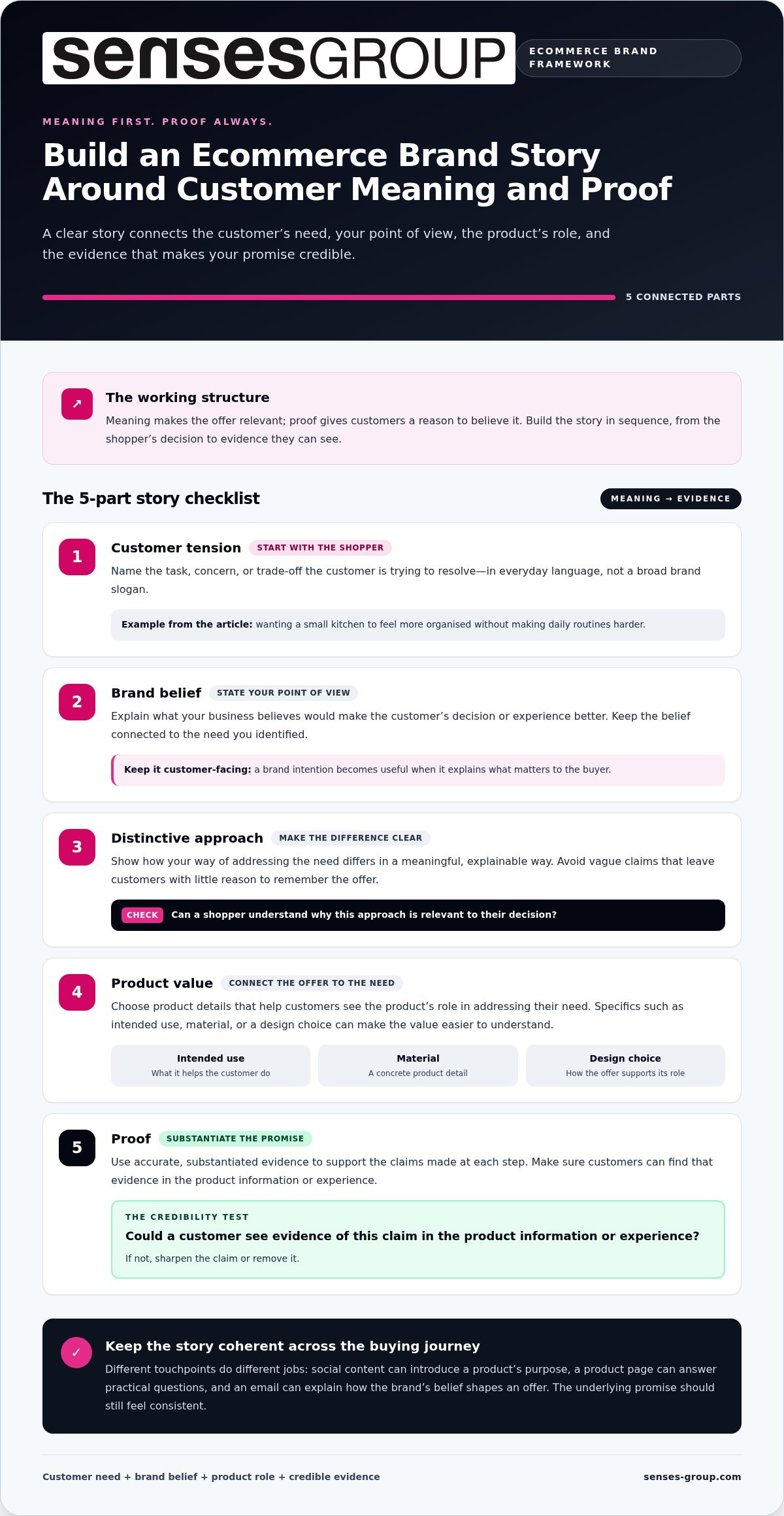
A strong story starts with the customer’s decision, not the brand’s desire to sound distinctive. The practical test is whether a shopper can understand the need you address, what you believe about meeting it, how your approach differs, what value the product offers, and what evidence supports your promise. This is the working structure behind brand storytelling for ecommerce: meaning gives the offer relevance; proof gives customers a reason to believe it.
Start with the customer’s real decision
Describe the customer’s tension in everyday language. A homeware shop, for example, might hear shoppers say they want a small kitchen to feel more organised without making daily routines harder. That is more useful than saying the brand “inspires better living.” Then clarify the intended practical outcome, such as making frequently used items easier to arrange, and the emotional outcome, such as feeling more in control of the space. Keep the customer at the centre.
From there, build the story chain in order:
- Customer tension: What task, concern, or trade-off is the shopper trying to resolve?
- Brand belief: What does your business believe would make that decision or experience better?
- Distinctive approach: How does your way of addressing the need differ in a meaningful, explainable way?
- Product value: Which product details help the customer see its role in addressing the need?
- Proof: What substantiated evidence supports the claims made at each step?
Harvard Business School Online’s guidance on creating a compelling brand story reinforces the value of connecting narrative with what matters to customers. Use that principle to distinguish internal ambition from buyer understanding. “We want to be known for thoughtful design” is a brand intention. “This design keeps everyday essentials within reach” is a customer-facing message, provided the product details support it.
Turn brand beliefs into credible proof
A belief earns commercial weight when customers can see how it shapes the offer. If a brand promises simplicity, show the relevant product or service details that make use straightforward. If it claims expertise, connect that claim to specific, verifiable experience. A proof point should answer a shopper’s likely question, not simply make the business sound impressive.
Before publishing, examine each claim: Is it accurate? Can the business substantiate it? Does it help the customer assess the offer? Remove or rewrite claims that fail these tests. A broad statement such as “the most sustainable choice” needs clear support. Without it, stronger storytelling won’t make the claim more credible.
A credible brand story connects a customer-relevant promise to evidence the customer can actually assess. For businesses preparing to sell overseas, preserve that central promise while choosing examples and explanations that make sense to each audience. If your positioning and proof feel disconnected, a focused brand strategy discussion can help bring them into alignment.
Brand Storytelling vs. Product Copy: Make Every Ecommerce Touchpoint Work
Your brand story sets the direction; each piece of content has a more specific job. Strategic story defines the promise and point of view. Product copy explains an individual offer and answers practical buying questions. A campaign message gives a particular reason to engage now, while customer proof provides evidence through substantiated feedback or experience. These elements should work together, not compete for attention.
For brand storytelling for ecommerce, consistency doesn’t mean repeating one slogan across every channel. It means using the same central promise to guide different messages. A retailer expanding overseas, for instance, can keep its core proposition steady while clarifying unfamiliar product terms or purchase details for each audience. The message adapts; the underlying meaning does not.
| Touchpoint | Its job in the story |
|---|---|
| Homepage | Establish who the brand serves and what makes its approach relevant. |
| Product page | Explain the product’s role, details, and evidence customers need to assess it. |
| Social content | Express the brand’s perspective through useful, engaging ideas and examples. |
| Continue a relevant conversation, such as helping a shopper return to an unfinished purchase. |
Conversion content should be direct. It should help customers decide while staying faithful to the wider brand promise. If the story says the brand makes thoughtful choices, product pages should give shoppers clear, accurate information, not vague language that leaves them guessing.
What belongs on a product page?
Lead with the product’s role and customer-relevant value, then support that message with the details shoppers need. Use accurate descriptions, imagery, and substantiated proof to reduce uncertainty. Avoid implying features or outcomes the product doesn’t have. A recognisable voice still matters, but clarity takes priority: customers should be able to understand what they’re considering and assess whether it suits their needs.
How should the story travel across channels?
Give each channel a distinct task. Social content can show the brand’s point of view in context; email can respond to a customer’s stage in the shopping journey. Keep the promise consistent, but tailor the format and information. For example, an abandoned-cart email can make it easy to revisit a product and address relevant questions without turning a helpful reminder into a disconnected sales pitch.
For a practical look at carrying that conversation into email, explore this guide to Klaviyo abandoned cart strategy. Across every touchpoint, review the same essentials: does this message clarify a choice, support the promise, and use evidence the business can stand behind? That discipline keeps the buying journey coherent while allowing each message to do its own work.
A Practical Framework for Ecommerce Brand Storytelling Across Markets
Consistency comes from a repeatable decision process, not from using identical copy everywhere. For businesses building local recognition or entering overseas markets, a practical framework keeps the customer promise clear while giving each channel and audience the context they need. Use these steps to turn brand storytelling for ecommerce into a working guide for content and customer experience.
Create a story foundation before producing more content
Before commissioning another campaign or rewriting product pages, document who you serve, the customer tension you address, what your brand believes, how your approach is distinct, and the proof you can substantiate. Shape these points into a short message hierarchy: core promise first, supporting reasons next, evidence beneath them. Check that it reflects the actual product experience and where the business is going.
- Gather customer insight. Review customer questions, feedback, and the language people use to describe their needs. Look for recurring concerns that affect discovery, comparison, or purchase, rather than relying only on internal assumptions.
- Define your positioning. State who the business is for, what need it addresses, and why its approach is meaningfully different. Keep the promise focused enough to guide decisions about products, content, and the buying journey.
- Connect the promise to proof. Match each important claim to evidence, such as accurate product information, a relevant process detail, or substantiated customer feedback. Remove claims the business can’t support.
- Translate the story into content. Give each channel a clear role. Use the story foundation to guide homepage messaging, product descriptions, campaign themes, and customer communications without copying the same wording everywhere.
- Review and refine. Listen for questions customers still ask and examine how content performs in context. Use those signals to identify unclear explanations or gaps in evidence; don’t impose arbitrary benchmarks or change the promise based on a single result.
Adapt the expression, not the underlying promise
Entering a new market calls for learning before rewriting. Explore how the audience describes the need, what product information they expect, and which examples feel familiar. Then adapt language, context, and channel emphasis while preserving the positioning. A brand might explain a product’s everyday role differently to overseas shoppers, but should not imply a different value or capability simply to sound local.
Review the store journey alongside the message: customers should be able to recognise the same promise from an initial campaign through product evaluation and checkout. A well-structured Shopify store makes it easier to carry that promise through each step. Visual expression matters, too; a cohesive brand identity helps connect the story across customer touchpoints.
Use this framework to identify where your story is clear and where the experience loses its thread. Build a brand and ecommerce strategy with Senses Group to connect positioning with the store journey and customer-facing content.
Connect Brand Storytelling to Your Ecommerce Growth System
A brand story creates growth value when the business experience backs it up. The strategy sets the promise; the Shopify store makes that promise clear during product discovery and purchase; marketing introduces it to relevant audiences; and retention communications carry it beyond the first order. If these parts are planned separately, customers may encounter different claims or a buying journey that doesn’t deliver on the message.
That’s why brand storytelling for ecommerce should be treated as part of an operating system, not a copywriting exercise. A business preparing to expand overseas needs a clear foundation that can guide store content, advertising, search visibility, and customer communications while leaving room for market-relevant adaptations. The goal is alignment: every touchpoint should help customers understand the same value in a way that fits its role.
When should a business revisit its ecommerce brand story?
Consider a review when product pages, campaigns, and emails describe the business differently; when customers struggle to understand why the offer is distinct; or when entering a new market exposes assumptions that no longer make sense. These are signals to investigate, not automatic reasons to change the positioning.
A useful reset starts with customer understanding, business goals, and the actual product experience. Review customer questions and feedback, check whether current claims are supported, and identify where the buying journey creates confusion. Then adjust the story only where the evidence points to a real gap. Consistency matters, but consistency around an unclear promise won’t solve the underlying problem.
How an integrated partner can put the story into practice
Brand Strategy can establish the foundation for identity, store content, and the wider customer journey. Shopify development can then translate that direction into a coherent online buying experience, while marketing carries the story through SEO, Meta and Google Advertising, and Klaviyo Email Automation. This connects what the brand says with what customers encounter, rather than leaving each activity to develop its own message.
Senses Group works as a Strategic Growth Partner, connecting brand strategy with ecommerce execution. Its work with Monchhichi Jewelry Atelier illustrates the role of an integrated system: revenue doubled shortly after the ecommerce system launched. That result reflects an integrated ecommerce rebuild, not storytelling alone, and isn’t a promise of the same outcome for every business.
For SMEs and startups, the practical question is whether the brand foundation, store, and marketing are working toward the same growth priorities, locally and internationally. If your message feels difficult to scale or your ecommerce experience no longer reflects your business direction, discuss how strategy can bring those elements into closer alignment. Talk to the Senses Group team.
Make Your Brand Story a Foundation for What Comes Next
The next step isn’t to produce more content. It’s to identify where your brand promise can guide the decisions that shape growth, from how customers first encounter your business to how they understand your offer in a new market. Start with one important customer touchpoint and ask whether it reflects your business direction and gives customers a clear reason to trust what you say.
Senses Group brings strategic and practical perspective to that work. Founded in 2008, the team has built and scaled an award-winning ecommerce brand selling in more than 20 countries. That experience informs an approach to brand storytelling for ecommerce that connects a clear brand foundation with the way a business presents itself and grows online.
If your brand feels difficult to distinguish or its story is becoming harder to carry across markets, make this a point of strategic focus. Talk to the Senses Group team about aligning your brand strategy with your growth priorities. A clearer story can give your next stage of ecommerce growth a stronger foundation.
Frequently Asked Questions
What is brand storytelling in ecommerce?
In ecommerce, brand storytelling connects a customer’s needs with what a business believes, offers, and can credibly support throughout the shopping experience. It’s more than a slogan or an About page biography. For example, a home goods store might explain how an item fits a particular routine, then provide relevant product information to support that message. The purpose is to make the offer meaningful and understandable, not to promise a sales result.
How do I create a brand story for my ecommerce business?
Start by learning what customers are trying to solve and how they describe the issue. Clarify your brand’s point of view, define the product’s role, and gather evidence that supports the claims you plan to make. Then decide where customers need each message, such as a landing page, product listing, or welcome email. Build this foundation before writing a tagline, and check every claim against the actual offer.
Does brand storytelling increase ecommerce sales?
Storytelling can make an offer easier to understand and distinguish, and can help build trust when claims are supported. That may contribute to a stronger buying experience, but it doesn’t guarantee higher sales or a particular uplift. Results also depend on factors such as product relevance, audience, offer, store usability, and marketing execution. Review the full customer journey to find friction, rather than treating narrative as a standalone conversion tactic.
What should an ecommerce brand story include?
An ecommerce brand story should explain the customer need, the business’s perspective, its distinctive approach, the product’s relevant role, and evidence for its claims. A dramatic founder biography isn’t essential. A practical example might be a specialist shop explaining who a product is designed for and which verified details make it suitable. Keep the core message clear enough to inform store pages and marketing, while adjusting the level of detail for each format.
How can I tell my brand story on product pages?
Lead with the product’s relevance to the customer, then provide accurate details that help them assess the offer. For a desk organiser, for example, explain its intended role and include only verified information about its design or use. Product pages should answer practical questions, not reproduce the entire brand narrative. Keep the language and positioning consistent with the wider brand, while making the product information specific enough to support a considered purchase.
How do I adapt an ecommerce brand story for overseas customers?
Keep the central promise and substantiated offer consistent, but adapt examples, wording, context, and channel emphasis to what a new audience needs to understand. Start by reviewing customer questions and feedback from that audience rather than assuming their preferences. If a local reference or phrase is unfamiliar, replace it with a clearer equivalent without implying a different product benefit. This makes the story more relevant while preserving the business’s actual positioning.
Can a small ecommerce business use brand storytelling without a large marketing team?
Yes. A small business can begin with a short internal guide that captures its customer, core message, and supporting evidence, then apply it to essential store and marketing content. Prioritise clear language and accurate product information over producing content at high volume. This guide helps make everyday decisions, such as whether a product description reflects the brand’s value. Storytelling is a communication framework, not a requirement to run campaigns or publish on every channel.