
What if the reason your brand struggles to stand out isn’t a lack of design, but a lack of consistency? For a business growing across ecommerce, social media, advertising and packaging, a visual branding agency should do more than create a polished logo. It should build an identity that carries one clear commercial story across every customer touchpoint.
It’s frustrating when each channel feels like a different brand, especially as you expand into new markets and need customers to recognise and trust you. Good design matters, but appearance alone isn’t the measure of success. The right visual decisions should support your business goals, strengthen recognition and make the customer journey feel coherent.
This article explains what a visual branding agency should deliver beyond a logo and how to assess whether its approach connects strategy with practical growth. You’ll learn how to compare agency approaches, link design choices to customer experience and build a flexible visual system for ecommerce and marketing as your business expands locally or overseas.
Key Takeaways
- Look for a visual branding agency that connects identity decisions to business objectives, not just polished creative work.
- Assess how strategy, visual guidelines and design applications work together to create a flexible brand system.
- Compare how agencies apply an identity across Shopify, advertising and social content, using channels that matter to your customer journey.
- Prepare a brief around your business challenge, audience, goals and channels to give creative decisions a clear commercial foundation.
- Consider how brand identity connects with ecommerce, SEO, advertising and email as your business expands.
Why a Visual Branding Agency Must Solve More Than a Logo Problem
A growing business can look like several different businesses at once. The website uses one style, social posts another, and packaging or paid ads introduce colours, fonts and imagery that don’t quite belong. As product lines expand or ecommerce reaches customers in new markets, that inconsistency becomes harder to manage. Customers encounter separate pieces of communication, but they need to recognise one credible brand.
A visual branding agency should address the system behind those encounters, not simply deliver a new logo. Visual branding is a connected system of recognisable cues that helps customers identify a brand wherever they meet it. A logo contributes to recognition, but it can’t clarify what makes the business distinct or ensure every customer-facing experience feels aligned on its own.
What does a visual branding agency actually do?
The work begins with direction: understanding the business, audience and intended position before shaping the visual expression. A logo, colour palette, typography, imagery and brand guidelines then work as related components, rather than a collection of attractive but disconnected choices. Together, they create a visual identity that teams can apply consistently across relevant channels.
This is the practical value of visual brand language: choices such as colour, shape, typography and composition express a brand’s character through repeated, recognisable cues. Guidelines turn those decisions into usable rules. For example, they can help a team apply the same visual principles to a Shopify storefront, advertising creative, social content and customer collateral without making every asset look identical.
Why do growing businesses outgrow an improvised visual identity?
Early-stage businesses often assemble their identity as needs arise: a logo for launch, a social template later, then product or campaign assets created under deadline. Each decision may make sense on its own. Over time, variations in colour, image style and typography can make it harder for customers to connect those touchpoints to the same business. Adding products and channels creates more opportunities for inconsistency.
That inconsistency creates friction. A potential customer moving from an advert to a product page may have to work harder to understand what the brand offers and whether the experience feels trustworthy. Design can’t guarantee trust or conversion, but a coherent presentation supports recognition and gives customers fewer conflicting signals to interpret.
Growth across local and overseas markets makes the need for a flexible foundation more apparent. A brand may need to adapt its content or presentation for different audiences and channels while preserving familiar visual cues. Without a system, each adaptation risks becoming a separate identity. With one, teams can decide what stays consistent and what changes, helping the brand remain recognisable as its reach expands.
That distinction matters: visual recognition is the outcome of repeated cues, while strategic direction determines what those cues should communicate and why. A logo may help people spot the business. The broader identity must make its character and difference clear, then carry that meaning through the customer experience.
How a Visual Branding Agency Connects Identity to Customer Touchpoints
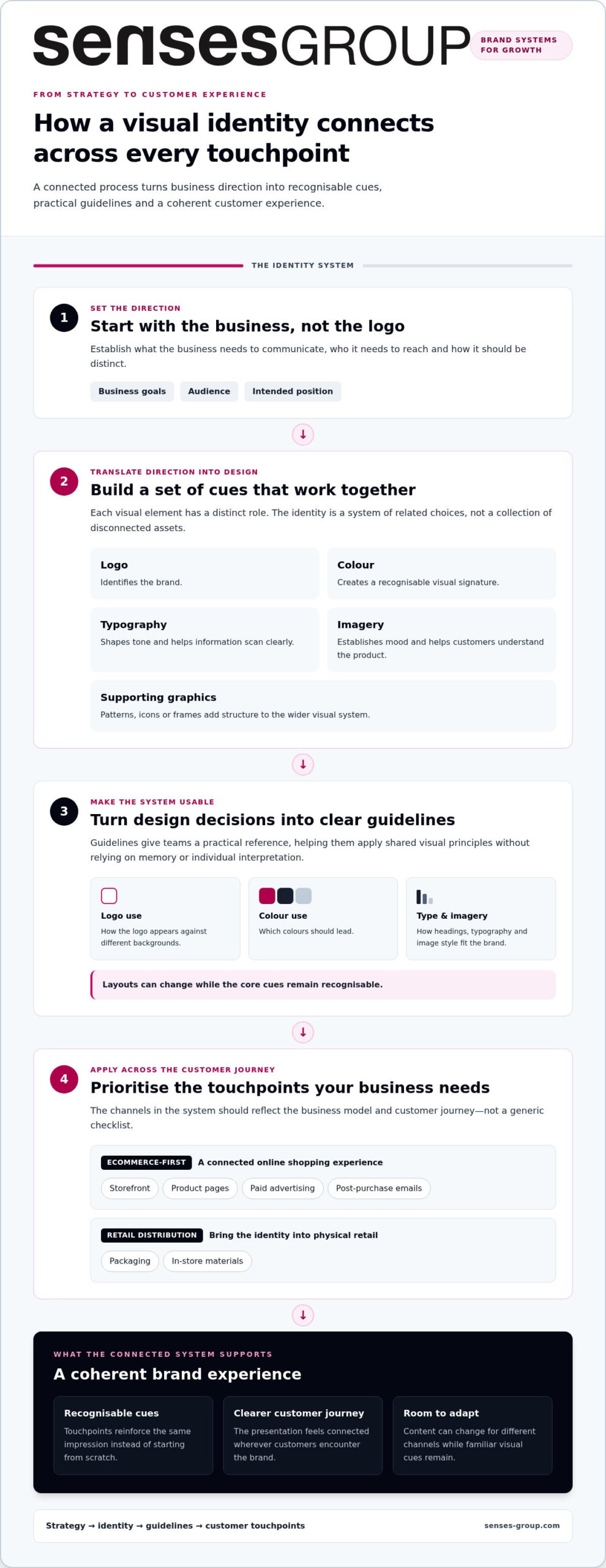
A brand identity earns its value through use. Strategy establishes what the business needs to communicate, who it needs to reach and how it should be distinct. Visual identity translates that direction into design choices; guidelines show teams how to apply them. The final test is execution: does the brand feel coherent wherever a customer encounters it?
Consistent identity makes brand cues easier to recognise, helping each touchpoint reinforce the same impression instead of starting from scratch. A retail brand identity guide can offer further context on shaping that foundation. The channels in the system should reflect the business model and customer journey, not a generic checklist. An ecommerce-first business may prioritise its storefront, product pages, paid advertising and post-purchase emails. A business with retail distribution may need packaging and in-store materials to carry equal weight.
Which visual identity elements need to work together?
Each element has a distinct role. The logo identifies the brand; colours create a recognisable visual signature; typography shapes tone and makes information easier to scan. Imagery establishes mood and helps customers understand the product, while supporting graphic elements such as patterns, icons or frames give the wider system additional structure.
Guidelines connect those components in practical terms. They can show how the logo appears against different backgrounds, which colours should lead, how type is used for headings and what image style fits the brand. That gives a team a reference when creating a product page, social post or campaign asset, rather than relying on memory or individual interpretation. Layouts can change while the core cues remain recognisable.
How does identity translate into an ecommerce experience?
On a Shopify storefront, brand expression is carried by more than the homepage. Navigation labels, page layouts, product photography, typography and the prominence of key information all influence how the experience feels and how easily customers can find what they need. A coherent design system helps product categories, descriptions and campaign landing pages feel like parts of the same shop.
Brand and user experience should support each other. Distinctive colours and imagery can express personality, while clear hierarchy and straightforward navigation help customers move through the store. If visual flourishes obscure product details or make important actions hard to find, the design is working against the journey. The aim isn’t decoration for its own sake. It’s an experience where brand character and practical usability reinforce one another.
For implementation detail, the strategic Shopify guide explores ecommerce planning for SMEs. A visual branding agency can connect identity decisions to storefront design and campaign execution, so the system remains useful beyond the initial launch. Senses Group’s branding and ecommerce work brings those disciplines together.
How to Compare Visual Branding Agencies Without Choosing on Aesthetics Alone
A polished portfolio can show that an agency has a strong eye. It doesn’t, by itself, show whether the team understands your audience, commercial priorities or the reasons your brand needs to change. For a business preparing to grow through ecommerce or enter overseas markets, the more useful question is whether the agency can connect its creative decisions to the actual business challenge.
Use a consistent framework to compare the thinking behind the work, the depth of the identity system and its relevance to your customer journey. A visual branding agency should explain not only what it created, but why those choices fit the brand and how the identity can work in practice.
What should an agency portfolio demonstrate?
Look beyond hero images and logo reveals. Strong examples show an identity operating across several applications, such as a storefront, product presentation, social content and campaign assets. Notice whether the work adapts to each format while retaining recognisable cues. A portfolio should also show range: different business contexts may call for different visual solutions, rather than one repeated style.
Ask what business problem each example addressed and how the resulting identity responded. Your own taste matters, but it isn’t the only measure. The underlying reasoning, consistency and suitability for real customer touchpoints offer stronger evidence of fit.
How can founders assess strategic and commercial alignment?
Compare agencies against the same criteria. The questions below help shift the conversation from “Which design do I like?” to “Which approach fits the business I’m building?”
| Criterion | What strong evidence looks like | Question to consider |
|---|---|---|
| Strategic discovery | The agency considers your audience, position and business objectives before proposing a visual direction. | Can the team explain how it will understand the challenge the identity needs to solve? |
| Identity-system depth | The work extends beyond a logo to a coherent set of visual elements and usable guidelines. | Will the deliverables help the team create future assets consistently? |
| Channel application | Examples show how the identity works across channels relevant to your business, including ecommerce and marketing. | Can I see how the system translates into the customer journey? |
| Collaboration | The agency explains how business context and feedback inform creative decisions. | How will our team contribute knowledge of customers and operations? |
| Relevant work | Case examples explain the context, design rationale and applications, not just the finished visuals. | Does this work demonstrate an approach relevant to our challenge? |
Commercial alignment means the proposed identity supports the audience you need to reach and the objectives you want to pursue. It doesn’t mean promising a particular sales result. For a deeper lens on evaluating the business value of design, explore this premium brand design ROI guide.
Prioritise evidence of clear thinking and practical application over a portfolio that simply matches your personal aesthetic. Senses Group’s branding approach connects strategic identity with ecommerce and marketing.
How to Prepare for a Visual Branding Project That Can Scale
A strong brief gives creative work a business foundation. Before engaging a visual branding agency, clarify the problem the identity needs to address, the customers you need to reach and where the brand must show up. You don’t need to arrive with the design solution. You do need to explain the conditions it must work within, from your current customer experience to your plans for growth at home and overseas.
What should a founder clarify before briefing an agency?
Start with the business challenge. Perhaps customers struggle to distinguish your offer, your existing materials feel inconsistent, or your brand no longer reflects the direction of the business. Then define the priority audience and the objectives the work should support, such as making the offer clearer or preparing the business to enter new markets.
Map the touchpoints where customers encounter the brand. For an ecommerce business, these might include the Shopify store, product pages, social content, advertising, email and packaging. Select applications based on your actual customer journey rather than trying to list every possible channel.
Give the agency useful source material: current logos and design files, existing guidelines, examples of customer-facing assets, and notes on what feels aligned or off-brand. A concise brief can cover:
- The business challenge and why it matters now.
- Priority audiences, growth ambitions and key objectives.
- Customer touchpoints that need a consistent identity.
- Existing assets and examples of what should change or be preserved.
This context connects creative choices to business needs without dictating a fixed design process. It also gives the team a basis for discussing trade-offs, such as balancing distinctive campaign visuals with everyday usability.
How can a visual identity support growth across markets?
Build a clear distinction between core cues and adaptable details. The brand’s central visual character should remain recognisable, while imagery, layouts or content can respond to the audience, product range and channel. For example, a campaign may use a different composition from a product page while retaining the same underlying visual character.
That balance matters as a business expands overseas. Teams need to know which identity elements should stay consistent and where adaptation is appropriate, without assuming every market needs a separate brand. Usable guidelines make those decisions easier for internal teams and collaborators, especially as new products and campaigns are added. They should explain how to apply the identity in real work, not simply present finished designs.
For a broader view of how branding connects with multiple growth channels, the integrated digital marketing guide provides useful context. For a consumer-facing brand, natural product or retail photography can make the identity feel tangible. Photography should also fit the brand’s visual system so product imagery feels connected to other customer-facing materials.
Prepare the business context, not a predetermined answer. Senses Group builds scalable brand identities by connecting design decisions to growth objectives and customer touchpoints.
How Senses Group Connects Visual Branding to a Growth System
A brand identity should shape more than how a business looks. It should connect the story customers encounter with the digital experiences and marketing activity that support growth. Founded in 2008, Senses Group brings branding and marketing together for businesses that need their identity to work across ecommerce and customer-facing channels. As of 2026, the agency has more than 18 years of expertise.
What makes Senses Group’s approach connected?
Branding work establishes the foundations: strategy and story clarify what the business stands for, while the logo, colours, typography, visual identity system and guidelines express that direction. The system informs how the brand appears in a Shopify store, campaign creative and other customer touchpoints. The aim is coherence, not copying the same layout everywhere.
Senses Group connects branding with Shopify ecommerce development, marketing funnels, SEO and GEO, Meta and Google advertising, and Klaviyo email automation. Each activity has a distinct role, but they can work from the same brand direction. A product page, for example, can present the offer in the visual language established by the identity, while marketing content carries a consistent story through the customer journey.
There’s no need to force every business into a standard package. A startup preparing to expand overseas may have different priorities from an established business addressing inconsistent branding across ecommerce and marketing channels. Senses Group crafts solutions around the business context, connecting relevant brand and growth activities without promising a predetermined commercial result.
What evidence can help founders assess the partnership?
Experience offers useful context, but it should be read as evidence of past work, not a guarantee of future performance. Senses Group has worked with global brands including Sony, Barclays, Panasonic and LVMH. The agency also reports managing more than $4 million in advertising spend. That figure describes documented experience; it isn’t a forecast of what a future campaign will achieve.
One ecommerce example is Monchhichi Jewelry Atelier, whose revenue doubled shortly after its new ecommerce system launched. This is an individual case outcome, not a typical or promised result for every business. For founders, the useful question is how the work connected the brand and ecommerce experience, and how a similar integrated approach could be tailored to their own objectives.
A capable visual branding agency should explain the link between identity foundations and the channels where customers meet the business. That means aligning design with the business story, connecting the identity to ecommerce and marketing, and shaping the work around the company’s priorities as it grows.
To connect brand identity with ecommerce and marketing, build a brand and growth engine with Senses Group.
Make Your Next Brand Decision a Growth Decision
Your next move doesn’t have to be a complete rebrand. Start by identifying where the customer experience feels least connected, then consider what your brand needs to communicate as the business grows. That focus gives a visual branding agency a clearer foundation for shaping an identity that supports your next stage, whether you’re strengthening ecommerce or reaching new customers overseas.
Think beyond the assets you need today. A scalable identity should help your team make confident, consistent decisions as new products, campaigns and channels emerge. The opportunity is to build a brand that evolves with the business without losing the qualities customers already recognise.
Ready to connect your brand direction with the systems that support growth? Build your brand and growth engine with Senses Group.
Frequently Asked Questions
What does a visual branding agency do?
A visual branding agency defines how a business should be visually recognised and makes that direction useful in real communications. For example, it can consider whether a logo remains legible in a small social profile image, how product photography sits alongside product details, and how campaign graphics relate to the online store. Ask to see identity work in everyday use, not only polished presentation boards.
Is a visual branding agency different from a graphic design studio?
Usually, the difference is the remit, not the title. A design studio may be engaged to produce a specific campaign or set of assets, while a branding engagement may also establish principles that guide future work. The scopes can overlap. Compare whether the proposed work addresses a one-off need, such as a launch campaign, or a continuing challenge across ecommerce and marketing.
Can a visual branding agency help an established business that already has a logo?
Yes. An established business can retain a familiar logo and address other points of friction, such as inconsistent product photography or unclear visual hierarchy in its online store. Before changing anything, review customer-facing materials and identify where the current identity still serves the business. This helps distinguish elements worth preserving from areas that need refinement, and prevents unnecessary change from becoming the project’s main objective.
How much should a business budget for visual branding?
There isn’t one useful budget for every project. Scope depends on what the business needs, which channels must be addressed and how extensive the final applications are. A founder can make proposals easier to compare by defining priorities first, such as refreshing core identity assets or preparing a wider system for ecommerce and marketing. Then assess each proposal against its deliverables and exclusions, not just its headline fee.
What happens if a business uses inconsistent branding across its channels?
Customers may need more effort to connect an advert, online store and product packaging to the same business. Internally, staff may also spend time recreating assets or debating which version to use. A practical response is to nominate a source of truth for approved brand materials and assign responsibility for keeping it current. That makes routine content production easier to coordinate as campaigns and products change.
How can a brand keep its identity consistent while adapting for overseas customers?
Separate the brand elements that carry recognition from details that may need audience-specific adaptation. Before changing imagery or presentation for an overseas audience, research how the intended customers understand the category and evaluate the offer. Avoid assuming that a design choice familiar to your existing audience will communicate the same way elsewhere. Document approved adaptations so ecommerce, advertising and other customer communications stay aligned as the business expands.