
What if your next paid social media advertising campaign brought in more than clicks? For Hong Kong SMEs and startups, success depends on more than choosing Meta, Instagram, or another platform. You need to know who you want to reach, what action the campaign should encourage, and whether your ecommerce experience can turn attention into sales.
Ad spend can generate traffic without building a dependable customer base. Growth comes from alignment: the channel and campaign objective should match your commercial goal, while relevant creative, a focused Shopify store, and thoughtful follow-up carry the customer journey forward.
This guide explains how to assess paid social channels for local and overseas audiences, choose objectives that support acquisition, and measure what happens beyond the click. It also shows how advertising can work alongside brand strategy, ecommerce conversion, and email retention as part of a connected growth system, rather than as a standalone traffic tactic.
Key Takeaways
- Paid social media advertising can create exposure, but sustainable growth depends on linking campaigns to a clear business goal and a purchase-ready ecommerce experience.
- Choose a channel and campaign objective based on who you need to reach and the action you want them to take, not platform popularity alone.
- Align the audience, creative, destination page, and conversion event before launch so results can be assessed against meaningful business outcomes.
- Connect advertising with brand strategy, Shopify, and follow-up marketing to support a customer journey that includes both acquisition and retention.
What Paid Social Media Advertising Can, and Cannot, Do for Business Growth
Buying exposure on a social platform is not the same as building a growth strategy. An ad can put an offer in front of potential customers, but it cannot make the offer compelling, the brand distinctive, or the buying experience clear on its own. For SMEs seeking local growth or overseas customers, paid distribution is one part of the commercial system, not the whole system.
Paid social media advertising is the use of paid placements on social platforms to distribute brand content, products, or offers to selected audiences and encourage a defined action.
Its role is to create opportunities for discovery and move interested people towards a next step, such as exploring a product page, joining an email list, or making a purchase. The right step depends on the business objective and where the audience is in the buying journey. The broader practice of social media marketing also includes organic and earned activity, which can help audiences understand and assess a brand.
Targeting can focus distribution, and reach can introduce an offer to people beyond a brand’s existing audience. Neither guarantees that people will notice, trust, or act on the message. Outcomes also depend on the offer, creative, landing page, price presentation, and follow-up experience. If these elements do not answer customer questions or make the next step clear, more exposure may simply send more visitors into a weak conversion path.
How paid social differs from organic social content
Paid social uses advertising placements to distribute content beyond the reach it would receive through ordinary posting. Organic social content is published without paying for placement. It can engage followers, express the brand’s point of view, and give people a reason to keep paying attention. The two approaches have distinct but complementary roles: paid distribution can introduce a business to new audiences, while consistent organic content helps build familiarity over time. Ads do not replace a credible, active brand presence.
When paid social is a sensible growth consideration
Paid social is easier to evaluate when the business has a clear offer, a defined audience, and the capacity to support the demand it wants to generate. Before increasing traffic, map what happens after someone sees an ad: where they land, what information they need, how they complete a purchase, and what follow-up encourages an ongoing relationship. If the positioning is unclear or the store makes buying difficult, ads will not fix the underlying problem. Strengthen the customer journey first, then use paid activity to support it.
How Paid Social Campaigns Connect Audiences, Creative, and Conversion
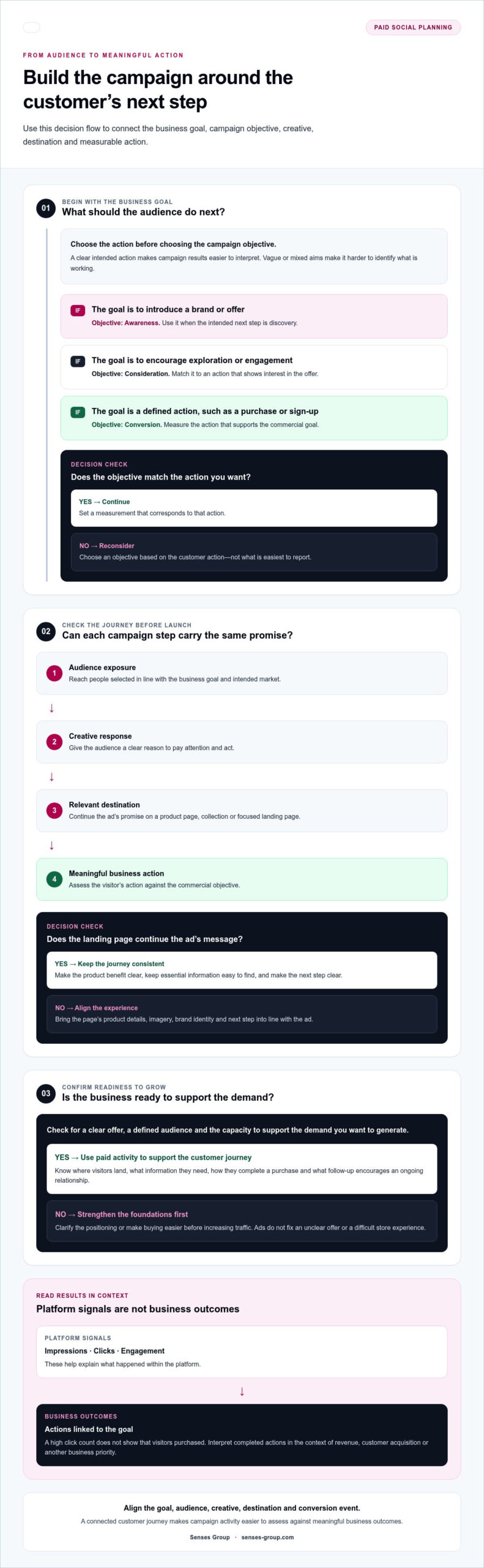
A campaign creates value through a connected journey, not an isolated impression. Someone sees an ad, recognises a relevant message, visits a destination that continues the same promise, and takes an action the business can measure. For an ecommerce brand, that action might be viewing a product, adding it to a basket, purchasing, or signing up for future updates. Each step should make the next one easier.
- Audience exposure: The campaign reaches people selected in line with the business goal and intended market.
- Creative response: The message and visuals give the audience a clear reason to pay attention and act.
- Destination: The ad leads to a relevant product page, collection, or focused landing page.
- Business action: The visitor completes a meaningful step that can be assessed against the commercial objective.
Paid social media advertising also generates platform signals, such as impressions, clicks, and engagement. These help explain what happened within the platform, but they are not business outcomes. A high click count does not show that visitors purchased. Even a completed action needs context: the business should understand whether it supports revenue, customer acquisition, or another priority. Link campaign activity to the action the business actually values.
Choosing a campaign objective that matches the business goal
Awareness aims to introduce a brand or offer. Consideration encourages people to explore or engage. Conversion focuses on a defined action, such as a purchase or sign-up. Choose the objective based on what you want the customer to do, not what is easiest to report. If the goal is to sell a product, a campaign optimised for general engagement may generate activity without showing whether the sales objective is being served.
Set the intended action first, then choose an objective and measurement that correspond to it. A clear objective makes results easier to interpret. Mixed or vague aims make it harder to identify what is working.
Why the ad creative and landing page must work together
If an ad promises a particular product benefit, the landing page should make that benefit clear straight away. Product details, imagery, brand identity, and the next step should feel like a continuation of the ad, not a different conversation. For mobile-first shopping journeys, make essential information easy to find and the route to checkout straightforward. A coherent Shopify store helps carry the campaign’s promise into the buying experience.
The post-click experience determines whether paid attention has a clear path to meaningful action. If a page is confusing, slow to answer customer questions, or inconsistent with the ad, the campaign may attract interest without supporting conversion. To connect campaign planning with ecommerce decisions, explore Senses Group’s Meta Ads management.
Paid Social Compared with Organic Social, Search, and Email
Each channel has a different role in the customer journey. Paid social can introduce an offer before someone is actively looking for it. Search advertising can reach people expressing interest through a query. Organic social gives a brand an ongoing presence, while email supports communication with an audience that has opted in. For businesses selling locally or overseas, the right mix depends on the offer, audience needs, and the content and customer experience available to support each channel.
These roles are not interchangeable, and none guarantees a particular result. Paid social media advertising can surface a product to someone who has not searched for it, while search advertising responds to demand already expressed. Organic posts give prospective customers more context about the brand, and email can continue the conversation after a sign-up or purchase. Choose channels based on the customer journey, not a contest to identify one universally “best” platform.
When paid social complements search and organic content
Social placements can introduce a product or offer during discovery, before a prospective customer knows what to search for. Search advertising serves a different moment: someone is already looking for a solution. Organic content can reinforce the message by showing the brand’s perspective and product details. Plan the roles together so discovery and active demand support each other rather than compete for the same task.
How paid social and email support different customer stages
Ads can reach prospective customers; email communicates with people who have opted in to hear from the business. Keep the offer consistent across both. An ad might introduce a product, while a follow-up email provides relevant details or guides a subscriber towards the next step. Plan the handoff with clear messaging and a destination that matches the original promise. This gives each channel a defined part in the customer journey.
For an SME, the practical decision is where the journey needs support. If awareness is limited, discovery-led content may help. If people are already searching, search can capture expressed intent. If interested visitors need continued communication, email may be useful. Assess the channels together against the offer, available creative, and intended customer action. A connected plan gives each activity a purpose without forcing every channel into the same job.
How to Plan and Evaluate Paid Social for an Ecommerce Business
A disciplined plan gives every campaign a commercial purpose and a way to assess progress. Before launching paid social media advertising, decide what the business needs, who the offer is for, and what evidence would show that the campaign is contributing. This matters for SMEs balancing local sales with plans to reach overseas customers: a clear path from message to purchase makes it easier to identify where the customer journey needs attention.
- Set the business objective. Choose a priority, such as introducing a product, generating qualified interest, or driving online purchases. Keep the aim specific enough to guide decisions.
- Define the audience. Describe the customers the offer is meant to serve and the market you are targeting. A broad potential audience is not the same as a clear customer profile.
- Clarify the offer. Explain what the customer is being invited to consider and why it is relevant. The message should make sense without asking the audience to fill in gaps.
- Develop the creative. Build the copy and visuals around the audience’s needs, the offer, and the campaign objective. Keep the brand identity recognisable.
- Choose the destination. Send visitors to a relevant product or landing page that continues the ad’s promise and makes the next step clear.
- Define the conversion event and review. Decide in advance which action counts as meaningful, such as a completed purchase or sign-up. Review campaign activity alongside that action and the wider business objective.
Campaign activity is not commercial evidence unless it connects to an action the business values. Impressions and clicks describe delivery and response. Purchases, qualified enquiries, or sign-ups may indicate progress towards a specific goal. The right event depends on what the campaign is designed to support.
Set the foundations before launching a campaign
Start with the customer problem and the offer that addresses it, then decide what action the campaign should encourage. Check that the destination explains the offer, answers essential questions, and provides a clear next step. Finally, compare the ad with the page. The visual style and message should feel consistent, so customers do not encounter a promise in the creative that the store fails to carry through.
Review results without mistaking activity for growth
Read results in stages. Delivery measures show whether ads were served, visits show whether people reached the store, and conversion events show whether they took the intended action. Consider those actions in the context of the customer journey and business objective. A sign-up may be useful when building an audience for follow-up; for a purchase-focused campaign, it is not the same evidence as a completed order. Avoid universal benchmarks. Interpret results against the goal, offer, and destination.
For a campaign plan that connects advertising with ecommerce decisions, explore Senses Group’s Meta Ads management.
Build Paid Social into a Connected Growth System with Senses Group
Paid social is strongest when it connects to the foundations around it. An ad can introduce a brand, but the wider growth system shapes what happens next: whether the message feels distinctive, whether the store makes the offer easy to understand, and whether interested visitors have a reason to return. For SMEs reaching local or overseas customers, aligning these parts ties campaign decisions to the full customer journey.
Senses Group manages Meta Ads as part of a broader mix of brand strategy, ecommerce, and digital marketing. The agency has managed over $4 million in ads and creates tailored solutions around a business’s goals and growth challenges, rather than relying on standard packages. The focus is not on promising a particular return. It is on giving advertising a clear role within the business’s sales funnel.
What an integrated paid social approach brings together
Strong integration starts with a consistent foundation. Brand positioning informs the campaign message and creative direction. The Shopify store carries that promise into product discovery and purchase. Klaviyo email automation supports relevant communication after an initial visit or sign-up. Each element has a distinct job, but all should feel connected to the customer. When the ad, store, and follow-up tell a coherent story, the business can assess the journey as a whole instead of treating each touchpoint as a separate activity.
This connection is especially useful when testing a new offer or expanding into an overseas market. The audience may need different context, but the core brand should remain recognisable. A campaign can show where the message attracts interest, the ecommerce experience can reveal whether the offer is clear, and follow-up communication can help sustain the relationship. These signals inform the next decision without suggesting that any one channel guarantees growth.
- Brand strategy and identity establish the position and visual language the campaign should express.
- Meta Ads bring the offer to selected audiences and support the campaign’s defined role.
- Shopify ecommerce presents the offer and provides the path from visit to purchase.
- Klaviyo email automation supports communication with customers and subscribers beyond the initial interaction.
Turn campaign decisions into a growth conversation
Useful planning starts with the business objective, the audience you want to reach, and the point where customers currently hesitate or drop away. Bring the offer, current customer journey, and plans for local or overseas expansion into the discussion. Senses Group can then shape a tailored approach that connects advertising to brand and ecommerce priorities, rather than treating media activity as a standalone fix.
Build a more connected ecommerce growth system with Senses Group’s growth engine strategy. The aim is to create a clearer structure for making and evaluating campaign decisions, grounded in your business context.
Make Your Next Growth Move with Clarity
Before committing to more media activity, identify the next decision your business needs to make. You may need to clarify which offer deserves attention, understand where prospective customers hesitate, or prepare your ecommerce experience for a new market. A focused priority gives paid social media advertising a sharper role and helps your team make decisions based on evidence rather than assumption.
That priority can become the starting point for a growth system shaped around your business, not a template. Considering brand, ecommerce, and marketing together creates a more coherent path from customer discovery to the next meaningful action, while leaving room to learn and adapt as the business develops.
Ready to define that next move? Build a growth engine with Senses Group and shape a considered direction for your ecommerce ambitions. Start with a clear decision, then build the customer journey around it.
Frequently Asked Questions
Is paid social media advertising suitable for a small business?
Yes, it can suit a small business when the campaign has a focused purpose and the business can support the response it seeks. Start with a focused test around one offer and one customer group, rather than trying to promote the full catalogue at once. For example, a small retailer could feature a best-selling product, then review whether the campaign attracts the intended action before deciding what to develop next.
How long does it take to see results from paid social advertising?
There is no reliable universal timeline. The sales cycle and the action being measured both matter. A product bought with little consideration may produce different signals from a higher-value item customers research before purchasing. Before launch, set review points around the campaign’s purpose: check that tracking works, examine early delivery and engagement, then assess commercial actions in relation to the customer journey. Avoid judging success from a brief burst of activity alone.
Can paid social advertising work without an online store?
Yes. The destination should fit the business model, even if it is not an ecommerce store. A service business might direct interested people to an enquiry form, while a retailer without online checkout could use a product information page or a clear way to request details. Decide what a useful response looks like before launch, and make sure the destination explains what happens next. A mismatch between the ad and destination can create unnecessary friction.
How do I know whether paid social is producing valuable results?
Judge value against the campaign’s intended outcome, not engagement alone. For a sales campaign, review completed orders alongside average order value, product margin, and the costs required to fulfil purchases. For a lead campaign, assess whether enquiries are relevant and progress into real conversations. Use consistent definitions throughout your review, and check that analytics and store records tell a consistent story before changing the campaign.
Should a business choose Meta Ads or Google Ads?
Choose based on how customers are likely to discover the offer. If people need to know a product exists before they can look for it, social creative may help introduce it. If they already search for the product or solution, Google Ads can respond to that expressed interest. A business can use both when each has a distinct purpose, such as introducing a new range on social and capturing relevant searches separately.
Can paid social help an ecommerce business expand into overseas markets?
It can help introduce an offer to prospective customers in a new market, but the campaign needs market-specific preparation. Review whether product descriptions, brand messaging, pricing presentation, delivery information, and customer support expectations are clear to that audience. For example, a store expanding beyond its home market may need to adapt its creative and landing-page details to the language and shopping context of its intended customers, then evaluate that market on its own terms.
Do I need email marketing alongside paid social advertising?
Not every business needs the same channel mix, but email can extend communication with people who have chosen to hear from the brand. For example, a retailer might use a welcome sequence to explain product choices to new subscribers, then send relevant updates based on their interests. Paid social and email should have distinct roles and consistent messaging. Consider email when the business has useful follow-up content and a clear reason to continue the conversation.