
What if the answer to rising acquisition costs isn’t simply to spend more on ads, but to give the right customers a clearer reason to choose you? A brand strategy to lower customer acquisition cost can reduce friction between discovery and purchase by making your value easier to understand and trust. For SMEs and startups competing locally and overseas, unclear positioning can make every click work harder than it should.
Paid campaigns still matter. But when your message, identity and shopping experience don’t align, attracting attention is only part of the challenge. Prospects may hesitate, compare on price or leave without buying. A stronger brand won’t guarantee an immediate CAC reduction, but it can create a better foundation for efficient growth.
This article explains how brand decisions influence discovery, trust and conversion. It outlines practical ways to improve your messaging, ecommerce experience and marketing, and how to measure brand-led progress over time while accounting for different audience expectations across markets.
Key Takeaways
- Define customer acquisition cost consistently, and distinguish it from the cost of a click or lead before assessing performance.
- Use clear positioning, a recognizable identity and aligned campaign-to-storefront messaging to reduce friction between discovery and purchase.
- Diagnose whether high CAC stems from brand issues, such as weak message recall, or channel issues, such as inefficient targeting.
- Apply brand strategy to lower customer acquisition cost by establishing a baseline, finding friction points, aligning touchpoints, testing changes and reviewing results over time.
- Connect brand strategy with ecommerce, SEO and GEO, paid media and email automation to build a more coherent acquisition system for local and overseas growth.
Why brand strategy matters when customer acquisition costs rise
For SMEs and startups, paid acquisition can become harder to scale sustainably. Increasing spend may bring more visitors without bringing enough new customers to justify it. The answer isn’t necessarily another campaign adjustment. If prospects don’t understand why your business is relevant or different, paid reach can amplify an unclear proposition rather than resolve it. A brand strategy to lower customer acquisition cost is about improving the foundations of acquisition, not promising that branding will automatically make every customer cheaper to win.
Customer acquisition cost, or CAC, is the amount a business spends to acquire new customers during a defined period. It differs from cost per click (CPC), which measures the price of an ad click, and cost per lead, which measures the cost of generating a prospective customer’s details. These figures describe steps along the way. CAC connects acquisition investment to customers gained, making it a broader measure of growth efficiency.
Brand strategy supports that efficiency by clarifying who the business serves, what it offers and why that offer is distinct. It doesn’t guarantee lower acquisition costs or replace channel analysis. The focus here is how brand choices affect customer understanding and evaluation, rather than a general list of advertising tactics. As an overview of the wider discipline, Brand management explores how businesses build and maintain the meaning and perceived value associated with a brand.
What customer acquisition cost reveals about growth
At its simplest, CAC compares acquisition investment with the number of new customers gained. For example, in a hypothetical scenario, if an ecommerce business spends HK$12,000 on defined acquisition activities and gains 60 new customers attributed to those activities, its CAC is HK$200. The result is useful only if the spending and customer count cover the same period and follow the same attribution rules.
Paid media is one input, not always the whole picture. Depending on how a business defines its measure, acquisition expenses may also include creative production, marketing tools, agency support or other costs tied to attracting customers. State clearly which costs are included, then keep the definition consistent when comparing results. Otherwise, an apparently improved CAC could reflect a narrower calculation rather than more efficient acquisition.
Why weak differentiation can create acquisition friction
When positioning is vague, prospects have to work harder to understand what a business sells, who it is for and how it differs from alternatives. An ecommerce brand expanding overseas may also find that a message that resonates with existing customers doesn’t explain its value clearly to a new audience. If ads, product pages and emails use disconnected language, each touchpoint must rebuild context instead of reinforcing a coherent impression.
That friction can show up as low-quality enquiries, hesitation on product pages or repeated requests for explanation. None of these signals proves that weak brand recognition is the cause of CAC. Treat them as clues to investigate alongside channel performance and customer feedback. Clear differentiation gives people a stronger basis for evaluating an offer; whether that supports more efficient acquisition depends on how well the whole experience delivers on the promise.
How brand strategy can reduce friction across the acquisition funnel
Acquisition moves through a sequence: a potential customer notices a message, decides it’s relevant, evaluates the offer and chooses whether to buy. Brand strategy connects those moments. Positioning gives the message focus, identity makes the business easier to recognize, and clear communication helps customers understand what to expect. The result isn’t guaranteed cost reduction. Brand-led acquisition efficiency means reducing friction between discovery and purchase so each touchpoint can do its job more clearly.
Positioning helps the right customers recognise the offer
Strong positioning brings four decisions into focus: the audience you serve, the problem you address, what differentiates your offer and the value customers can expect. These choices shape campaign messages. Instead of relying on broad claims such as “quality products,” explain which customer need your ecommerce business meets and why its approach is relevant. Specificity helps intended buyers recognize a fit, while giving others a clearer basis to decide the offer isn’t for them.
For a brand selling locally and overseas, the core promise should remain coherent while its expression reflects each audience’s context. Buyers may have different expectations, language preferences or reasons to purchase. Adapt examples and supporting details to the market, but keep the underlying value proposition recognizable. This creates consistency without assuming one message will work unchanged everywhere.
A coherent brand experience supports conversion
Once a campaign earns attention, the storefront needs to carry the promise forward. If an ad presents a product as simple to choose, but the Shopify product page leaves key details unclear, the gap can create uncertainty. When campaign language, visual identity, product presentation and next steps reinforce one another, customers can move from interest to evaluation with fewer conflicting signals.
Consistency is not repetition for its own sake. A recognizable visual system helps customers identify the business across touchpoints; consistent wording explains what the offer does and who it serves. Together, these cues can support trust by making the experience feel coherent. They don’t guarantee a purchase, but they give people fewer reasons to pause because the brand appears different at each step. A considered approach to mastering retail brand identity can connect visual expression to the wider customer journey.
Harvard Business School’s Creating Brand Value examines how brand equity relates to consumer decisions and customer relationships. For practical application, review one journey from ad to product page: does the promise stay clear, does the visual identity remain recognizable, and can the customer find the information needed to assess the offer? These questions turn brand strategy to lower customer acquisition cost into a disciplined improvement process, not a promise of a particular outcome.
Businesses coordinating positioning with identity and ecommerce can explore Senses Group’s brand and ecommerce approach as one way to connect those decisions.
Brand strategy versus channel tactics: find the source of high CAC
A high CAC is a signal to investigate, not a diagnosis. A business may be paying to reach the wrong audience, presenting an unclear offer, sending interested prospects to a weak landing page, or facing several of these problems at once. Changing brand positioning won’t repair poor campaign setup; adjusting targeting won’t make a generic value proposition distinctive. Diagnose the source before deciding what to change.
Brand relevance problems concern what customers understand and value; media delivery problems concern who sees the message, where they see it and what happens after they click. Use performance data to locate friction, then check whether the message or execution is responsible.
Brand clarity symptoms
A generic promise, inconsistent product descriptions or weak message recall may suggest that the offer is difficult to distinguish or explain. Compare campaign language, storefront content and customer feedback to see whether people understand the same value proposition.
Useful evidence
Customer interviews, reviews, enquiry themes and conversations with sales or support can reveal what customers think the business offers, what they find distinctive and where they need more explanation.
Channel or conversion symptoms
Uneven results between audiences or campaigns, low landing-page conversion, or clicks that don’t progress through the Shopify purchase journey may point to targeting, campaign structure, page experience or measurement issues.
Useful evidence
Review campaign settings and results alongside landing-page behaviour, checkout progression and tracking consistency. This helps separate ad delivery problems from barriers that appear after a visitor reaches the store.
When the underlying issue is brand clarity
Look for a promise that could describe any competitor, product descriptions that use different language for the same benefit, or campaigns that don’t make clear who the offer is for. Increasing campaign activity may create more exposure, but it won’t resolve a value proposition that customers struggle to understand. Compare what the brand says with the words customers use in feedback, enquiries and reviews. If those accounts diverge, test clearer positioning before treating additional reach as the answer.
When the underlying issue is channel or conversion execution
If the brand promise is clear but relevant visitors aren’t progressing, investigate delivery and experience separately. Check whether campaign audiences match the intended customer, whether campaign structure supports a clear comparison, and whether measurement records the same journey consistently. Then inspect the Shopify path: does the landing page reflect the ad, and can visitors find the information needed to decide? An integrated digital marketing scaling guide can provide broader context for coordinating these moving parts.
Brand and channel causes can coexist. A clear message may still reach an unsuitable audience; precise targeting may still lead to a confusing storefront. For a disciplined brand strategy to lower customer acquisition cost, match each suspected cause to evidence before changing several variables at once. That makes the next test more useful and helps distinguish a strategic issue from an execution gap.
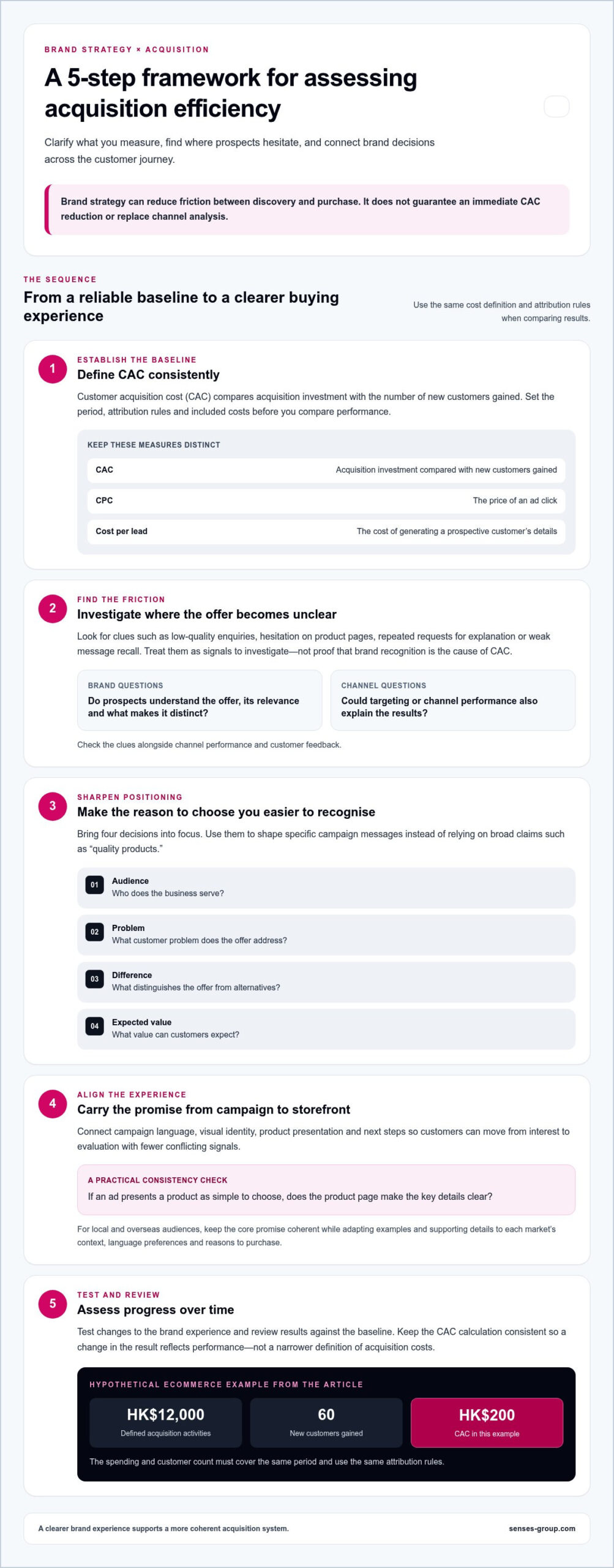
A practical brand-led framework for measuring acquisition efficiency
Brand changes need a measurement plan, not an assumption that a sharper message will automatically lower CAC. For ecommerce businesses, a useful framework connects changes in the brand experience with what customers do next, while keeping comparisons consistent enough to guide decisions.
- Establish a baseline. Define the customer group, observation period and acquisition expenses included in your CAC view. Decide whether you’re measuring paid media alone or a broader set of acquisition costs, and keep that definition unchanged when comparing results.
- Identify friction. Find where prospective customers lose momentum. Review qualified traffic, campaign engagement, product-page behaviour, checkout progression and customer questions. These indicators can help locate a problem, but don’t establish its cause by themselves.
- Align brand touchpoints. Select the part of the journey that appears inconsistent, such as campaign language that doesn’t match the Shopify storefront or product pages that don’t explain the offer clearly. Make the intended change specific enough to assess.
- Test one change. Adjust one message, positioning element or storefront detail at a time where practical. Record what changed, which audience or market saw it, and the outcomes you’ll review.
- Review and refine. Compare results using the same customer definition, cost inputs and observation period. Look beyond CAC to qualified traffic, conversion behaviour and customer value, then decide whether to retain, adapt or investigate the change further.
Set a baseline that reflects the whole acquisition journey
Choose what counts as a new customer and which acquisition expenses belong in the calculation. If your records support it, segment results by channel, audience or market to see whether an overall figure hides a pattern. For example, local and overseas activity may need separate views if their audiences and journeys differ. Note attribution limits: a customer may encounter several touchpoints before buying, so a change that coincides with a CAC shift isn’t automatically the cause.
Test brand changes against observable outcomes
Make each test answer a clear question, such as whether a more specific value proposition helps intended visitors understand a product page. Compare customer response and conversion data across a consistent observation period, and avoid changing the campaign, message and storefront simultaneously if you need to understand which change mattered. A practical Shopify guide can help you assess the storefront as part of the measurement journey, rather than treating it as separate from brand communication.
Keep a simple record of the hypothesis, change, audience, period and observed outcomes. This creates a basis for learning even when the results are mixed; a test can reveal that the original friction was elsewhere. That discipline makes brand strategy to lower customer acquisition cost a measurable growth practice, not a guarantee of an immediate reduction.
To connect brand decisions with ecommerce and acquisition measurement, explore Senses Group’s brand and ecommerce strategy.
Build an integrated brand and acquisition system with Senses Group
Acquisition works best as a connected system, not a collection of disconnected activities. Brand strategy sets direction: who the business serves, what makes its offer distinct and how it should communicate that value. Brand identity gives the strategy a consistent visual and verbal expression. From there, ecommerce, discovery, paid campaigns and customer communications can reinforce the same promise at different stages of the customer journey.
For a business selling locally and preparing to expand overseas, that connection matters. Customers need a coherent experience from the first campaign or search result to the product page and follow-up email. The core brand promise can remain consistent while content and market-specific details are adapted for different audiences. This gives the business a stronger foundation for growth without assuming one message or experience will work identically in every market.
Connect brand foundations to ecommerce execution
Each discipline has a distinct role. Brand strategy clarifies the value proposition; brand identity makes it recognizable; a Shopify store brings the offer to life through its structure and product presentation. SEO and GEO can support discovery through search and AI-driven answers, while Meta and Google advertising bring campaign messages to audiences. Klaviyo email automation can extend that experience through customer communications. Coordination helps prevent the website, ads and emails from describing the business in conflicting ways.
The right starting point depends on the diagnosed constraint. If buyers don’t grasp the offer, revisit strategy and messaging before scaling campaign activity. If the proposition is clear but the store creates hesitation, focus on the Shopify experience. If discovery is limited, consider how SEO and GEO or paid media fit the audience’s path to purchase. If customer communications feel disconnected, review how Klaviyo automation reflects the brand voice and promise.
Choose the next step based on the business’s growth constraint
Growth does not require every discipline to change at once. Identify whether the priority is clarity, conversion, discovery or marketing coordination, then align the work around that constraint and the evidence available. This keeps investment focused and makes it easier to understand what each change is intended to improve.
Senses Group brings these connected disciplines together through a custom, end-to-end approach for consumer and ecommerce businesses. Its documented experience includes managing more than $4 million in advertising spend. That provides context for its work across acquisition channels, not a promise that brand strategy will lower CAC or produce a particular commercial result. The objective is to build a coherent growth system in which the brand, storefront and marketing support one another.
If your next step is to connect brand foundations with ecommerce and marketing execution, Build your growth engine with Senses Group.
Make your next growth decision with greater clarity
Your next step doesn’t need to be a full-scale rebrand or a larger advertising budget. Start with the constraint your evidence points to, then decide which connected part of the customer experience needs attention. A focused brand strategy to lower customer acquisition cost should strengthen the business’s ability to attract and convert suitable customers, while measurement keeps expectations grounded in what the data shows.
Senses Group has worked across branding and ecommerce since its founding in 2008. In one documented case, a client’s revenue doubled shortly after an ecommerce rebuild launched. That outcome followed a coordinated rebuild and shouldn’t be attributed to branding alone; it illustrates why connected business decisions matter, not a guaranteed result for another company.
If you’re ready to connect your brand foundations with the ecommerce experience and marketing that support growth, Build your growth engine with Senses Group. A clearer system can give your next stage of growth a stronger foundation. Keep testing, learning and building with purpose.
Frequently Asked Questions
Does brand strategy lower customer acquisition cost immediately?
Not reliably. Brand strategy to lower customer acquisition cost builds clearer foundations, but changes to customer understanding and behaviour take time to assess. A refreshed proposition may first improve how people respond to campaign messages or navigate product information, while the effect on completed purchases needs separate observation. Set a baseline before making changes, then review results over a consistent period. Treat early movement as evidence to investigate, not proof of a lasting outcome.
Can a startup invest in brand strategy before it has a large advertising budget?
Yes. A startup can define its audience, customer problem, offer and point of difference before spending heavily on promotion. Start by writing a concise value proposition and checking whether the website, social profiles and product descriptions communicate it consistently. This gives a small team a clearer standard for future decisions, from choosing campaign themes to explaining the offer in customer conversations. Strategy is a decision-making foundation, not a requirement to launch a large campaign.
Is customer acquisition cost the same as cost per lead?
No. To make lead reporting more useful, track what happens after a prospect shares their details: whether they respond to follow-up, visit the store or place a first order. Compare these outcomes by lead source and campaign message, using the same attribution approach over time. This helps identify which sources bring prospects who are a stronger fit for the business, rather than judging performance by the volume of contacts alone.
Can a stronger brand reduce dependence on paid advertising?
It can support a broader mix of customer discovery, but it won’t remove the need for paid advertising in every business. Clear positioning may make it easier for customers to understand and remember an offer, while useful content and a coherent customer experience can support discovery beyond campaigns. Track how direct visits, branded search activity and returning customers change alongside paid results. Consider these signals together, rather than assuming any one proves that brand activity caused the change.
How can an ecommerce business adapt its brand for overseas customers?
Keep the central brand promise intact, then adapt how it’s expressed for each market. Review whether product descriptions, language, imagery, sizing or usage explanations answer the questions local customers actually have. Make the shopping journey understandable to people unfamiliar with your business, and gather feedback from overseas buyers or customer enquiries to spot missing context. Avoid relying on assumptions about a whole market; use observed questions and behaviour to guide refinements.
Should a business change its brand or its advertising when CAC rises?
Investigate before changing either. If campaign reach and clicks appear sound but customers don’t understand the offer, revisit positioning and message clarity. If the proposition is understood but the wrong audience is responding, or the purchase journey is underperforming, examine campaign delivery and the storefront experience. Check tracking and customer feedback too, since unreliable measurement can distort the diagnosis. Make one focused change at a time so you can learn what deserves attention next.